

A workshop should be planned in reverse: first the result, then the method, then the agenda, and finally the room and technology. Those who start with the agenda fill time instead of achieving goals. Here you will find the complete process from conception and method selection to room setup and follow-up.

To successfully plan a workshop, you must define measurable goals in advance for an ideal group size of 8 to 20 people. A structured schedule divides the day into short keynote presentations, active group work, and regular breaks every 90 minutes. For the technical setup on-site, you will need a high-brightness projector with at least 3000 lumens, reliable wireless microphones, and sufficient flipcharts and moderation materials. This guide shows you the entire organization from the initial goal setting to the final follow-up.
The best agenda is useless if the technology fails or the exact goal remains unclear. Anyone wanting to deliver real results needs professional preparation. This guide leads managers and trainers safely through all key planning phases. Is the agenda set, but the venue has poor technology? Discover our deposit-free event technology for workshops and seminars.
Workshop preparation does not begin with booking a room, but with three questions: Who is the target audience? What should be achieved by the end of the day? And how will we measure success?
Defining goals: Formulate goals using the SMART principle: specific, measurable, achievable, relevant, and time-bound. "We want to develop new ideas" is not a goal. "We will develop three actionable measures for customer retention by the end of Q2" is. Clear goals are the foundation for everything that follows: methods, content, schedule, and performance monitoring. Without clear objectives, every workshop becomes an unstructured meeting.
Selecting the target audience and participants: Specifically invite the people who will benefit directly from the results or who will implement them. The composition of the group determines the dynamics. An interdisciplinary team brings different perspectives. Too many participants slow down the discussion; too few provide insufficient input. For most workshops, the ideal group size is between 8 and 20 people.
Workshop planning and time structure: Outline the total duration, main phases, and necessary buffer times. A half-day workshop (3 to 4 hours) is sufficient for focused topics. Full-day formats require longer breaks and more variety in methods. Create a schedule with clear blocks: introduction, input, work phases, synthesis, and conclusion. The program structure should be divided into logical parts so that participants always know where they are in the process.
Looking for the right way to start? Here are the best workshop warm-ups and icebreakers.
Time management is the difference between a productive workshop and one that drags on. Every phase needs a clear purpose and a defined duration.
Introduction and expectation alignment: The first 15 minutes set the tone. Present the agenda, clarify participant expectations, and create an open workshop atmosphere. A short warm-up helps to activate the group and keep motivation high. Communicate transparently what will happen today and what the desired outcome is.
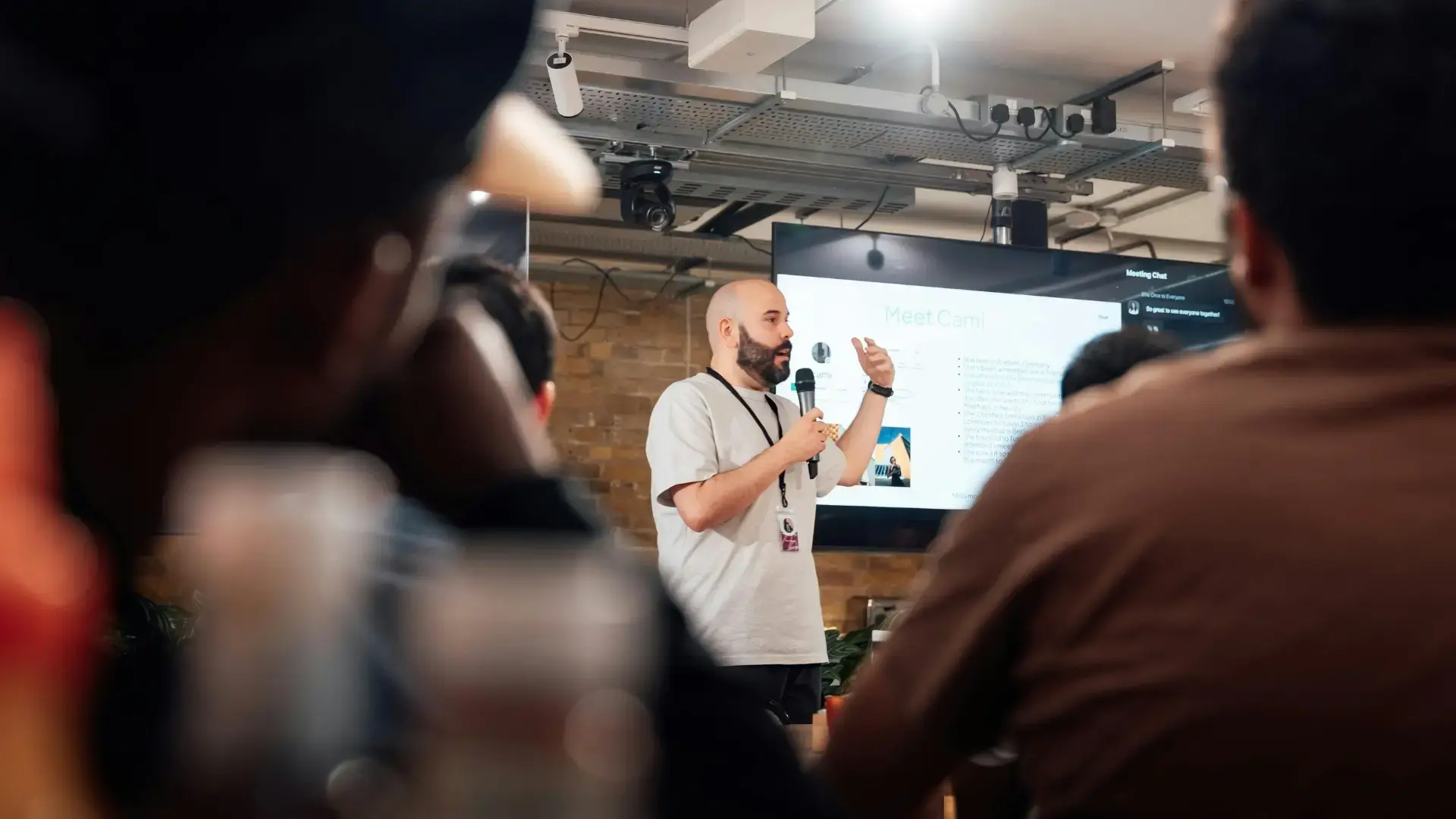
Input and work phases: Short impulses (presentations of no more than 15 to 20 minutes) followed by focused work sequences. This is where workshop methods come into play. Alternate between plenary sessions, small groups, and individual work. Involving all participants, especially quieter individuals, promotes better results and sustainable engagement. Use visual tools like flipcharts or digital whiteboards to make content visible.
Synthesis and securing results: Bundle results, reach a consensus, and clarify responsibilities. This step is often underestimated. Without clear documentation, the best ideas will fizzle out after the workshop. Record results in real-time and make them immediately accessible digitally.
Conclusion and next steps: Record concrete measures, deadlines, and follow-up responsibilities. A short reflection block at the end gives the team the opportunity to evaluate the workshop and provide feedback. Schedule this step firmly, even if time is tight.
The methods determine how productive the collaboration will be. Not every method fits every topic and every group.
| Method | Suitable for | Group size | Duration |
|---|---|---|---|
|
☕
World Café
|
Brainstorming, gathering perspectives | 12-50 | 45-90 min |
|
💡
Design Thinking
|
User-centered solutions, prototypes | 6-20 | Half-day to full-day |
|
🔍
Retrospective
|
Reflection, deriving improvements | 5-15 | 30-60 min |
|
✅
Dot voting
|
Prioritization for large numbers of ideas | Any | 10-15 min |
|
🎭
Role-playing
|
Changing perspectives, empathy | 6-20 | 20-45 min |
|
🧠
Brainstorming / Brainwriting
|
Rapid brainstorming | 4-15 | 15-30 min. |
In a World Café, small groups rotate between tables to develop diverse perspectives on a topic. The focus is on teamwork and collaborative idea generation. Design thinking elements bring rapid prototyping and user-centered iterations into practice. Retrospective formats are particularly well-suited for the structured reflection of past projects. Prioritization techniques like dot voting allow for quick decision-making when the group has generated many ideas.
You can find more on methods and facilitation techniques in our guide: Strategy Workshops: Topics and Methods.
The venue influences results more than most people think. A bare conference room with echoing acoustics and flickering fluorescent lights kills creativity. The environment has to be right.
Room layout and seating arrangements: Flexible seating promotes collaboration. A U-shape is suitable for workshops involving presentations and discussions. A circle works well for open conversation. Table clusters are ideal for group work. Ensure there is enough space for movement and materials. The seating arrangement should match the chosen method.
Lighting, acoustics, and temperature: Natural light and good ventilation keep concentration levels high. Rooms with poor acoustics require technical support: a decent microphone makes all the difference when there are more than 15 people in the room. The workshop atmosphere benefits from an environment where everyone feels comfortable.
Breaks and catering: Schedule a break every 90 minutes. Short movement breaks encourage relaxation and informal exchange. Catering needs to be organized, but it doesn't have to be elaborate: coffee, water, fruit, and lunch are sufficient for a full-day workshop.
This is where it gets practical. The standard projectors in rented conference rooms are often too dim for rooms with natural light. A laptop's built-in microphone isn't enough when a speaker is standing in front of 30 people. And an unstable Wi-Fi connection will cause any collaborative tool to crash.
What you really need: A high-brightness projector (at least 3,000 lumens for bright rooms), a wireless microphone or headset to keep your hands free for the flipchart, a portable PA system if the room is large, a moderation kit with cards, pens, and adhesive dots, flipcharts or a mobile whiteboard, and a stable internet connection for digital tools like Miro or Mentimeter.
You can find the checklist for all materials and technical requirements here: Workshop materials and technical checklist.
Don't leave your expert status to chance. Rent high-quality workshop materials and presentation technology from Renty: projectors, microphones, and portable speakers, with no deposit required and delivery directly to your location.
When it comes to seminar room technology, the issue is rarely the projector itself, but the lighting. A device with 3,000 lumens is perfectly fine in a darkened room, but not in daylight with white walls. Check the blackout options before choosing your device. Our projectors for seminar rooms are sorted by lumens.
One point that is almost always overlooked in technical planning is the surface area for capturing results. With about twelve participants or more, one flipchart is no longer enough because work happens in parallel and each small group needs its own space. The overview of presentation technology for seminars shows what is available for this purpose.
The success of a workshop depends on its moderation. A good moderator maintains focus, structures discussions, sticks to the plan, and ensures that all participants have a chance to speak.
Timeboxing: Strictly adhere to time blocks. Use a visual timer so the group develops a sense of the remaining time themselves. Build in buffers, but don't let things drag on. If a discussion is productive, it is better to shorten the next block than to completely abandon the schedule.
Documentation: Secure results in real-time. Take photos of flipcharts, use digital notes, or maintain a shared document in the cloud. If you postpone documentation until "after the workshop," you lose information and context. Appoint someone responsible for documentation in advance.
Handling disruptions: Define rules for respectful communication in advance and establish escalation paths. If one participant dominates the discussion, it is the moderator's job to actively solicit other perspectives. Psychological safety is created through clear ground rules and appreciation for all contributions.
Online workshops require special planning. Attention spans are shorter in front of a screen, and interaction must be managed more actively. Choose platforms with breakout rooms, whiteboard functions, and reaction tools. Communicate technical requirements (browser, headset, camera) to all participants early on.
Hybrid formats, where part of the group is on-site and the rest joins remotely, are the most technically demanding. You need a camera that captures the room, a microphone that transmits even quiet comments, and a screen where remote participants are visible. Without proper technology, online participants feel like spectators rather than active contributors. Modern technologies like automatic camera tracking and room microphones help, but simpler solutions also work if they are used thoughtfully.
Use polls, breakouts, and collaborative boards to keep engagement high for all participants in online workshops. Pay attention to data protection and hosting options when recording and sharing content.
Follow-up is what determines whether workshop results actually turn into change. Distribute the documentation to all participants within 48 hours. Clearly state: What decisions were made, who is responsible, and what is the deadline for implementation?
Gather structured feedback: What worked and what didn't? Questions about content, facilitation, methods, and organization provide concrete starting points for the next workshop. Schedule a status meeting two to four weeks after the workshop to check the progress of the agreed-upon measures.
Collect lessons learned and archive them systematically. This information is the foundation for planning future workshops and seminars. Follow-up is not an optional step; it is the part that ensures long-term success.
Are you planning a workshop or seminar and need equipment that works? At Renty, you can get projectors, microphones, and PA systems for your event, deposit-free, with delivery to your venue.
How do I define clear goals for my workshop?
How do I find the right number of participants for my workshop?
Which methods are best suited for interactive workshops?
How important is technical equipment for the workshop?
How do I design an effective workshop schedule?
What does workshop follow-up include?
Check event equipment, book in 90 seconds, and choose pickup or delivery. Deposit-free and insured throughout Germany and Austria.

Wir haben dir eine Mail geschickt, bitte bestätige sie um den Rabattcode zu erhalten.