


The beverage requirement is 1.5–2 liters per person for an evening of four to five hours. That is about five to six glasses. Approximately 45 percent of this is non-alcoholic, significantly more in warm weather. This figure applies to adults at a standard party. It is a guideline, not a hard-and-fast rule. The ratio of alcoholic to non-alcoholic drinks shifts depending on the weather and the crowd.
Two things shift the value significantly. The duration is not linear, because most is drunk in the first hour and significantly less from the fifth hour onwards. The occasion determines the mix. At a marquee festival, beer is popular; at a dinner, wine; at a summer party in July, more water is consumed than anything else.
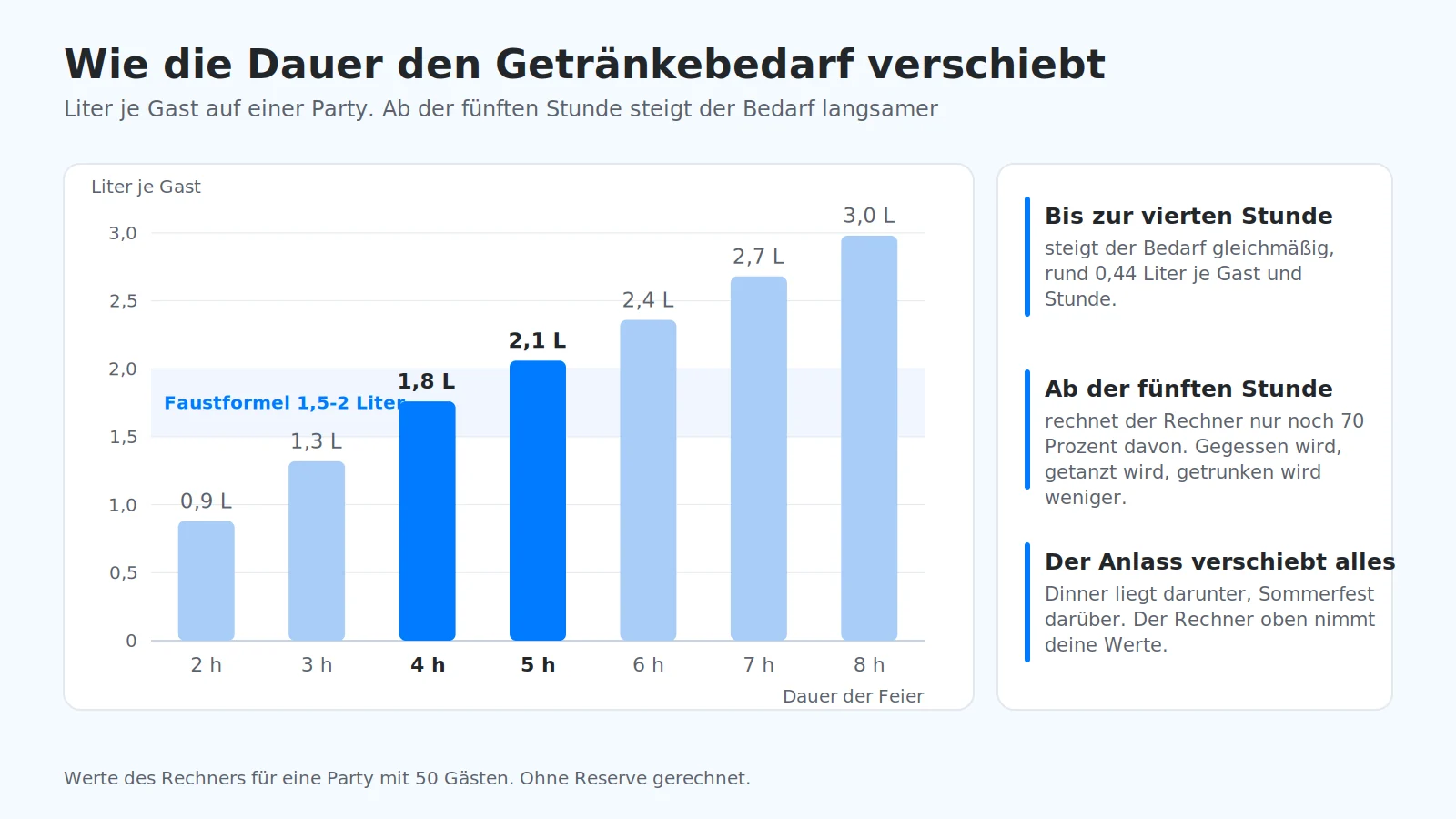
The rule of thumb for drinks at a party is: one drink in the first hour, then one per guest per hour. This rule of thumb covers the beverage requirements for a normal celebration. That makes about two liters per person. If you prefer to think in crates, use these three lines:
This rule of thumb works for up to about 100 guests. Beyond that, it’s worth thinking in terms of kegs and pallets and letting the dealer do the math. More important than the third decimal place is the return policy: buy on commission, then you can return full crates and the error on the high side costs nothing.
A crate of beer with standard bottles contains 20 bottles of 0.5 liters each, totaling 10 liters. A crate with small bottles holds 24 bottles of 0.33 liters, which is about 8 liters. A small keg holds 30 liters, a large one 50. The table converts all common container sizes into glasses so you don't have to think about it at the beverage store.
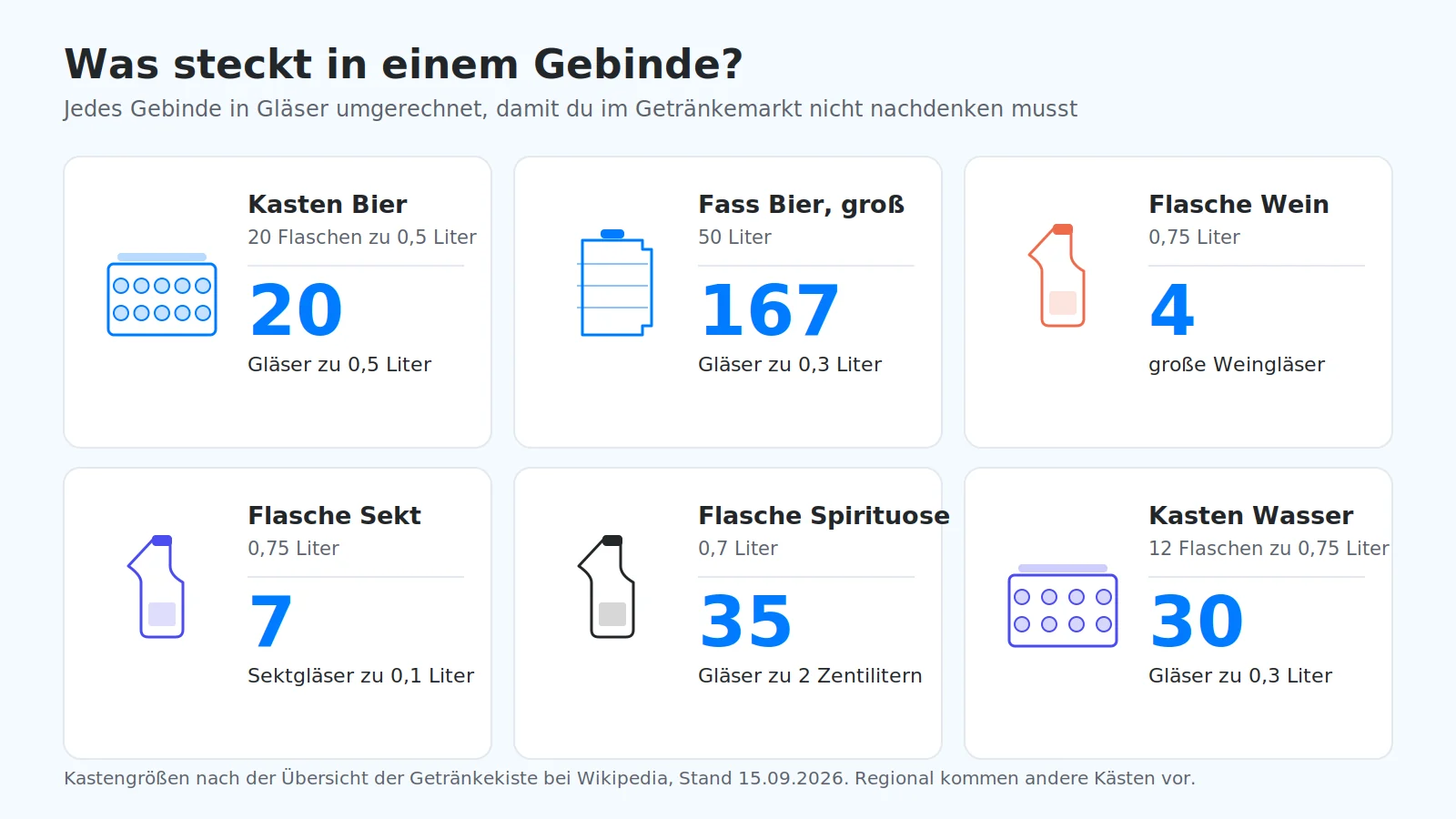
Two figures from the table are searched for most frequently. You get seven glasses out of a 0.75-liter bottle of sparkling wine, so for 20 guests with one glass for a toast, you need three bottles. And a 0.7-liter bottle of spirits yields 35 glasses at 2 centiliters each; at a generous 4 centiliters, it’s 17.
At a party, a guest will drink about 2.2 beers and half a glass of wine over the course of the evening, plus a quarter glass of sparkling wine and two and a half non-alcoholic drinks. In liters, that is about 1.1 liters of beer and a total of 0.8 liters of water and soft drinks. These figures shift depending on the occasion, but the total remains around two liters.
A short drink menu is better than a long one. Four to six varieties cover almost every taste. It is better to buy enough of each than to have too little of ten different types. This selection has proven successful at our events:
The beverage quantities in the calculator above are distributed across these types. When it comes to alcohol, it’s worth looking at your guest list: men tend to reach for beer more often, while women prefer wine and spritzers. Averages can hide this, which is why a 20 percent buffer is a smart move for mixed groups.
A draft beer system is worth it for about 100 liters of beer or more, which is roughly enough for 50 beer drinkers. The price per liter is lower for kegs than for bottles, and there is almost no empty packaging to deal with. Plus, no one has to lug around crates. On the flip side, there are three things to consider: you need electricity for the flow cooler, someone to man the tap, and the keg must be finished within one to two days.
Think in glasses rather than liters, and the decision becomes easy. A 50-liter keg yields 167 glasses of 0.3 liters each, while a 30-liter keg yields 100. The calculator above switches the shopping list to kegs as soon as you toggle the setting for a draft beer system. For smaller gatherings, bottles remain less complicated because guests can serve themselves.
The table shows a ready-made drinks list for the most common guest numbers, calculated for a five-hour party. You can use it exactly as it is. If you want to change the duration or the occasion, enter your own figures into the beverage calculator above.
The jump from 50 to 100 guests does not quite double the quantity. This is because larger groups tend to drink more slowly, and the proportion of those who stick to one glass increases. If you want to play it safe, enable the 20 percent reserve in the calculator.
This depends so heavily on the retailer that any flat figure would be misleading. Depending on the brand and region, one crate of beer can cost twice as much as another. There is also a price gap between discounters and beverage stores. That is why the beverage calculator does not set prices, but performs the calculation using your own figures.
You can get a reliable figure in ten minutes. Check the prices for a crate of beer, a bottle of wine, and a crate of water in a brochure or online. Enter them into the calculator under "Include costs." You will get the total sum and the amount per guest. Don't forget the deposit. With 20 crates, it quickly adds up to a three-digit figure, but you get it all back. That sets your budget for the drinks. How drinks fit into the overall budget is explained in the Event Cost Calculation guide.
A beverage flat rate is a fixed amount per guest for which a venue or caterer provides drinks over an agreed period. Instead of paying for every bottle individually, you pay once per head. It is common to have tiered pricing based on hours and the range of drinks. This usually includes beer, wine, soft drinks, and water. Spirits and cocktails are charged separately.
It is worth it if your guests are known to drink a lot or if the venue prohibits bringing your own drinks anyway. It is not worth it for a mixed group with many children or designated drivers. Calculate both options beforehand: the flat rate versus the value from the calculator above multiplied by your purchase price. As soon as you sell drinks for money at a public event, you will need a permit. The conditions can be found in our guide to liquor licenses.
For a wedding, you should plan more generously than for a party, as the day is longer and divided into different phases. Plan the champagne reception separately: one to two glasses per guest, which is about 20 bottles for 80 guests. During the meal, the proportion of wine consumed is significantly higher than in the evening. After the first dance, demand shifts back towards beer and long drinks.
Two rules of thumb from our events: water is almost always underestimated, especially in summer and on the dance floor—it's better to plan for one crate too many here. And a 20 percent reserve is a must rather than a precaution at a wedding, because by 10:30 PM, no one wants to go out and get more. You can calculate how much space your guests and the dance floor need in the Space Requirement Calculator.
The most important tip first: ask your beverage retailer about buying on a sale-or-return basis. Almost everyone offers this. You take a generous amount and return any unopened stock afterwards. This way, the reserve costs you nothing. It also prevents any shortages during the evening. Order two to three days in advance, or a week ahead for large quantities or during holidays.
Cooling is where plans often fall apart. Ten crates delivered warm won't be cold by the evening. Allow for four to six hours in the fridge. A refrigerated trailer or chest freezer will take the worry off your hands. The fastest way to cool drinks is in tubs filled with ice and water. Drinks outdoors need shade, otherwise the sparkling wine will end up lukewarm.
Once the drinks and equipment are sorted, the rest is routine. For music, you can find the right size among our sound systems for parties of up to 500 guests, with no deposit required and options for pickup or on-site setup.
Plan for 1.5–2 liters per person for four to five hours, which is about five to six glasses. About 45 percent of that should be non-alcoholic. Increase these amounts if it's hot, the party is long, or there is a lot of dancing.
For 30 guests at a party lasting five hours, that’s about 62 liters: 4 crates of beer, 5 bottles of wine, 1 bottle of sparkling wine, 1 crate of soft drinks, and 2 crates of water. For a dinner, the proportion of wine is higher and the total amount is lower.
A crate of standard beer bottles contains 20 bottles of 0.5 liters each, totaling 10 liters. A crate of smaller bottles holds 24 bottles of 0.33 liters, which is about 8 liters.
Yes. After calculating, the "Print or as PDF" button generates a checklist with quantities, packaging types, and space for notes. In the print dialog, select "Save as PDF" instead of a printer, and the list will be saved as a file on your device.
Plan for one to two glasses per guest. A 0.75-liter bottle yields seven champagne flutes; for 20 guests, that’s three bottles, and for 80 guests, about 20.
Not for a private party with a guest list. As soon as you sell drinks for money and the event is open to the public, you need a permit or liquor license. The rules vary by state.
Plan every detail of your event with our free calculators and configurators. All tools can be used without registration.
Wir haben dir eine Mail geschickt, bitte bestätige sie um den Rabattcode zu erhalten.

