

Yes. Whether GEMA fees apply does not depend on an admission fee, but on whether the music usage is public. A club festival that anyone can attend is public, even if no one pays anything. The admission fee only affects the amount: if there is no admission fee, the lowest tier of the tariff table simply applies. For an outdoor festival covering 200 square meters, this is around 45 euros gross per day; indoors with a DJ, it is about 78 euros.
Conversely, the same applies: a celebration with an admission fee can be fee-free if the guest list is closed. The deciding factor is always the public nature of the event, never the money.
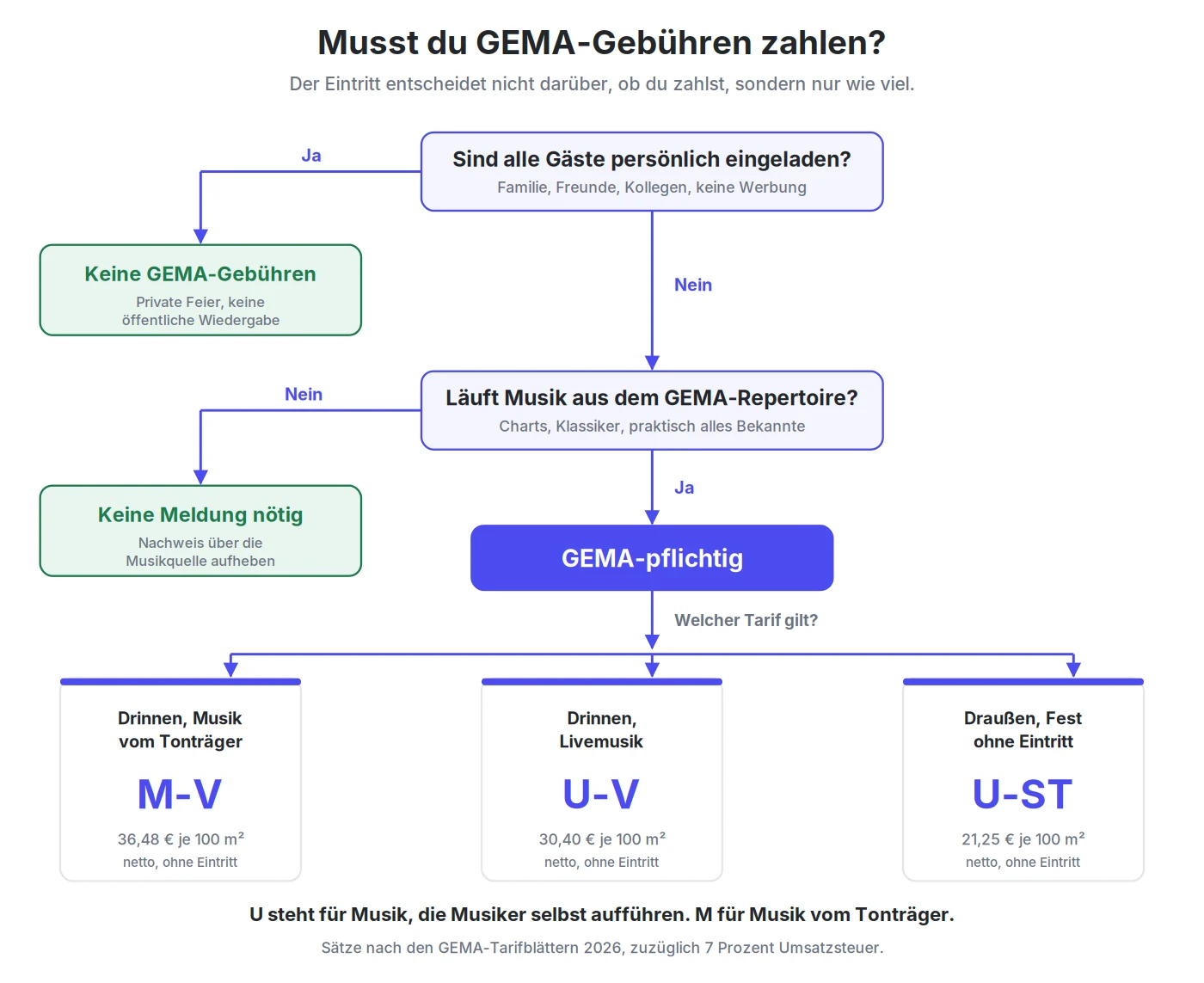
The term is more narrowly defined than most people expect. A performance is considered public whenever it is intended for a group of people who are not personally connected to each other or to the organizer. This personal connection is the core of the matter.
A wedding with family and friends is a private event. An 80th birthday party with 80 personally invited guests is, too. A Christmas party exclusively for your own staff remains private because everyone present is connected through their employment relationship. In all these cases, no notification is required and no fees apply, regardless of how much music is played or how loud it is.
It is helpful to keep proof. If GEMA asks later, the invitation list or the message distribution list is the only thing that counts.
As soon as you put up flyers, announce the festival publicly on social media, or sell tickets freely, the classification changes. Even an association festival intended only for members becomes public as soon as members are allowed to bring guests whom no one knows. The same applies to company parties as soon as customers, suppliers, or partners are invited. At a Christmas party with 200 employees and their guests, the line is blurred in practice, and GEMA tends to interpret it broadly.
The basis for calculation is the event area in square meters, not the number of guests. This surprises many, but it is consistent: the area determines how much music is being made audible. Added to this is the level of the net admission fee, and if there is no admission, it is the lowest level.
Which tariff applies is decided by two questions: are musicians playing themselves or is music being played from recorded media, and is the festival taking place indoors or outdoors? The type of event determines the tariff, and the area determines the amount.
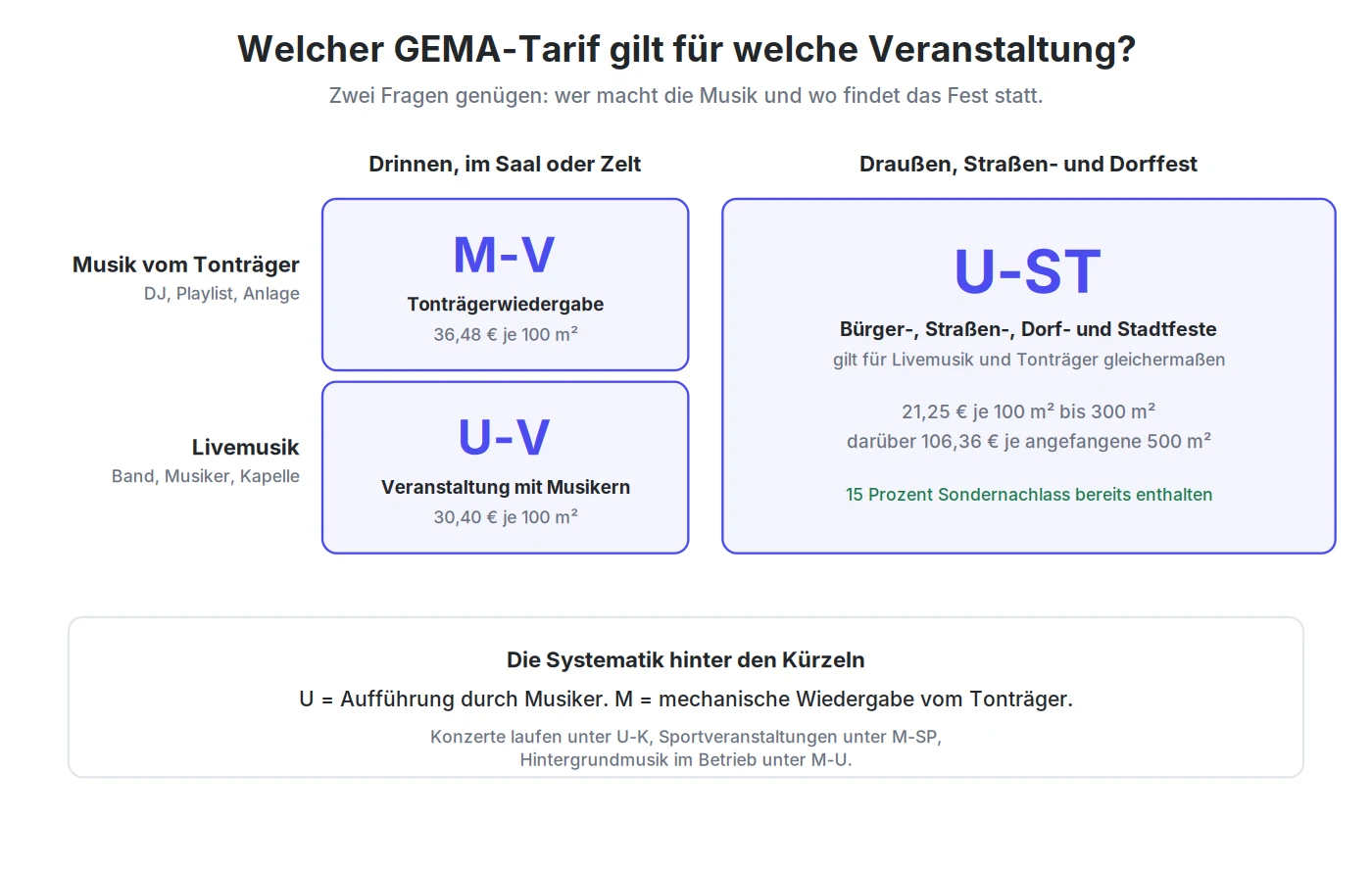
A practical example: a summer festival on the association grounds, 400 square meters of space, DJ, no admission fee. This is an outdoor festival, so the U-ST tariff applies. For over 300 square meters, GEMA calculates per started 500 square meters, so here it is one unit at 106.36 euros net. With 7 percent VAT, you end up at 113.81 euros for the day.
The same event in a hall instead of outdoors falls under M-V and costs 145.92 euros net, or 156.13 euros gross. The difference arises because the U-ST tariff already includes a special discount of 15 percent for cultural, social, and religious purposes. Which tariff applies to your format and what the individual abbreviations mean is explained in detail in the guide to GEMA fees for events.
Associations are not exempt from GEMA. This is the most persistent myth in association life. Even a non-profit association pays for public music use; it just often pays less. This applies to association events just as it does to a summer festival, and it applies to a cultural association just as it does to federations with sports clubs. Three ways can noticeably lower the amount.
The first way is the general agreement via the umbrella organization. If your association is a member of an organization that has a general agreement with GEMA, you receive a 20 percent discount on the fee. This applies to many state sports federations, music associations, and industry associations. It is worth asking, as the discount is not granted automatically but must be indicated during registration.
The second way is the blanket agreement. Those who hold events regularly do not pay for each one individually but instead pay an annual flat rate. This primarily saves on administrative effort and is usually cheaper if you have more than a handful of events per year.
The third way is new and often overlooked: some federal states have concluded framework agreements and cover all or part of the GEMA fees for volunteer associations. Bavaria and North Rhine-Westphalia have led the way here. Whether your state is included and what requirements apply changes constantly, so asking your state association is the fastest way to find out.
For outdoor events, the entire event area from the first to the last stall counts, including walkways and escape routes. It is not the area covered by sound or the dance floor that counts. This is a frequent point of contention, but it is the basis of the U-ST tariff.
Indoors, the room where the music is played counts. A hall measuring 15 by 20 meters equals 300 square meters, even if half of it is occupied by tables. Adjacent rooms without sound systems are excluded. If you are still in the planning phase and don't know how much space you actually need, the space requirement calculator can help with an initial estimate.
Two points that often cost money in practice: First, GEMA charges per day of the event. A three-day festival costs three times as much. Second, tariff U-V has an eight-hour limit; after that, an additional 25 percent of the base fee is charged for every two hours.
The calculator gives you the figure. You will need a few more details for the registration in the online portal, and it is worth gathering them beforehand.
After the one-time registration, the online portal asks for the date and location, the type of event, the event area, and the admission fee. These are exactly the values you entered above. Additionally, it asks who is acting as the organizer, because the party liable for payment is not the band or the DJ, but the person or entity organizing and assuming liability for the event.
For live music, there is an additional requirement that associations often overlook: the setlist. For every performance with musicians, you must report the works played, i.e., the titles and authors. This is the only way GEMA can distribute the money to the correct music creators. Without a setlist, they distribute it according to a standard key, which rarely matches the band that actually performed. For music played from recordings, a setlist is generally not required.
The GEMA price calculator on their online portal is the official preliminary estimate. Our calculator handles the initial calculation for you so you know the approximate cost before you even engage with their portal. Ultimately, the invoice from GEMA is the binding document.
Registration must take place before the event, not after. Those who register late pay a surcharge, and discounts are forfeited. Details on how the registration process works and what information you need can be found in our guide to GEMA registration. For events in Austria, the AKM is responsible rather than GEMA; you can use the AKM calculator for that.
The only alternative for those who want to avoid the fee entirely is to use music outside the GEMA repertoire. All other alternatives are not real options. One final point that is often overlooked: standard streaming subscriptions are licensed exclusively for private use. For public performance, you need a commercial source, in addition to the GEMA registration. The two are completely separate. If you still need equipment for the event, you can find it under sound systems.
Yes, as soon as the event is public. The admission fee only determines the tariff category. Without an admission fee, the lowest category applies; for an outdoor event, this is 21.25 euros net per 100 square meters per day.
No. Non-profit associations must also pay, but they often receive discounts: 20 percent through a general agreement with their umbrella organization, plus flat-rate agreements and, in some federal states, regional agreements that cover the fees for volunteer-run associations.
For an outdoor event covering 300 square meters with no admission fee, the cost is 63.75 euros net, or 68.21 euros gross per day. In a hall with live music, it would be 91.20 euros net, and with a DJ, 109.44 euros net.
No, as long as all guests are personally invited. A wedding among family and friends is not considered a public performance. This changes as soon as you promote the celebration publicly or sell tickets.
GEMA conducts inspections. If unauthorized use is discovered, a surcharge is added to the standard rate, and any discounts are forfeited. Registering after the fact is still cheaper than waiting.
The organizer. The person or entity organizing the event and taking responsibility for it is liable for payment, not the band or the DJ.
Use these free calculators and generators to plan the rest of your event, from the technical requirements to the tournament schedule.

Wir haben dir eine Mail geschickt, bitte bestätige sie um den Rabattcode zu erhalten.

