


Renty rents out wireless microphones, headsets, and wired microphones starting at €19.90 per day, with the receiver included for wireless sets. You can book online and pick them up for free, or have the microphones delivered and set up for you. You can see which mics are available for your date directly in the catalog.

There are three types of microphones for events: handheld, headset, and lavalier. The handheld microphone is the most versatile design. It fits comfortably in the hand, can be passed from table to table during speeches, and fits on any stand; it is the first choice for toasts, announcements, singing, and karaoke. As a wireless microphone, it transmits to a receiver on the speaker, and as a wired microphone, it connects directly via XLR.
A headset sits on the ear with a frame, with the capsule positioned in front of the mouth. Both hands remain free, and the distance to the mouth remains constant even if the person moves around the room. This freedom of movement is ideal for speakers, fitness instructors, and wedding celebrants. A lavalier microphone, also known as a lapel mic, clips onto clothing and is barely noticeable, even in photos and videos. Both types connect via cable to a bodypack transmitter worn on a belt.


The most common question we get about microphones isn't which model to choose, but how many you actually need. Speeches, moderation, and music are three separate microphone tasks, not one. The moderator keeps their own mic, the speeches get a second one, and anyone singing needs a third one on a stand. From the third microphone onwards, you should add a mixing console.
At a wedding, the celebrant uses a headset or lavalier microphone during the ceremony, leaving both hands free for her book. For the exchange of vows, she hands a handheld microphone to the couple. In the evening, there are speeches from the best man, maid of honor, and parents, as well as games and announcements. You can find more tips for planning your ceremony in our guide Planning a Wedding Ceremony.
At company parties, anniversaries, and Christmas parties, the focus is usually on a speech by the management. A wired microphone is sufficient for a lectern, while anyone moving freely around the room should use a wireless microphone. If someone is hosting the evening, the moderator should have their own dedicated microphone.
For lectures, seminars, and conferences, the speaker wears a headset so their hands remain free for a presenter and notes. At conferences, a second microphone is passed through the rows for questions from the audience. Projectors, screens, and presenters for slides can be found under Conference Technology.

Ready on the table: The wireless microphone is waiting for the first speech. Battery-powered and no tangled cables.
A microphone on its own remains silent. A speech only becomes audible through a speaker with a microphone input; together, this forms a microphone system. If you already have an active speaker, you can connect the wireless microphone receiver to its microphone input, and you won't need any other equipment. If you don't have your own speaker, you can rent a microphone and speaker together. For music and speeches in one evening, a sound system with its own microphone volume control is a great fit.
You can find suitable speakers under Speakers, and complete systems for music and speeches under Sound Systems. From the third microphone onwards, you should control the audio levels via a mixing console; our selection is available under Mixing Consoles. For karaoke nights, we offer dedicated Karaoke Systems that include everything you need to sing.
A wireless set starts at €19.90 per day. For this price, you get two handheld microphones with one receiver with the Tonor TW630, or a headset and a lavalier microphone for a bodypack transmitter with the Tonor TW621. The rental period is calculated in full 24-hour blocks starting from pickup; day 1 is charged at the base price, and each additional day is 15% of that.
Individual wireless systems from t.bone, Shure, Sennheiser, and LD Systems range between €39.90 and €49.90, while the Shure SM58 BLX set with two handheld transmitters and the Tonor TW844 with four headsets cost €79.90 each. Wired microphones start at €19.90 per day. All prices are gross, there is no security deposit, and insurance is included in the rental. Self-pickup is free of charge; delivery, setup, and dismantling cost €59 per hour or part thereof. All information regarding our pricing policy and a calculation example can be found under Prices.
For a wedding on a Saturday, for example, you would pick up the Tonor TW630 on Friday evening and return it on Sunday evening. The rental fee for these two days is €22.89, and both the moderator and the person giving a speech will each have their own microphone.
| Funkset | Bild | Bauform | 1 Tag | 3 Tage |
|---|---|---|---|---|
| Tonor TW630 |  | Handmikrofon | € 19,90 | € 25,87 |
| t.bone free solo HT |  | Handmikrofon | € 39,90 | € 51,87 |
| Shure SM58 BLX |  | Handmikrofon | € 39,90 | € 51,87 |
| Sennheiser XSW 1-825 |  | Handmikrofon | € 39,90 | € 51,87 |
| Sennheiser EW-D 835-S Set |  | Handmikrofon | € 49,90 | € 64,87 |
| Sennheiser EW 100 G4 |  | Handmikrofon | € 49,90 | € 64,87 |
You pick up the equipment from the location in your city and set it up yourself. Everything is prepared for plug-and-play, and there is a video tutorial for every device.

We bring the equipment to your venue and pick it up again after the event. You can handle the connection and setup yourself; every device is prepared for it.
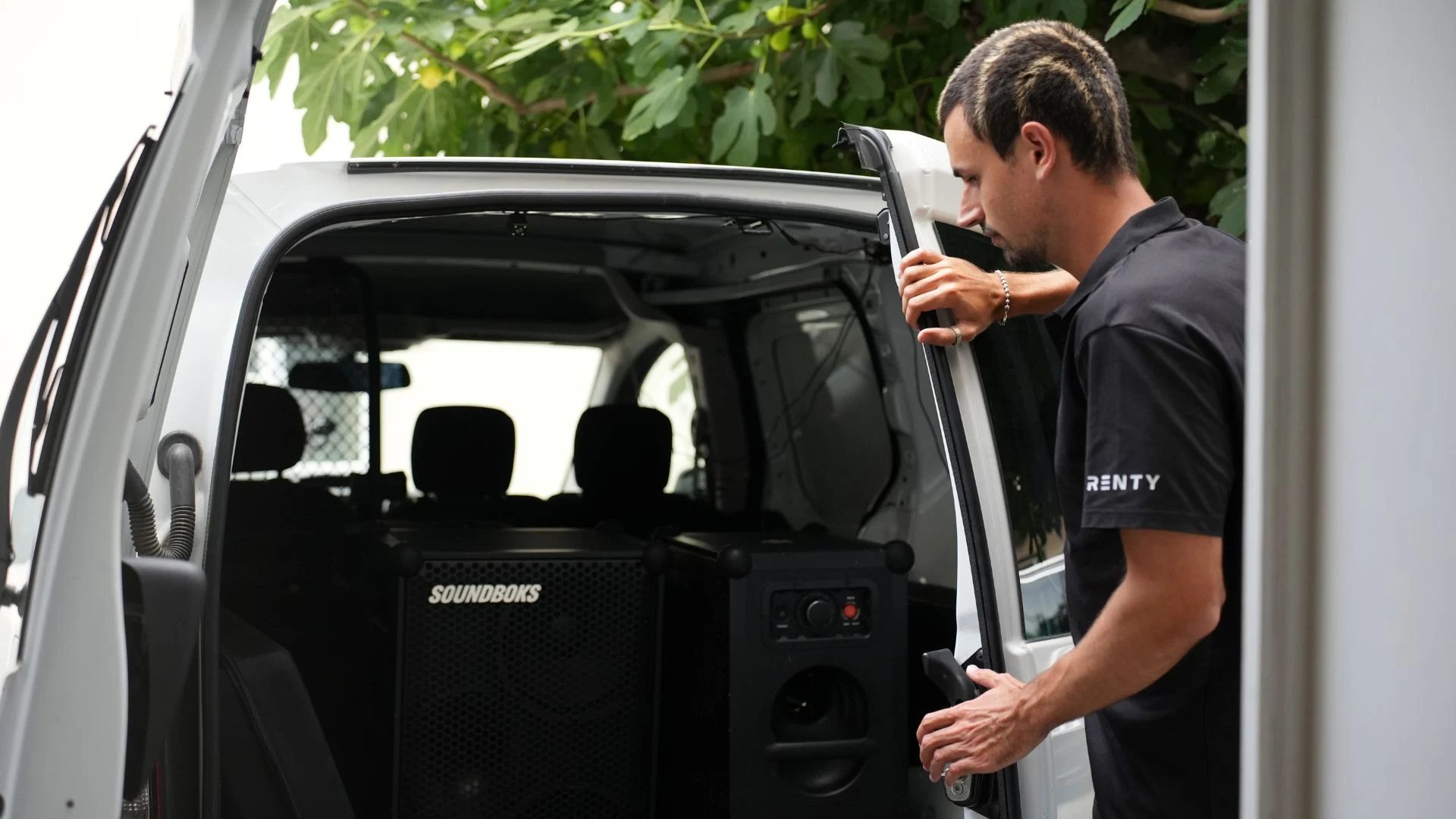
We set up the equipment on-site, handle the cabling, configure the sound and lighting, and dismantle everything after the event. You receive a fully configured system ready to go.

A technician stays on-site during the event, responds to changes in the schedule, and handles the teardown afterward. The safest option for speeches and presentations.
Enter your city and date in the catalog above to see what is available.
Select your equipment and set the rental days; the price is displayed immediately.
Book online, with no deposit and no need for email inquiries.
Pick up with a briefing or have it delivered and set up for you.
Describe your event and we will suggest the right equipment for you. Our consultation is free of charge.
Available daily from 8:00 AM to 10:00 PM.
How much does it cost to rent a wireless microphone?
How many microphones do you need for speeches and moderation?
Do you need to register a wireless microphone?
What is the range of a wireless microphone?
How long do wireless microphone batteries last?
Can you connect the microphone to your own speaker?
Can you use multiple wireless microphones at the same time?
Headset or handheld microphone: which is better for a presentation?
How do you prevent microphone feedback?
How do you find out if a microphone is available in your city?
Renting a microphone is worth it for events that only happen a few times a year: a wedding speech, an address at a company party, a presentation at a conference, or a musical performance at a club event. We offer wireless handheld microphones, headsets, lavalier mics, and wired microphones, as well as wireless sets with two or four microphones.
We have 28 locations across Germany and Austria where we provide personal service to private individuals, companies, and clubs. You can find your nearest location using the filter in our catalog, and prices are listed directly on each item. You will receive a briefing when you pick up your equipment, and a service technician can set up the microphones and speakers on-site if requested.
Renting microphones instead of buying them saves money, especially with wireless systems. A high-quality wireless set costs many times the daily rental rate and would otherwise just sit in a cupboard after the party. We handle all maintenance and care as part of our event technology rental service.
Great sound depends on the entire chain of microphone, speaker, and setup. You can book the rest of your audio equipment, such as speakers and stands, in the same order to complete your microphone system. Lighting, projectors, and other event technology can also be added to your booking upon request. Rentals are available at all locations under the same terms: no deposit required and fully insured.
Wireless is the right choice whenever someone is moving around or the microphone needs to be passed from person to person. A wired microphone is ideal for fixed positions, such as at a lectern or for singing. It requires no batteries and no open frequencies, but it does require a cable running to the speaker. For speeches, announcements, and wedding ceremonies, wireless is the top choice, while a wired mic is often preferred for concerts on smaller stages.
A wireless microphone system consists of a transmitter and a receiver, collectively known as a wireless link. The transmitter is either built into the handheld microphone or worn as a bodypack on a belt, while the receiver connects to the speaker. This keeps cables out of the way and gives presenters full freedom of movement around the room.
A wired microphone connects directly to the speaker. It runs without batteries or wireless signals, so there is no interference from other wireless systems. With its metal housing and steel grille, it is the most robust solution for use at a lectern or on a microphone stand.
Conferences and panel discussions often involve multiple wireless sets running simultaneously. Each transmits on its own frequency, so you must set them to different channels to prevent interference. This is not an issue with wired microphones.
A wired microphone requires an XLR input on the speaker or mixing console. Route the XLR cable so that no one trips over it, ideally by securing it to the floor with tape.
The range specified by a manufacturer applies when there is a clear line of sight between the transmitter and receiver. In a hall, walls, pillars, and crowds will shorten the range, so it is best to place the receiver in an elevated position close to the stage. For outdoor events, it should be kept under a roof, protected from rain and direct sunlight. Even so, manufacturer specifications provide enough headroom for events in a banquet hall or garden.
Wireless microphones transmit on fixed frequencies, and not every frequency is approved for everyone. In Germany, anyone can transmit without registration or fees on bands including 823-832 MHz, 863-865 MHz, and 1785-1805 MHz, as stated in the general allocations by the Federal Network Agency. The 470-608 MHz and 614-698 MHz ranges are reserved for professional production until the end of 2030, such as for broadcasting, theater, and event technology service providers. Other frequencies require a specific license, which involves fees.
In Austria, wireless microphones no longer require registration as of April 16, 2026, including those operating between 470 and 694 MHz. You can find which band a wireless set uses on its type plate.
Whether a speech comes across well often depends not on the microphone itself, but on where it is placed and how it is held. Microphones for vocals and speech usually use a cardioid polar pattern, meaning they pick up sound from the front and dampen noise coming from behind. That is why the microphone belongs in front of the mouth and the speaker in front of the person speaking, never behind them. A microphone stand keeps the microphone at the right height for singing or at a lectern; you can find our selection under Stands.
Hold the microphone about a hand's width from your mouth and point it at your lips, not your chest. Cupping the grille with your hand covers the capsule, which makes the voice sound muffled and increases the risk of feedback.
Test each microphone before the guests arrive, standing where the speech will be given and speaking at a normal volume. This lets you check if the speaker volume is too high and if the wireless signal reaches the speaking area.
Turn off or mute the wireless microphone when passing it to someone else. A microphone left open on a table will transmit every clatter and side conversation into the room as background noise.
A wireless handheld microphone usually runs on two AA batteries, lasting several hours depending on the model. Keep spare batteries ready for a long evening and swap them during a break, not in the middle of a speech.
Singers at concerts and parties usually use a dynamic vocal microphone. The classic choice is the Shure SM58 with its cardioid polar pattern and a frequency response of 50 to 15,000 Hz. The Sennheiser e845-S, with its supercardioid pattern, captures sound even more narrowly from the front and keeps feedback at bay longer when monitors are placed close to the microphone. Dynamic microphones do not require phantom power and are very durable.
The difference compared to condenser microphones lies in their sensitivity. They record more precisely but require phantom power for the capacitor in the capsule and are more prone to feedback on a loud stage, which is why they are better suited for studio recordings than for parties.
For live events with a band, you route the microphones through a mixing console, where each voice gets its own channel. If you're moving around the stage during your performance, use a wireless microphone like the Shure SM58 BLX, which features the same microphone head as the wired model.
The power required for speeches and music depends on the size of the room and the number of guests. The PA calculator shows you what you need for both indoors and outdoors.
Who will host if there's no DJ, and what equipment you need for speeches, games, and music.
Speaker and microphone input in one system, perfect for music and speeches in a single evening.
All audio equipment categories at a glance, from speakers to mixing consoles: Audio Equipment

Wir haben dir eine Mail geschickt, bitte bestätige sie um den Rabattcode zu erhalten.


