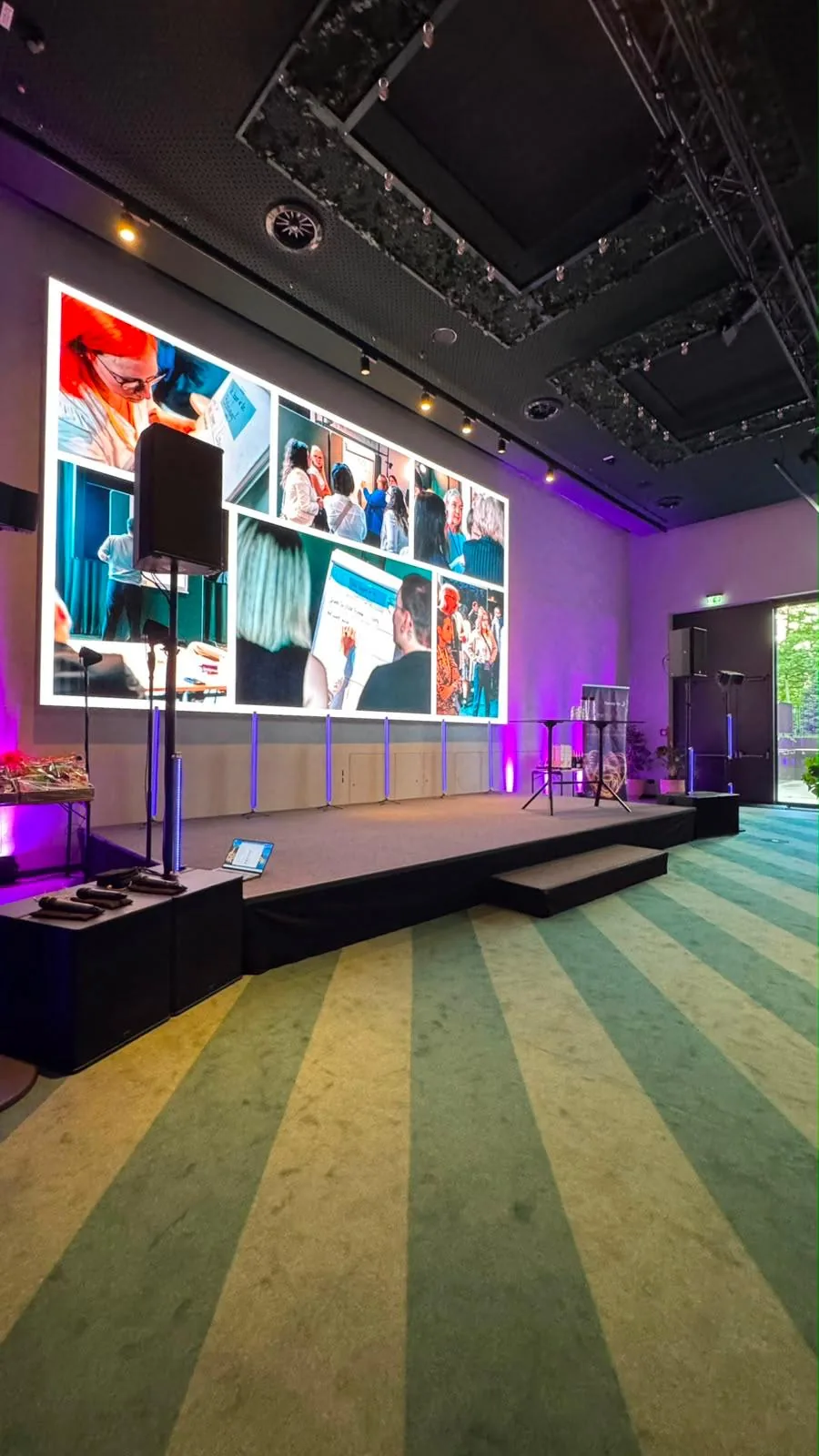
Renty rents out LED displays in two ways: as a complete wall with a floor stand, processor, and technician starting at €2,090 per day, or as individual cabinets starting at €54.90 for those who prefer to build it themselves. Five standard sizes between 7 and 28 square meters are available for direct booking; we plan larger displays and hanging installations individually. The difference compared to projection is simple: the display is self-illuminating and therefore remains legible even in daylight.

An LED wall is not just a large screen; it is a grid of individual cabinets, often called LED modules. Each one measures half a meter wide and either half a meter or a full meter high. They lock together to form a seamless surface. A video processor scales the image across the cabinets, turning many individual parts into a single, cohesive picture.
Everything else follows from this. The size is flexible because cabinets can be added as needed. A faulty part can be replaced individually rather than losing the entire display. Since the weight increases with every cabinet, an LED wall is usually mounted on a floor stand. Hanging it from a truss is also possible; we can plan this upon request. The drawings show the five standard sizes and the three cabinet types to the same scale.


Three questions are all it takes to determine which system suits your location, viewing distance, and desired size. The catalog selection will then show you what is available for your dates.
At a trade fair, light is the problem. Hall lighting is often over 1,000 lux, plus there are spotlights from neighboring booths. A projection struggles against this and loses because it casts its image onto a surface that absorbs all ambient light. The LED wall emits its own light and therefore remains readable even if a spotlight is shining right next to it.
The second reason is distance. At a trade fair booth, the audience stands directly in front of the screen, often only a few meters away. This requires the fine 2.6 mm pixel pitch; with a coarser system, individual pixels would be visible from that close. This exact scenario is why there are two indoor systems available. Additionally, there is a refresh rate of at least 7,680 Hertz: the screen does not flicker in photos or live streams from the booth.
The third reason is simple but decisive: an LED wall does not require depth in front of the image. In a six-by-six-meter booth, every meter of floor space is planned out. There is no room for a projection path across the booth. You can find what else belongs at your booth in the overview of technology for trade fairs.
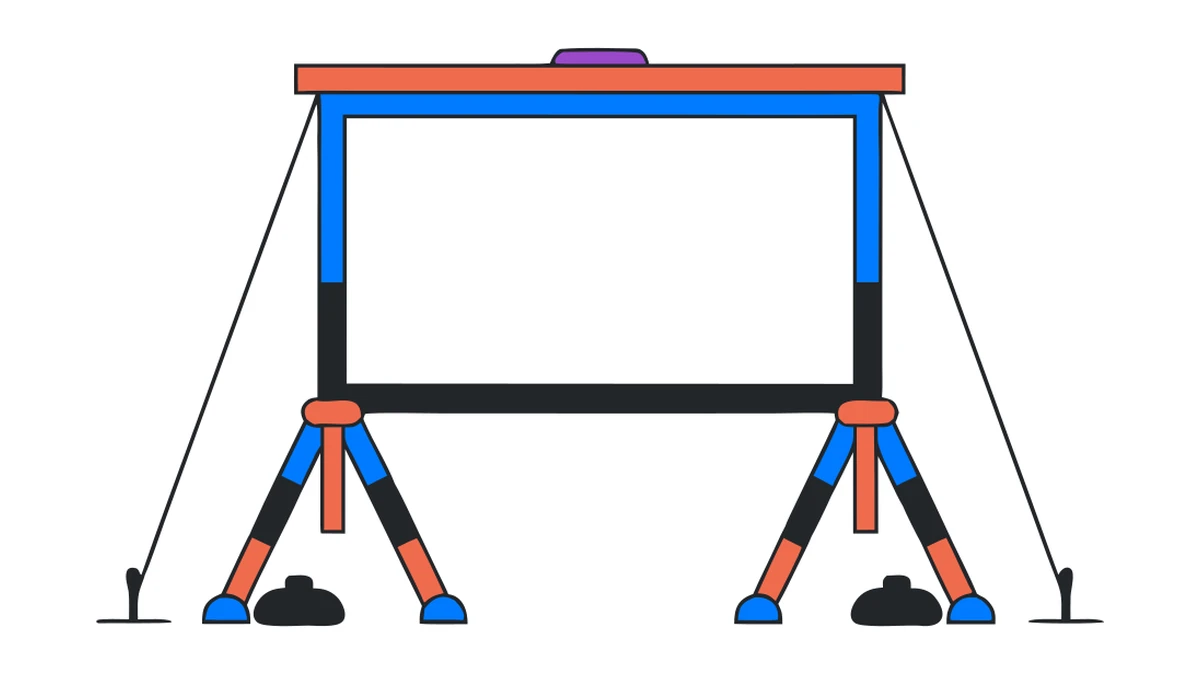
Seven square meters made of 28 cabinets with 2.6 mm pixels, the complete screen for trade fairs.
The decision comes down to a single question: how bright is the location where the image will be displayed? If the room can be darkened or the event takes place in the evening, projection is the cheaper and faster solution. If the program takes place in daylight, a projection will be ineffective, regardless of how many lumens are listed on the data sheet. A projector must compete with ambient light, whereas an LED screen does not.
The second question is duration. For a one-hour presentation, the effort of an LED wall is rarely worth it. However, if the program runs from morning to evening, the calculation changes: an LED screen has no lamp that gets hot and no projection path that people might walk through. For projection needs, we offer projectors and projection screens; all image categories can be found under Media Technology.
A complete LED wall starts at €2,090 per day for a 3.5 x 2 meter setup. The rental includes the cabinets, the floor stand, the video processor with cabling, and a technician who handles setup, configuration, on-site support during the event, and teardown. A second person is added for screens 5 x 3 meters and larger, and a third for 7 x 4 meters. If you set it up yourself, you can rent individual cabinets starting at €54.90 per day each. For a 3.5 x 2 meter screen with 2.6 mm pixels, that is 28 cabinets, totaling €1,537.20 for the hardware alone, excluding the processor, floor stand, and personnel.
The rental of a complete screen includes one day of operation with up to ten hours for the team. Each additional hour costs €94.90 per person. For work performed between 10:00 PM and 6:00 AM, as well as on Sundays and public holidays, personnel costs increase by 50%. For multi-day rentals, only the hardware costs decrease: the second day is half the price of the first, and from the third day onwards, it is a quarter. Personnel and support costs remain the same every day. Delivery and pickup are based on distance; self-pickup for individual cabinets is free of charge.
You pick up the equipment from the location in your city and set it up yourself. Everything is prepared for plug-and-play, and there is a video tutorial for every device.

We bring the equipment to your venue and pick it up again after the event. You can handle the connection and setup yourself; every device is prepared for it.
We set up the equipment on-site, handle the cabling, configure the sound and lighting, and dismantle everything after the event. You receive a fully configured system ready to go.

A technician stays on-site during the event, responds to changes in the schedule, and handles the teardown afterward. The safest option for speeches and presentations.
Enter your city and date in the catalog above to see what is available.
Select your equipment and set the rental days; the price is displayed immediately.
Book online, with no deposit and no need for email inquiries.
Pick up with a briefing or have it delivered and set up for you.
Describe your event and we will suggest the right equipment for you. Our consultation is free of charge.
Available daily from 8:00 AM to 10:00 PM.
How much does it cost to rent an LED wall?
Which sizes can I book directly?
Does an LED wall really work in daylight?
What does pixel pitch mean?
How much power does an LED wall need?
Who sets up the wall and how long does it take?
Can I assemble the cabinets myself?
What happens in case of rain and wind?
How far in advance should I rent the LED wall?
So, is it called an LED-Wand, LED wall, or video wall?
An LED wall is a self-illuminating display surface made of individual cabinets. Because it generates its own light, it works where projection reaches its limits: in daylight, at a brightly lit trade fair booth, or in continuous operation throughout the day. Renting an LED wall from us means: by the day, either as a complete screen with a technician or as individual cabinets for self-assembly.
The rental process is straightforward: define the size and date, book it, and the screen will be there on the day of the event. For the five standard sizes, a technician handles setup, configuration, support, and teardown, which is included in the price; delivery and pickup are added based on distance. If you only rent the cabinets and build it yourself, you save on personnel costs but take responsibility for structural integrity, the processor, and configuration. Both options are deposit-free and covered by all-risk insurance.
Regarding terminology: "LED wall" is the English term for the same thing and is more common in the events industry than the German word. "Videowand" (or "videowall" in English) originally referred to something else: multiple screens placed together with visible borders between them. Today, the term is also used for a seamless surface, and anyone looking for an LED video wall usually means exactly what is shown here. The term "LED-Leinwand" (LED canvas/screen), however, is misleading because a canvas does not emit light; it only reflects what a projector casts onto it.
"Großbildwände" (large-screen walls) is the older German collective term; while it usually refers to the same thing today, it can also include projection surfaces.
All equipment is mobile. The cabinets arrive in flight cases, and the floor stand is assembled on-site. A few hours after the event ends, there is no trace left. Permanently installed video walls, such as those found in stadiums or mounted on building facades, are not included. That is a different trade requiring building permits, lightning protection, and maintenance contracts.
This technology is booked for trade fair appearances, product launches, annual conferences, concerts, public viewing events, city festivals, and sporting events. The occasion matters less than two practical questions: how bright is the setup location, and how close is the front row? These determine the system and pixel pitch; the rest is a matter of screen size and budget. The calculation for a corporate event is different from that for a city festival in July.
For public viewing, the screen makes the evening. The 7 x 4 meter outdoor LED wall remains legible from up to a hundred meters away and is bright enough for broadcasting even in daylight. Because setup and teardown take up to nine hours combined, it is best to have it set up the day before. Permits and broadcasting rights are the responsibility of the organizer; you can find out what is involved under Hosting a Public Viewing.
Regarding availability: An LED screen is not an off-the-shelf product. It doesn't come from the inventory of your local branch; instead, it is delivered and set up for a specific date. You will still have a local contact person, however, with 28 locations across Germany and Austria. They will handle the scheduling and site access. Because there are only a few units of each standard size available and every deployment ties up a team for a full day, it is worth inquiring earlier here than in any other category.
An outdoor LED wall and an indoor screen may look similar from the front, but they are two different devices. The difference lies not in the image, but in brightness, housing, and weight. Four points determine which version belongs at your location.
An indoor screen provides around 1,200 nits per square meter, while an outdoor screen provides over 5,000. Wherever daylight reaches, the indoor value is insufficient, even under a roof. If the screen is in a marquee with an open side or in a foyer with a glass front, the brighter version is required, even if it is technically indoors.
The housing of the outdoor cabinets can withstand precipitation, dust, and temperatures from minus 20 to plus 60 degrees Celsius. What it doesn't solve is stability. A freestanding screen requires ballast, the amount of which depends on the surface area and height. This calculation belongs in the planning phase, not on the day of the event.
It is technically possible, but rarely makes sense. Outdoor cabinets weigh 13 kilos instead of 11, and their pixel pitch is coarser than the fine indoor system. With over 5,000 nits, they are brighter than is comfortable for an indoor space. If you are booking for an indoor event, you will save money and provide a better experience for your guests by choosing the indoor option.
A closed tent without direct sunlight is considered an indoor space, so an indoor system is sufficient. As soon as one side is open or the roof is translucent, more light will hit the screen in the afternoon than expected. When in doubt, take a look at the installation site at the relevant time of day rather than relying on the weather forecast.
Pixel pitch is the only number that truly determines image quality. And it is frequently over-specified. It refers to the distance between the centers of two pixels. The smaller this distance, the closer someone can stand to the screen without seeing individual dots. The rule of thumb for planning: the minimum distance in meters is roughly equivalent to the pixel pitch in millimeters. This is an estimate, and in practice, it is usually quite generous.
This leads to the decision. If the audience is standing more than three meters away—which applies to every stage and every hall—3.91 millimeters is sufficient. The fine 2.6-millimeter pitch is only worth it where people are standing right up against the screen, such as at a trade fair booth, in a reception area, or in a studio. It costs significantly more per square meter and requires twice as many cabinets for the same screen size because they are only half as tall.
There is also an upper limit, though it is rarely reached. Even the coarsest screen offered here remains legible up to one hundred meters. If you are standing further away, the issue isn't the pixels, but the size: beyond that distance, the image is simply too small. In that case, the only solution is a larger screen or a second one in a different location.
Three things determine whether an LED screen will work on the day of the event: the floor, the power, and the wind. None of these can be improvised on-site; all three must be clarified in advance.
The cabinets for the smallest setup weigh around 154 kilos, while a 7 x 4 meter outdoor screen weighs about 730 kilos, plus the floor frame and ballast. Indoors, the wall requires a level, load-bearing floor; outdoors, it needs a paved surface. Installation on grass is only possible by prior arrangement. If the screen is placed on a stage with limited load capacity or on an upper floor, the weight must be reported to the venue in advance.
The average value describes standard image content, while the peak value applies to a full-white screen. There is a factor of three between the two. If you plan based on the average, you will be left in the dark the moment a bright slide appears. The smallest indoor setup runs on a standard wall outlet with its own circuit; all others require high-voltage power. If that isn't available on-site, we can provide a generator upon request.
A freestanding outdoor screen acts like a sail. To counter the tipping moment, we use ballast and wind bracing, the amount of which is determined by our technician based on the screen size and location. In the event of a storm or thunderstorm, the technician decides whether to shut down or dismantle the wall. This decision is made on-site and is not negotiable on the day of the event.
Without a video processor, the wall won't display an image. It receives the signal from your laptop or media server and scales it to the actual number and arrangement of the cabinets. For our pre-configured screens, the processor is included and pre-set, along with brightness, scaling, and a test with your content. If you are renting individual cabinets, you must provide your own processor or book one upon request.
The wall accepts any signal provided via HDMI from a laptop, media server, or camera. The standard sizes are close to 16:9, so a presentation will fill them almost entirely. The image is sharpest when slides and videos are created in the wall's native resolution—for a 3.5 x 2 meter screen with 3.91 mm pixel pitch, that is 896 x 512 pixels. You provide the laptop for playback; cameras and video switchers are available upon request. Outdoors, the control area needs to be protected from rain.
Setup takes between 1.5 hours for the smallest screen and six hours for a 7 x 4 meter wall, from unloading to a fully configured display. Dismantling takes 45 minutes to three hours and requires the same access route. The daily rental rate includes one day of operation with up to ten hours for the team. For large outdoor screens, there is little time left after setup and dismantling, so it is best to have the wall in place the day before the event.
The screen size grows in cabinets, not inches. A standard cabinet measures half a meter wide by one meter high, while the high-resolution indoor system measures half a meter by half a meter. Consequently, the width increases in half-meter increments, and the height increases in half- or full-meter increments depending on the system. A format like 4.30 by 2.20 meters does not exist; it is rounded to the nearest grid size.
For the size itself, there is a useful rule of thumb from the field: the image height should be at least one-sixth of the distance to the back row. For a room depth of twelve meters, that means a height of two meters—the 3.5 x 2 meter option from our catalog. For eighteen meters, you need three meters, which corresponds to our 5 x 3 meter screens. If the back row is thirty meters away, you need a height of five meters; this is the point where a standard size becomes a custom-engineered construction. The table lists the resolution, weight, power requirements, and setup time for each pre-configured screen—the key figures that dictate the installation. You can calculate the power consumption in our power consumption calculator.
Resolution is the number that counts for your content. A wall doesn't have "Full HD"; it has exactly as many pixels as its cabinets support. If you create slides and videos in this specific size, you get the sharpest image; the processor handles any necessary scaling for everything else. The five standard sizes are close to a 16:9 aspect ratio. A presentation will fill them almost entirely, leaving at most a narrow border at the top and bottom that can be filled with a background.
Everything a booth needs beyond the floor space, from sound systems to power.
Permits, site access, broadcasting rights, and all the technical requirements.
From the reception to the evening program, with all the necessary equipment.
All media categories at a glance: Media Technology

Wir haben dir eine Mail geschickt, bitte bestätige sie um den Rabattcode zu erhalten.