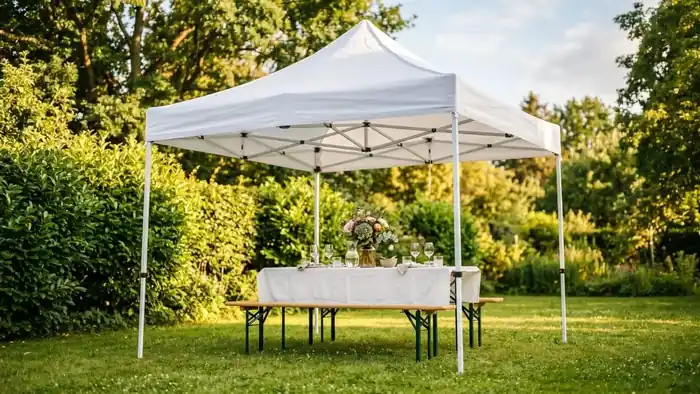
Renty rents out folding pavilions in 3 x 3 m and 3 x 6 m sizes, each with or without side walls, with the 3 x 3 m pavilion with side walls costing €99 per day. Both can be set up without tools in about ten minutes, and they fit into a station wagon in their bags. You can book online and pick them up for free, or have the pavilion delivered and set up for you.

A folding pavilion can be set up without tools in about ten minutes—a 3 x 3 m by two people, and a 3 x 6 m by two or three people. You pull the steel scissor frame apart at opposite corners until it clicks into place. Then, you set the legs to one of three heights, attach the side walls, and secure each leg.
The images show the 3 x 3 m pavilion from the trunk to deployment: the bag and frame, the corner connector that tensions the roof, the dimensions when set up, and the pavilion on a lawn. When collapsed, the frame is 134 cm high, and the wheeled bag measures 145 cm.


Three questions about guests, usage, and the ground surface. After that, you will know whether 3 x 3 m is enough, whether it should be 3 x 6 m, or if a party tent is a better fit, and how to secure the pavilion on your ground.
At a flea market, a club's Christmas market, or a street festival, a pavilion protects goods and vendors from sun and rain without blocking the view of the stand. A 3 x 3 m pavilion is almost always enough for one stand. On public property, an event usually requires a special use permit from the local municipality. You can find out what else you need to plan for the festival under Street Festival.
For a garden wedding, the pavilion is usually placed over the champagne reception, the cake buffet, or the bar. With side walls, it looks tidy; without them, it provides shade. A 3 x 6 m space can accommodate a champagne reception with high tables for up to 30 guests, but for a formal dinner with the entire party, more space is required.
At club festivals and corporate events, the pavilion serves as a station next to the large tent: for drink service, a cash desk, an information table, or a DJ booth. Because it fits in a station wagon and can be set up without tools, even helpers without tent-building experience can assemble it.
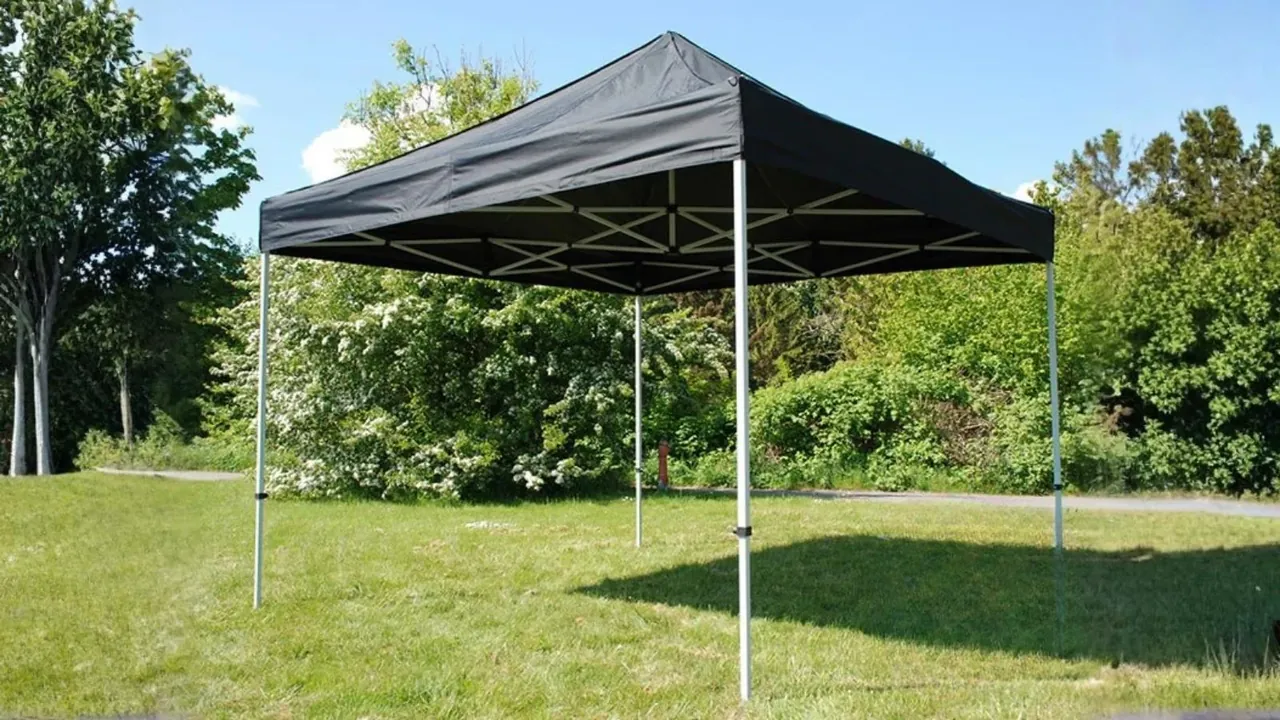
Without side walls, the pavilion provides shade; with side walls, it keeps out rain showers.
A pavilion covers a station or a group of up to about 50 people standing, while a party tent covers the entire event. The deciding factor is whether all guests need to be under the roof at the same time and whether they will be standing or sitting.
The rule of thumb: A 3 x 3 m pavilion is sufficient for up to about 25 standing guests, and one measuring 3 x 6 m for up to about 50. If more guests need to be under one roof or if more than about 20 people need to be seated at tables, a party tent is the right choice.
If the number of guests is slightly higher, you can combine a pavilion for the buffet and bar with a tent for the guests. This leaves space in the tent for tables and a dance floor.
The 3 x 3 m folding pavilion with side walls costs €99 per day, including a wheeled bag and all-risk insurance. We will provide the daily rate for the 3 x 6 m version upon request. A rental day consists of a full 24 hours from pickup or delivery, regardless of when your event begins. The base price applies to day 1, with each subsequent day charged at 15% of that rate, meaning the daily price decreases with the rental duration.
A weekend from Friday to Sunday counts as three rental days; for the 3 x 3 m pavilion, this is €128.70 instead of three times €99. Delivery, setup, and dismantling cost €59 per started hour of work, with travel time included in the working hours. You can rent pegs for grass surfaces as an add-on. The complete pricing policy can be found under Prices, and the premium version with fastening materials is listed with its own price in the catalog.
| Pavillon | Bild | Fläche | 1 Tag | 3 Tage |
|---|---|---|---|---|
| Faltpavillon 3 x 3 m |  | 9 m² | € 99 | € 128,70 |
| Faltpavillon 3 x 6 m |  | 18 m² | auf Anfrage | |
You pick up the equipment from the location in your city and set it up yourself. Everything is prepared for plug-and-play, and there is a video tutorial for every device.

We bring the equipment to your venue and pick it up again after the event. You can handle the connection and setup yourself; every device is prepared for it.
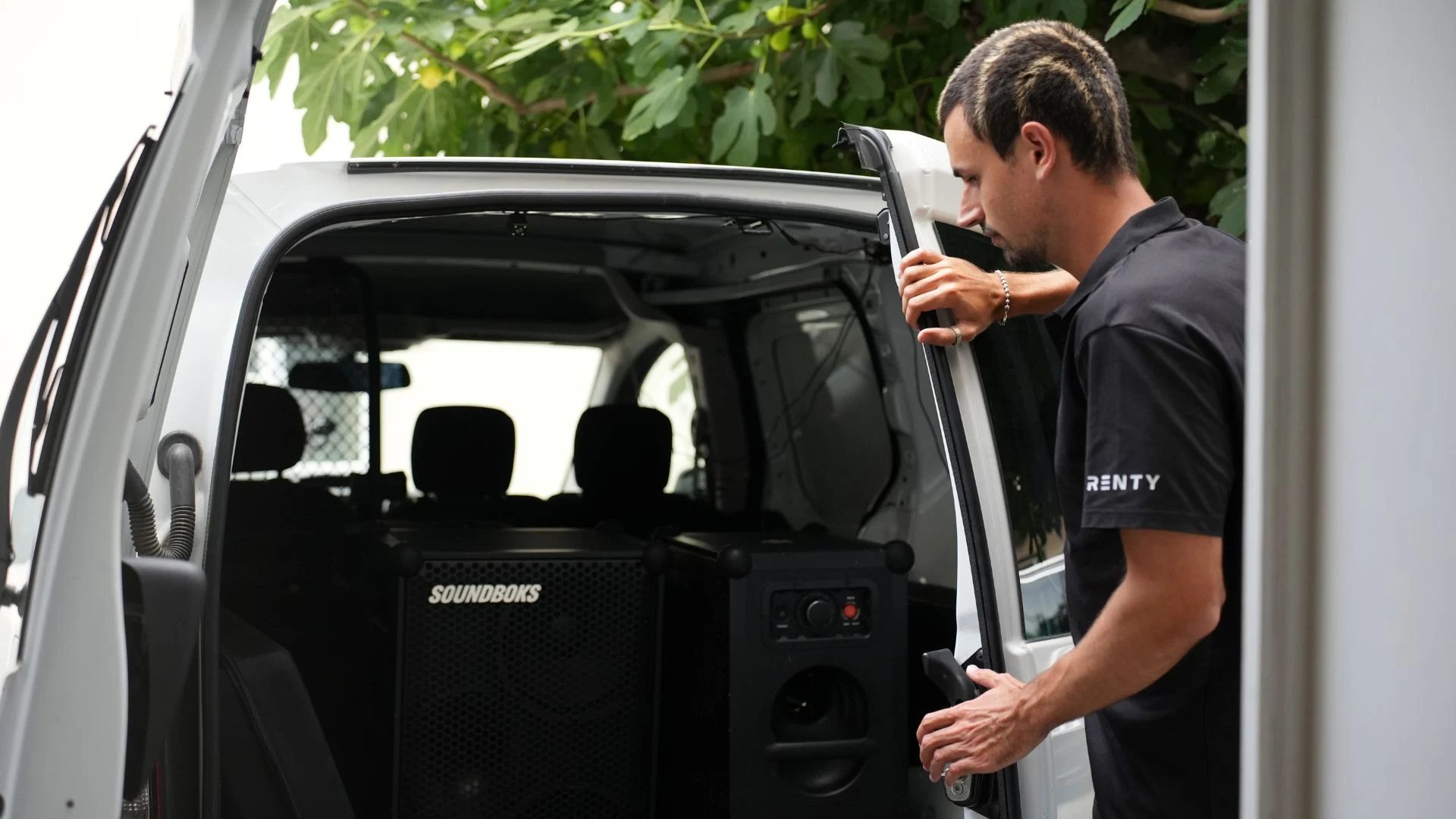
We set up the equipment on-site, handle the cabling, configure the sound and lighting, and dismantle everything after the event. You receive a fully configured system ready to go.

A technician stays on-site during the event, responds to changes in the schedule, and handles the teardown afterward. The safest option for speeches and presentations.
Enter your city and date in the catalog above to see what is available.
Select your equipment and set the rental days; the price is displayed immediately.
Book online, with no deposit and no need for email inquiries.
Pick up with a briefing or have it delivered and set up for you.
Describe your event and we will suggest the right equipment for you. Our consultation is free of charge.
Available daily from 8:00 AM to 10:00 PM.
How much does it cost to rent a pavilion?
How many people fit under a pavilion?
How long does it take to set up a pavilion?
At what wind speed must a pavilion be taken down?
Are side walls and fastening materials included?
Does a pavilion fit in a car?
What is the difference between a pavilion and a party tent?
Is a pavilion waterproof?
A folding pavilion is a freestanding tent with a steel scissor frame, a roof, and removable side walls. It can be set up without tools or electricity, and after the event, it packs away into its bag just as quickly. Renty offers it in two sizes: 3 x 3 m with 9 m² for a booth, a buffet, or a small group, and 3 x 6 m with 18 m² for up to 50 standing guests, both with or without side walls.
The catalog will show you which pavilions are available in your area once you enter your city. At each of our 28 locations in Germany and Austria, you will have a dedicated contact person who will provide you with instructions during handover. Pickup is free of charge; delivery with setup costs €59 per started hour of work.
Renting is especially worthwhile if you only need a pavilion for a few dates a year: you don't need storage space, you don't have to worry about repairs, and all-risk insurance is included. It's best to book early for summer weekends, as each pavilion can only be rented out once per date.
There are limits to consider. In winds around 30 km/h, any pavilion should be taken down. If you need to accommodate more than about 50 guests under one roof or have more than 20 people sitting at tables, a party tent is the better choice.
Renty offers folding pavilions in two sizes: 3 x 3 m (9 m²) and 3 x 6 m (18 m²). How many people fit underneath depends on whether they are standing, sitting, or using it as a station. A 3 x 3 m pavilion is sufficient for 20 people standing, but if they need to sit, choose the 3 x 6 m model. For more precise planning, use our space requirement calculator, which also accounts for buffets and walkways.
If everyone crowds under the roof during a rain shower, a 3 x 3 m pavilion can hold 15-25 people, and a 3 x 6 m pavilion can hold 30-50. For an entire evening, the space requirement calculator plans for 2 people per m², which is about 18 and 36 people respectively.
With high tables, 6-9 people fit comfortably under a 3 x 3 m pavilion and 12-18 under a 3 x 6 m one, based on 1-1.5 m² per person. If placed more closely, you can fit 10-15 and 20-30 people, which is typical for a champagne reception after a wedding ceremony.
At tables with benches, 10-12 people can sit comfortably in a 3 x 3 m space, and 20-24 in a 3 x 6 m space. For a dinner with chairs, our space requirement calculator estimates 1.5-2 m² per person, allowing for 4-6 and 9-12 seats respectively.
When using the pavilion for a stand, buffet, bar, or DJ booth, the number of guests is not the primary factor. Visitors stay outside, while the pavilion protects your goods, food, and equipment. Under a 3 x 6 m pavilion, you can fit a buffet and drinks side by side.
Both sizes stand on a steel scissor frame; the 3 x 3 m model has four legs, and the 3 x 6 m model has six. These values are based on product data and manufacturer specifications for our rental models and may vary slightly depending on the specific version.
Adults can stand upright under the roof, and by using the highest leg setting, you gain extra space for high tables and decorations. Since the 3 x 6 m pavilion weighs nearly 40 kg, it is best carried by two people.
A pavilion doesn't require electricity. If you need power for music or lighting and there is no outlet nearby, a power station is a great option. Route cables so that no one trips over them, and only use cords rated for outdoor use.
Wind load: The pavilion must be taken down in winds of around 30 km/h (approx. Beaufort scale 5) or if there is a severe weather warning, even if it is well-weighted. A folding pavilion is lightweight and offers a large surface area to the wind—a 3 x 6 m model has twice the surface area of a 3 x 3 m one. Check the weather forecast for gusts the day before, not just the average wind speed, and secure every leg, even in calm weather.
You can attach the walls individually and remove them just as easily. When open, the pavilion provides shade; a wall on the windward side blocks drafts, and when fully enclosed, your buffet and equipment stay dry in the rain. On the 3 x 6 m pavilion, one wall features a zippered entrance.
On grass, tent pegs keep the legs in the ground. After heavy rain, the ground becomes soft, so sandbags should be added.
Stakes won't hold on hard ground. In that case, weigh down each leg with a sandbag—four for a 3 x 3 m model, six for a 3 x 6 m model.
The roof is waterproof. In the event of continuous rain, water may collect on the canopy, so check it periodically. The pavilion must be returned dry or aired out, otherwise, it will develop mildew stains.
A pavilion can be set up on almost any level surface, whether it's grass, pavement, asphalt, or gravel. It can be set up without tools—a 3 x 3 m model takes two people, while a 3 x 6 m model is best handled by three—in the following order:
If you don't want to set it up yourself, you can book delivery, setup, and teardown. A service technician will bring the pavilion, set it up, secure it, and take it down after the event for €59 per hour or part thereof.
Calculate how much space you need for seating, tables, a buffet, and walkways under the canopy.
Inflatable party tents and star tents for celebrations where you want all your guests under one roof.
When a celebration on public property requires a permit and how the application process works.
All categories of event equipment, from pavilions to stages: Event equipment
Find the right pavilion to rent in your city

Wir haben dir eine Mail geschickt, bitte bestätige sie um den Rabattcode zu erhalten.