


Renty rents out tripod screens, folding frame screens, and outdoor screens from 90 to 183 inches starting at €29.90 per day. You can book online and pick up for free, or have the screen delivered and set up for you. You can see which screens are available for your date directly in our catalog.

When thinking about a projection, the projector usually comes to mind first. However, it is the surface that determines how large the image actually is in the end. The projector throws the image as large as the distance and lens allow, but the screen determines how much of that image is clearly displayed: its border frames the image, its fabric reflects the light evenly, and the black frame enhances image quality by making contrasts appear sharper. That is why size comes first: renting a screen means defining the image width from the start.
This is why planning begins with the screen. Our rental selection ranges from 90 inches to 183 inches diagonal, all in a 16:9 aspect ratio. Each comes with a tripod or aluminum frame, a bag, and instructions; everything fits into a standard car. Only the motorized high-contrast screen requires power.



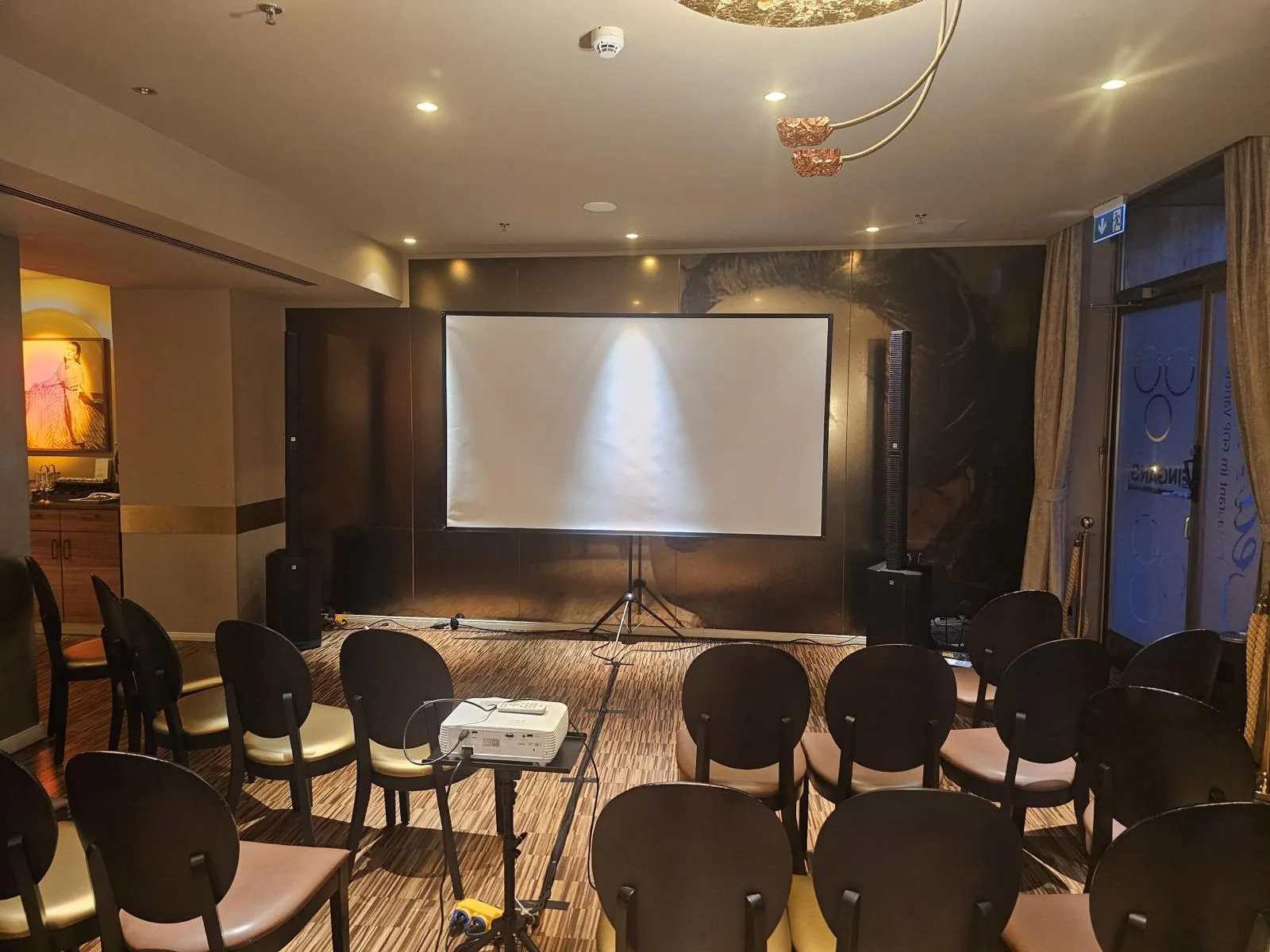
Three questions are all it takes to determine which design suits your event's audience, lighting, and setup. The selection in our catalog will then show you which screens are available for your date.
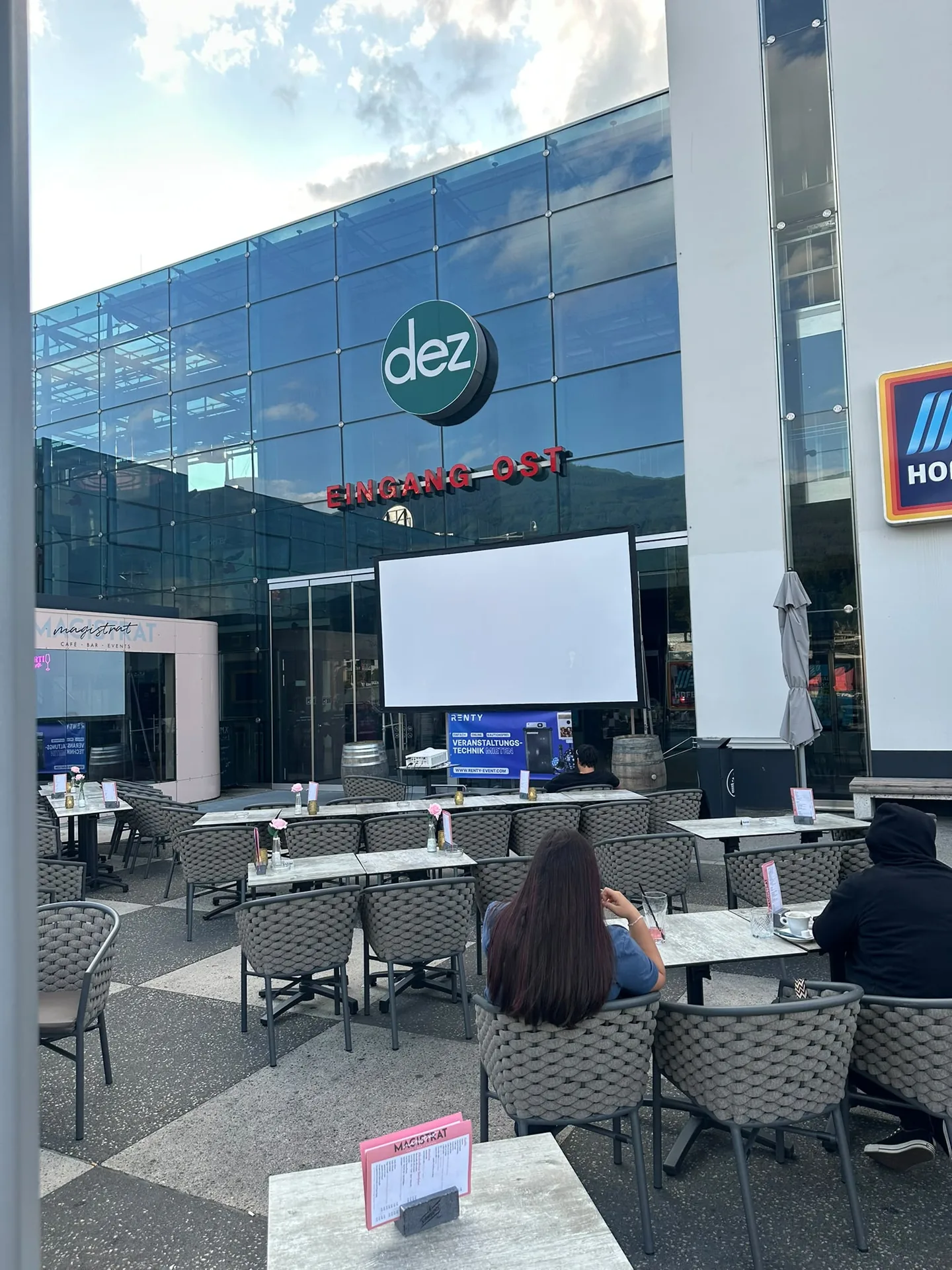
Public viewing is the most common reason to set up a screen outdoors. Outside, wind is the primary concern: a stretched fabric acts like a sail. According to the manufacturer, the weather-resistant outdoor screen can withstand winds of up to 30 km/h and is secured with guy ropes and ground pegs. For a tripod screen, set it up in a wind-protected area, such as in front of a house wall.
The second point is light. Before dusk, any image will look washed out, no matter how bright the projector is. Therefore, plan your kickoff or film start for after sunset. You can find an overview of how to arrange seating, image, and sound for a group viewing in our Public Viewing guide.
The more people watching, the higher the top edge needs to be. According to the manufacturer, the 183-inch frame screen remains legible from up to about 25 meters away. Our guide on screens in the garden explains how to set up a screen safely outdoors.
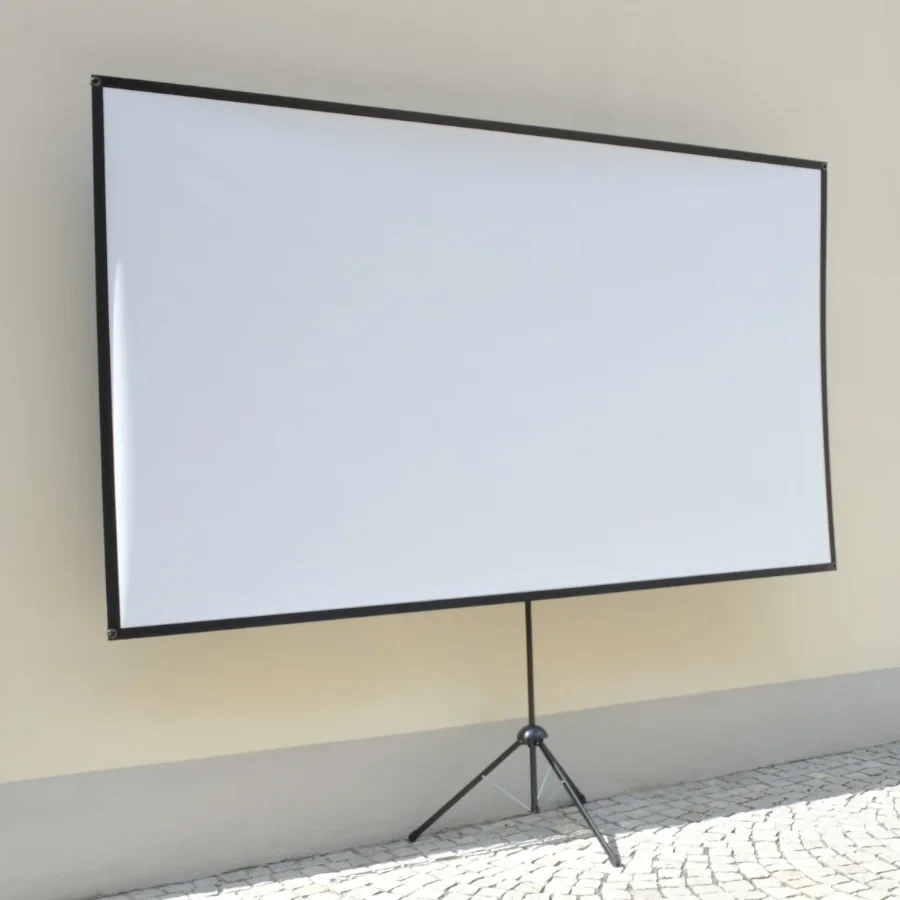
Positioning the screen in front of a house wall protects it from the wind. The movie night begins as soon as dusk falls.
Choosing between a tripod screen and a frame screen is the first decision. It depends less on the image and more on the setup. A tripod screen stands on its own in minutes, with the fabric rolling up out of the casing. A frame screen takes longer: the aluminum frame is assembled, and then you stretch the fabric using the surrounding snap fasteners. In return, the fabric is stretched perfectly flat, without waves or creases. The largest sizes are only available in this design.
In short: use a tripod screen for mobile appointments, and a frame screen for stages, galas, or large audiences where image quality is paramount. Use the outdoor screen for open-air events, the high-contrast screen in daylight, and the rear projection screen for trade fair booths. More equipment can be found under Media Technology; if you need both a screen and a projector, choose the projector and screen set.
Renting a screen starts at €29.90 per day. This applies to tripod screens from 90 to 120 inches. Folding frame and high-contrast screens are €39.90, rear projection screens are €49.90, and the large 183-inch surface is €79.90. From the second day onwards, you only pay 15% of the base price, so a three-day rental does not cost three times as much. The selection of models and prices can be found in the table.
The rental includes the tripod or aluminum frame, the carrying bag, and all-risk insurance. Self-collection is free of charge; our delivery service, including setup, dismantling, and on-site support, costs €59 per hour or part thereof. There is no security deposit. Furthermore, screen rentals can be processed without needing to send an inquiry via email.
| Leinwand | Bild | Standorte | 1 Tag | 3 Tage |
|---|---|---|---|---|
| Stativleinwand 120 Zoll |  | 28 Standorte | € 29,90 | € 38,87 |
| Stativleinwand 90 Zoll |  | 5 Standorte | € 29,90 | € 38,87 |
| Stativleinwand 100 Zoll |  | 1 Standort | € 29,90 | € 38,87 |
| Faltrahmen Leinwand 135 Zoll |  | 1 Standort | € 39,90 | € 51,87 |
| Faltrahmen Leinwand 183 Zoll |  | 1 Standort | € 79,90 | € 103,87 |
| Outdoor Leinwand 120 Zoll |  | 1 Standort | € 29,90 | € 38,87 |
| Hochkontrast Leinwand 100 Zoll |  | 1 Standort | € 39,90 | € 51,87 |
| Rückprojektion Falt-Rahmen-Leinwand 100 Zoll | 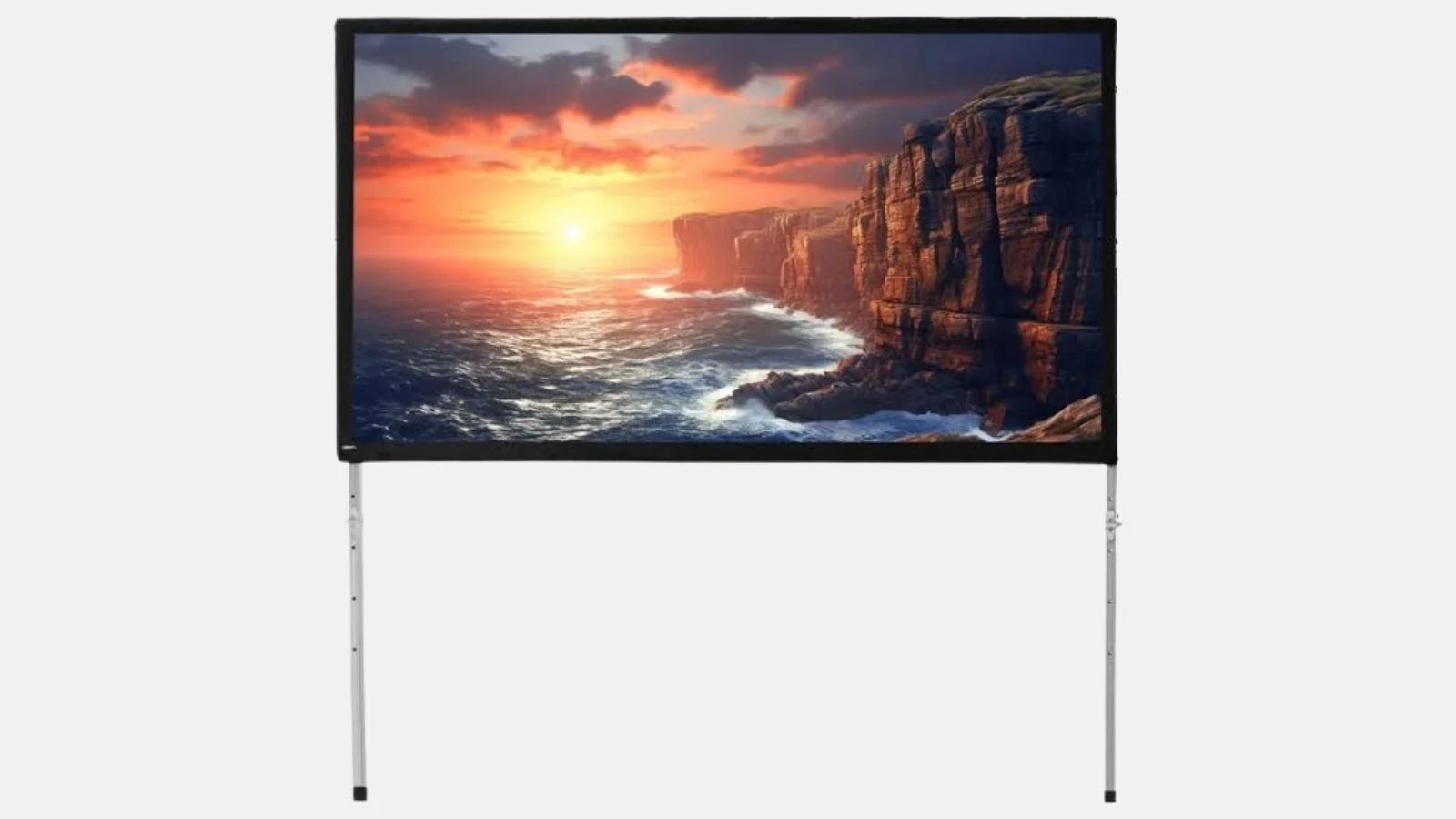 | 1 Standort | € 49,90 | € 64,87 |
You pick up the equipment from the location in your city and set it up yourself. Everything is prepared for plug-and-play, and there is a video tutorial for every device.

We bring the equipment to your venue and pick it up again after the event. You can handle the connection and setup yourself; every device is prepared for it.
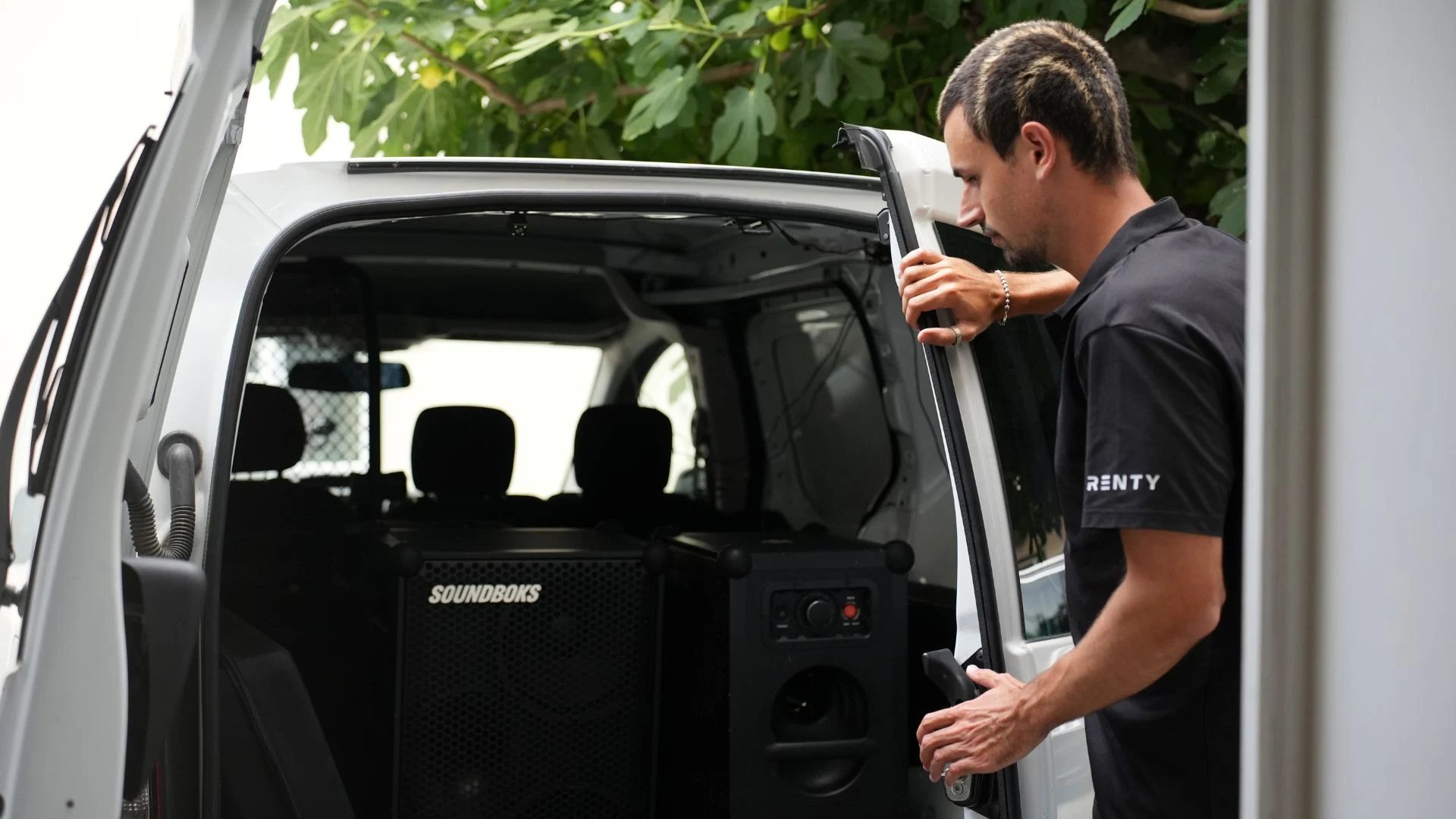
We set up the equipment on-site, handle the cabling, configure the sound and lighting, and dismantle everything after the event. You receive a fully configured system ready to go.

A technician stays on-site during the event, responds to changes in the schedule, and handles the teardown afterward. The safest option for speeches and presentations.
Enter your city and date in the catalog above to see what is available.
Select your equipment and set the rental days; the price is displayed immediately.
Book online, with no deposit and no need for email inquiries.
Pick up with a briefing or have it delivered and set up for you.
Describe your event and we will suggest the right equipment for you. Our consultation is free of charge.
Available daily from 8:00 AM to 10:00 PM.
How much does it cost to rent a screen?
What screen sizes are available for rent?
Which screen is suitable for outdoor public viewing?
How long does it take to set up a screen?
Does a screen work in a bright room?
Does a large screen fit in a standard car?
Is a projector included in the rental?
How do I find out if a screen is available in my city?
A rental screen can be brought in for an evening or a weekend, complete with a tripod or frame, carrying case, and setup instructions. You pay a daily rate, which includes insurance and a local contact person. You can see what is available for your date in the catalog; there is no need to send an email inquiry.
The rental process is quick: book the screen online, pick it up yourself for free or have it delivered, and return it after the event. There is no need for a deposit or an email inquiry. Our service also includes delivery, setup, and on-site support, which costs €59 per hour or part thereof.
Our screen rental service caters to both private and commercial customers. Companies rent screens for presentations, conferences, training sessions, press conferences, and trade fair booths; clubs for meetings and anniversaries; and private individuals for weddings, birthdays, film screenings, and movie nights. Large-format screens are typically used for public viewing and galas, while mobile screens are used wherever presentations take place at changing locations throughout the year.
Renting a screen is the same process at all 28 locations: enter your city, select a date, and book. The catalog will show you which screens are available at your location as soon as you enter your city. The 120-inch tripod screen is the most widely available, while special types like folding frames, rear projection, and high-contrast screens appear in the catalog once the location is confirmed.
For presentations, a readable image in ambient light is key; for film screenings, it's an evenly illuminated projection surface; and for outdoor group viewing, it's size and stability. That is why there are various designs and models rather than just one. Our event technology rental service also includes sound and lighting if needed, from microphones to lighting rigs.
The size should be based on the depth of the room and the number of viewers, not the budget. Choosing a screen that is too small means losing the back rows, while choosing one that is too large makes it impossible to set up properly in the space. Inches always refer to the diagonal, not the width.
For up to 30 people, a 90 or 100-inch screen is sufficient. The 90-inch model measures 200 × 110 cm and weighs 4.7 kg; it fits into any car trunk along with its carrying bag. The manufacturer suggests a seating distance of 4 to 6 meters.
The 120-inch tripod screen, measuring 265 × 150 cm, is built for 30 to 100 people. Its fabric has a manufacturer-rated gain of 1.5 and a 160-degree viewing angle, ensuring the image remains bright even from side seats. It is intended for rooms up to 80 m².
For audiences of 100 or more, image height is key. The 183-inch folding frame screen measures 405 × 228 cm and remains legible up to about 25 meters according to the manufacturer; it is intended for 50 to 300 people.
Set the bottom edge high enough so that it is above the heads of the first row. Otherwise, the last row will not see the bottom part of the image. This is exactly where footers and chart labels are located during presentations. Both the tripod and the frame are height-adjustable.
Inches always refer to the diagonal. In 16:9 format, 120 inches becomes about 265 cm in image width, and 183 inches becomes about 405 cm. For planning purposes, dimensions in centimeters are more important, as they determine whether the screen will fit between a window and a door. All our rental screens have a 16:9 aspect ratio, which is ideal for laptops, streaming, and cameras. You only need the older 4:3 format if your slides were created in that ratio.
There are two rules of thumb in projection technology for seating arrangements: the last row should be no more than six times the height of the image away, and the image diagonal should be about one-third of the viewing distance. Both lead to the same values for our screens as shown in the table: the 120-inch model is 150 cm high, six times that is 9 meters, and the manufacturer suggests around 10.
The distance of the projector depends on the image width and the lens. As a rough guide: a standard device for a 265 cm wide image should be placed about 4 meters in front of the screen, while a short-throw device can be placed much closer. The projector distance calculator calculates the required distance for any image width. If the distance is not correct, the image will be smaller than the screen, but it will remain sharp.
A screen is quick to set up. Whether the final image is impressive depends on the light in the room, the stability of the surface, and how the screen is handled.
Every screen can handle ambient daylight from the side, but not direct sunlight on the surface. Close the curtains or turn the screen so its back faces the window. If the room cannot be darkened at all, the high-contrast screen is designed to filter out over 80 percent of ambient light.
Indoors, a tripod is stable as long as there are no cables in the way. Outdoors, the surface catches wind like a sail. According to the manufacturer, the outdoor screen can withstand winds up to 30 km/h when properly anchored; all other screens should be placed in a wind-protected area.
The gain factor describes how strongly a screen reflects light. 1.0 is neutral; the PVC fabric of the 120-inch model has a manufacturer-rated gain of 1.5, making it appear brighter while still providing a uniform image for guests seated to the side. Do not fold the screen or touch it with your hands, as grease marks will remain visible. Always use the included bag for transport. Small wrinkles in a tripod screen will smooth out on their own after half an hour of being set up.
Screens do not require power, with the exception of motorized high-contrast screens. Plan for a power outlet for the projector; if you are outdoors without a connection, a power station will handle the supply.
A surface needs a projector. Both must be compatible, which depends on three factors:
Booking both together saves you the math: in our projector and screen set, the device and surface are already perfectly matched. If you are bringing your own projector, check the distance beforehand using the projector distance calculator.
Inflatable screens are not part of our range. They require a blower, a constant power supply, and significantly more setup time, which doesn't fit a rental service where you can pick up the equipment yourself and set it up in an hour.
Calculate how far the projector needs to be from the surface for your desired image width.
Video and step-by-step instructions for the tripod, fabric, and height.
How image and sound come together based on audience size, from the signal chain to the speaker.
All media categories at a glance: Media Technology
Find the right screen to rent at your location

Wir haben dir eine Mail geschickt, bitte bestätige sie um den Rabattcode zu erhalten.


