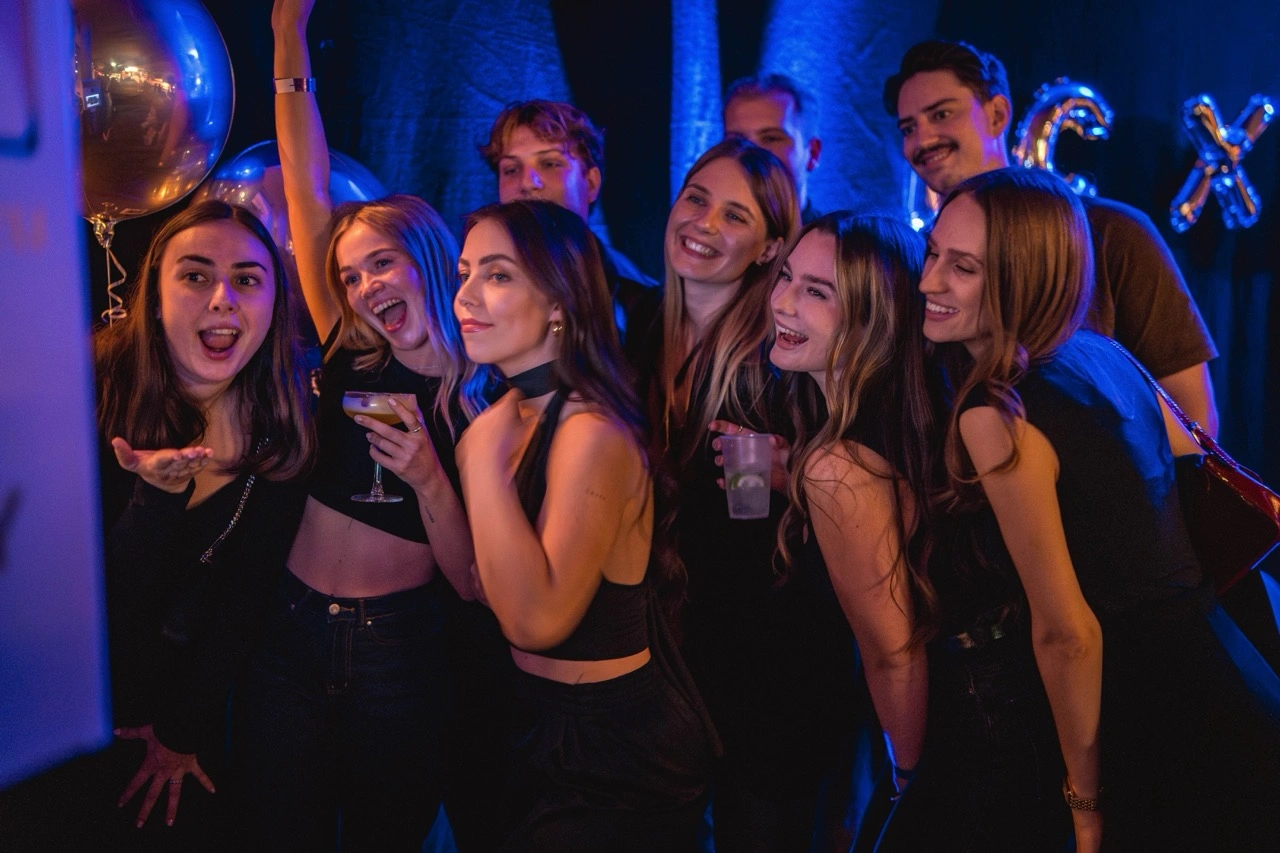
A public viewing event rests on three pillars: legal classification, noise protection, and lag-free transmission. As soon as access is not restricted to personally invited guests, the event is considered public, which triggers licensing requirements and permits. This guide shows which framework suits which guest count, why satellite is preferable to streaming, and how to size your projector, screen, and sound system.

At a glance
A public viewing event rests on three pillars: legal classification, noise protection, and lag-free transmission. As soon as access is not restricted to personally invited guests, the event is considered public, which triggers licensing requirements and permits. Technically, the signal source is the deciding factor: satellite or cable provides a live picture, while an internet stream arrives seconds later.
Public viewing refers to watching a sporting event together on a screen or large display in front of an audience. The term became established in German-speaking countries during the 2006 World Cup in Germany, when fan zones in Berlin, Frankfurt, and other cities attracted millions of people. It does not refer to a quiet evening of watching TV with a friend, but rather to a public broadcast for a group.
That very word contains the entire legal distinction. As soon as a broadcast becomes public, rights and obligations apply that are not relevant for a private gathering. The next section clarifies where this line is drawn and what the consequences are.

The location determines almost everything else: the effort required for permits, the necessary technology, and how strictly noise regulations apply. These four scenarios cover most projects.
| Framework | Typical size | Permit requirements | Technical essentials |
|---|---|---|---|
| 🏡 Private garden | up to about 30 guests | low, as long as it is private and before 10 p.m. | a projector and two active speakers are usually sufficient |
| 🏛️ Club house | 30-150 guests | medium, public as soon as non-members attend | sightlines in the room and clear audio |
| 🍺 Beer garden | 30-200 guests | high, commercial and outdoors | multiple screens instead of one projector screen |
| 🎪 Square or meadow | 200+ guests | high, with safety concept | high-brightness projector, power and weather protection |
The larger and more public the event, the sooner you should speak with the local authorities.
A practical rule of thumb: for up to about 30 people in your own garden, a public viewing is a matter of technology. Beyond that size, it also becomes a matter of formalities, which require more lead time than the setup itself.
The classification determines everything else. Private is an event where you personally invite a closed group of people, do not charge admission, do not involve sponsors, and do not advertise publicly. Public is when you invite people via social media or posters, charge admission or require a minimum spend, involve sponsors, or have a commercial interest behind it.
If the event is public, three levels come into play: the license from the rights holder for the broadcast, registration with GEMA in Germany or AKM in Austria for the music, and, depending on the location and size, a permit from the local authority. These three are independent of each other; one does not replace the other. You can find information on the fees involved, the applicable deadlines, and where the line is drawn for commercial events in our guide to licenses and costs for public viewing.
No legal advice
This article provides an overview. The legal situation changes, and every individual case is different. When in doubt, check with your local authority.
The point at which most public viewings fail is not the license, but the clock. Nighttime quiet hours begin at 10 p.m., and matches with late kick-offs regularly end after that. For tournaments outside of Europe, this shifts even further.
For a public event, this means contacting the local authority four to eight weeks in advance to apply for an exemption from nighttime quiet hours. For a private gathering in the garden, it means informing the neighbors in advance, setting up directional speakers instead of omnidirectional ones, and actively turning the volume down after 10 p.m. You can find the decibel levels, the application text, and concrete measures in our guide to music after 10 p.m. and exemptions from nighttime quiet hours, including a template for your neighbors.
The neighbor is cheering, but the ball is still rolling on your screen. This problem has a name, and it’s the most common reason why a public viewing loses its atmosphere.
Internet streams via smart TV apps, IPTV, or streaming sticks can lag behind the live signal by several tens of seconds, depending on the provider and connection. Satellite and cable, on the other hand, are under a second. While you might not notice this during a quiet night in, it’s a different story with 50 guests in the garden: the neighborhood cheers before you do, phone notifications give away the goal, and the moment is ruined.
The recommendation is therefore clear: use satellite or cable as your primary source, and streaming only as a fallback. If you have no other choice, warn your guests in advance and have them put their phones away during the match.
| Module | What matters | Guidance |
|---|---|---|
| 📽️ Projector | Brightness in ANSI lumens | from about 3,000 for games after sunset, significantly more if there is ambient light |
| 🎬 Screen | matte instead of glossy | screen diagonal of around 100-150 inches for 50 people |
| 🔊 Sound | two active speakers instead of projector speakers | directional output so the commentator remains clear |
| 🔌 Power | plan for a reserve | at least 3 kW for the projector, sound, and accessories |
| 🔗 Cables | Measure the length beforehand | use active HDMI cables or extenders for distances over 15 m |
No portable projector can compete with full daylight. In that case, you'll need shade or a later kick-off time.
You can calculate the space you need for your number of guests in advance using the space requirements calculator. For setups of up to about 50 people, including sample wiring, the technical guide to projectors, sound, and cabling goes into detail.

For bars, beer gardens, and restaurants, match days are a great opportunity to fill otherwise quiet evenings. A TV behind the bar is fine as long as you don't advertise it and don't charge admission. As soon as you actively promote a public viewing event, set up a screen and sound system in an outdoor area, or involve sponsors, the rules for public events apply.
Three things stand out in practice: several medium-sized screens almost always work better than one large screen that can only be seen from three tables. The sound must be evenly distributed so that everyone can understand the commentator without any one area being too loud. And outdoors, you have to deal with wind, reflections, and noise control—exactly the factors that don't matter indoors. Always keep escape routes clear, even when the house is full.
| Mistake | What happens | The solution |
|---|---|---|
| Missing cables and adapters | HDMI cable too short, receiver and projector are incompatible | Set up and test the entire system one day in advance |
| Streaming only instead of satellite | Picture lag, goals are spoiled | Use satellite or cable as the primary source, streaming as a backup |
| Projector not powerful enough | Picture barely visible in ambient light | Choose lumens based on kick-off time, always use a matte screen |
| Forgetting licenses | Authorities shut down event, back payments loom | 4-6 weeks lead time for licenses, music rights (GEMA/AKM), and local permits |
| Noise protection ignored | Complaints and shutdown in the middle of extra time | Inform neighbors, use directional speakers, obtain permits for after 10 PM |
| Step | What to do |
|---|---|
| 1. Define the scope | Estimate guest numbers with a buffer, define target audience and matches |
| 2. Check legal requirements | Determine if private or public, then clarify licenses, music rights (GEMA/AKM), and local permits |
| 3. Choose a location | Check sightlines, power supply, weather protection, and emergency exits |
| 4. Plan the technology | Select screen size and projector brightness suitable for kickoff time |
| 5. Secure the signal | Arrange satellite or cable, gather cables and adapters in advance |
| 6. Sound and neighborhood | Size the sound system, position it directionally, inform neighbors |
| 7. Catering and logistics | Calculating drinks, organizing entry, and having a Plan B for rain and power outages |
For the latter, our drink calculator helps by breaking down quantities based on the number of guests and the duration of the event.

Once legal, noise, and technical requirements are sorted, the rest is just organization. You can find the right equipment for public viewing at Renty—no deposit required, fully insured, and including video tutorials for setup.
What does public viewing mean?
Do I need a license for a public viewing event in my garden?
How early should I start planning?
Why does an internet stream lag behind television?
How many lumens does a projector need for public viewing?
What insurance do I need for a public viewing event?
Check event equipment, book in 90 seconds, and choose pickup or delivery. Deposit-free and insured throughout Germany and Austria.

Wir haben dir eine Mail geschickt, bitte bestätige sie um den Rabattcode zu erhalten.