A Christmas quiz needs four to five rounds of six questions each, mixed teams, and a maximum of one hour. The mix is key: general knowledge, movies, music, true or false, and a round for estimation so that those who haven't memorized facts can also win. Below are 40 questions with answers, sorted by round and ready to use.

A Christmas quiz needs four to five rounds of six questions each, mixed teams, and a maximum of one hour. The mix is key: general knowledge, movies, music, true or false, and a round for estimation so that those who haven't memorized facts can also win.
Below are 40 questions with answers, sorted by round and ready to use. The first ten can be played immediately, and the remaining thirty serve as a catalog for the party. Plus, what is missing in most question collections: a scoring system, the flow, and the four things that reliably cause a quiz to fail.
Ten questions covering traditions, music, and film, each with three possible answers. The solution is below and remains hidden until clicked. Anyone who gets eight or more right should probably host the party instead of playing.
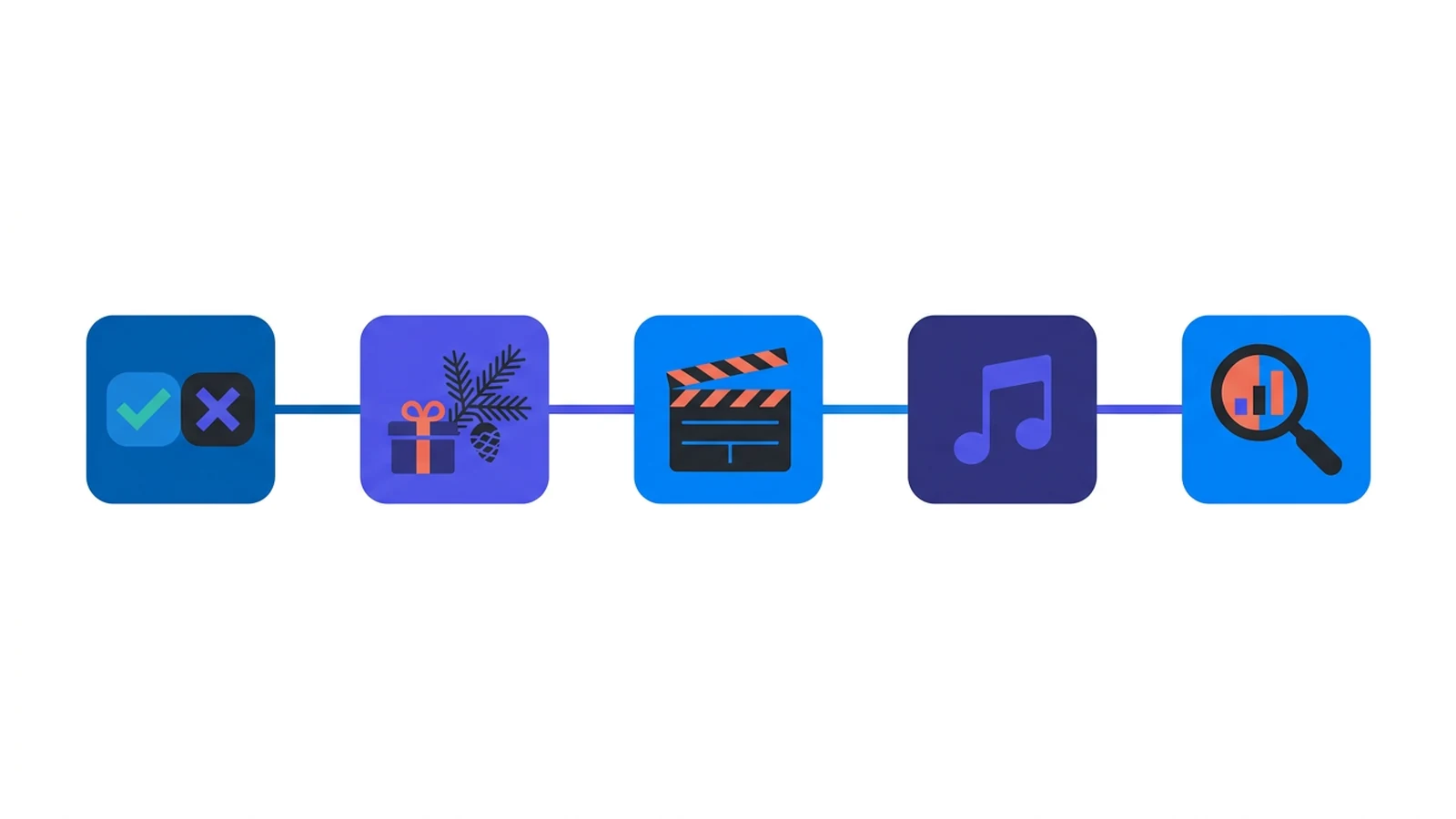
Five types, in this order: true or false to warm up, traditions and countries for the knowledge section, then movies and music as the two rounds that generate the most laughter, and finally, estimation questions. If you only ask knowledge questions, you’ll lose half the room after twenty minutes.
The following 30 questions are sorted according to this pattern. Each round works on its own, so you don't have to play all five.
Four to five rounds of six questions each, for a total of 24-30 questions, taking 45-60 minutes. This is the length at which a quiz is still seen as a highlight rather than a chore.
Plan for about 90 seconds per question. That sounds like a lot, but it covers reading aloud, asking follow-up questions, discussing at the table, and writing down the answer. Between rounds, allow an extra three to four minutes for swapping answer sheets and checking the current standings. If you start with thirty questions and notice the mood is great, just add a fifth round. Conversely, you can skip a round without explanation if things start to drag, and no one will notice.
Teams of four to six people are the ideal size. With only two, there’s no real discussion; with more than eight, the same two people always do all the talking. If you have more than ten teams, scoring takes longer than playing, so it’s better to have teams grade each other’s answers after every round.
One point per correct answer, no point deductions, and after each round, tables swap answer sheets and grade each other. This saves you from having to do all the scoring at the end and, incidentally, creates the best moments of the evening.
For estimation questions, the closest guess wins, not the exact number. In the event of a tie, a single tie-breaker question—which no one knows in advance—decides the winner. It should be an estimation question to avoid further debate. If you’re playing alone, you can test yourself against the 40 questions in this article:
When it comes to prizes, the rule is: small, visible, and a bit silly beats expensive. A traveling trophy that sits on the winning team’s desk for a year will be a topic of conversation again next December. A gift card just disappears into a drawer.
After the main course, not before. This is the only moment in the evening when everyone is full, awake, and at their seats at the same time. Before that, half the people are still arriving; after that, they’re deep in conversation and won’t get up for anything.
The quiz should be hosted by someone who knows the flow and has read the questions out loud beforehand. This is rarely the CEO, because hosting and playing are mutually exclusive. Teams should be mixed up, which is easiest to do via the seating arrangement: whoever is sitting at the same table forms a team, and the tables should be pre-mixed.
The point where a company quiz most often falls apart isn't the choice of questions, but audibility. With about thirty people in a room with music and clattering dishes, the back half of the room won't hear the questions, they'll start asking for repeats, and the round will fall apart. A handheld microphone solves this problem completely, and a second one for heckling and announcing answers makes it even better. You can find out which types are suitable and the difference between wireless and wired in our overview of microphones for events. Based on Renty's experience: people request two microphones for quiz rounds more often than one, and always only after the first party without them.
If the quiz isn't meant to be the entire evening, add something short before or after it. You can find a selection, including duration and materials, in our overview of games for the Christmas party.
Not the ones everyone is supposed to laugh at, but the ones where half the room is certain of the answer and still gets it wrong. The laughter comes from the contradiction at the table, not from the punchline of the question.
Three from the catalog above work reliably for this reason: that Coca-Cola didn't invent the red Santa Claus, that December 24th is not a public holiday, and that the Bible doesn't name a single one of the Wise Men. With all three, at least one person at the table will be completely convinced of the opposite, and that’s exactly when it gets loud. If you’re looking for funny questions, you’re actually looking for questions that contain a common misconception.
What rarely works, however, are jokes without a correct answer and anything at the expense of someone present. The difference is simple: the whole group laughs along at a misconception, but they laugh *at* someone when it’s directed at a person.
Four things, and none of them have to do with the questions. They occur with this frequency and can all be prevented in advance.
Then there’s the classic that can’t be put on a card: the quiz that schedules a sixth round even though half the room was already on their way to the bar during the fifth. A quiz should end while it’s still fun, not when you run out of questions.
For children, make the questions shorter and the answer options visible; for seniors, the main changes are the pace and the choice of decades. The question catalog itself can be adapted in both directions without having to rewrite it.
For children, images work better than text, three answer options are better than open-ended questions, and movement is better than sitting: instead of writing things down, everyone runs to the left or right wall. The film and music rounds work almost unchanged, but numbers and estimation questions are too abstract. Ten questions are the maximum.
For a round with seniors, the opposite applies: more time per question, larger font on the sheets, and music questions from the 1950s to 1970s instead of the nineties. True or false is the strongest round here because no one has to write anything down and everyone can guess along. Time pressure is avoided entirely.
Using the browser's print function, in two passes: once for the page as a whole for the quizmaster, and once for just the questions for the tables. The question blocks are set so that they do not break in the middle of a question when printed.
You don't need a questionnaire for the tables; a blank sheet with the team name and numbers 1-30 is enough. That is the whole trick behind the numbering: the answer sheet only contains the number and the answer, and it is corrected against the master list. One sheet per team, one pen, and you're done.
If the whole evening is still up in the air and the quiz is just one part of it, the Christmas party guide will help. If you are still working on the concept and wondering if it will even be a classic evening, you can find a comparison of formats under fifteen concepts for the Christmas party.
What kind of questions belong in a Christmas quiz?
How many questions does a Christmas quiz need?
How long does a Christmas quiz take?
How is a Christmas quiz scored?
How does a Christmas quiz work at a company party?
How can a Christmas quiz be adapted for children or seniors?
Check event equipment, book in 90 seconds, and choose pickup or delivery. Deposit-free and insured throughout Germany and Austria.

Wir haben dir eine Mail geschickt, bitte bestätige sie um den Rabattcode zu erhalten.