You can calculate the power requirements of a carnival float in two steps: add up the wattage of all devices, then multiply by the duration of the parade. The result in watt-hours determines the size of the power station. For most parades, this is a more practical choice than a gasoline generator because it runs quietly and produces no exhaust fumes.

To provide a reliable and safe power supply for a carnival float, use a guideline of approximately 1000 to 3000 watts of continuous power for smaller setups and 3000 to 6000 watts for large PA systems, including lighting and fog machines. Since loud and smelly gasoline generators are increasingly being banned at parades, emission-free and whisper-quiet power stations with modern, long-lasting LiFePO4 batteries are the best choice for mobile use. Models like the EcoFlow Delta Pro or the ECTIVE BlackBox deliver perfectly clean sine wave voltage for several hours without dangerous power spikes, actively protecting your valuable event equipment from costly damage to internal inverters or power amplifiers.
Ultimately, the power supply on your carnival float determines whether your booming sound, elaborate lighting, and thick fog will really last for three to five hours or if they will silently give up halfway through. In most cities, traditional gasoline generators are now viewed extremely critically or are banned entirely. Fortunately, if you are planning a new energy source today, a high-performance power station offers a reliable alternative that is readily accepted by all authorities and visitors at street parades. This guide provides a detailed look at which mobile power source works best for each scenario, what you need to consider regarding maximum output and total capacity, and how to reliably prevent short circuits on your float. You can find the broader context in our Carnival & Mardi Gras Guide.
Before you decide on a solution, calculate your requirements. This will save you frustration later if your float suddenly moves through the city in total silence.
The biggest power consumer is almost always the music. To see how much power different speakers draw and what really works on a float, check out our overview of speakers for carnival floats.
| Device | Typical Power | Continuous Operation |
|---|---|---|
Battery-powered PA (e.g., Soundboks) |
150-300 Watts | 4-5 hours |
Passive PA with amplifiers |
800-2500 Watts | 4-5 hours |
Fog machine (small) |
400-900 Watts | Intermittent |
LED lighting technology |
50-300 watts | 4-5 hours |
Wireless microphone & accessories |
10-50 watts | Continuous / Intermittent |
As a rule of thumb, plan for 1 to 3 kW of continuous power for medium setups, and 3 to 6 kW for larger rigs with lighting and fog machines. Your power source must provide this output stably, even during short load spikes caused by bass transients or equipment startup. The total weight of all components is often underestimated: a 5 kW generator can easily weigh 60 kg, plus fuel and soundproofing. A power station with similar output weighs around 45 kg and requires no fuel tank.
A standard 3 to 5 kW generator provides enough power for almost any setup.
Advantages:
Disadvantages:
If you stick with a generator, choose a model with AVR (Automatic Voltage Regulation) and a pure sine wave output. Simple units without a proper inverter risk damaging your amplifiers and mixing console. By the way, the noise issue is also a factor for the audience: a running generator next to the float will ruin the vibe, even if the PA system is powerful enough.
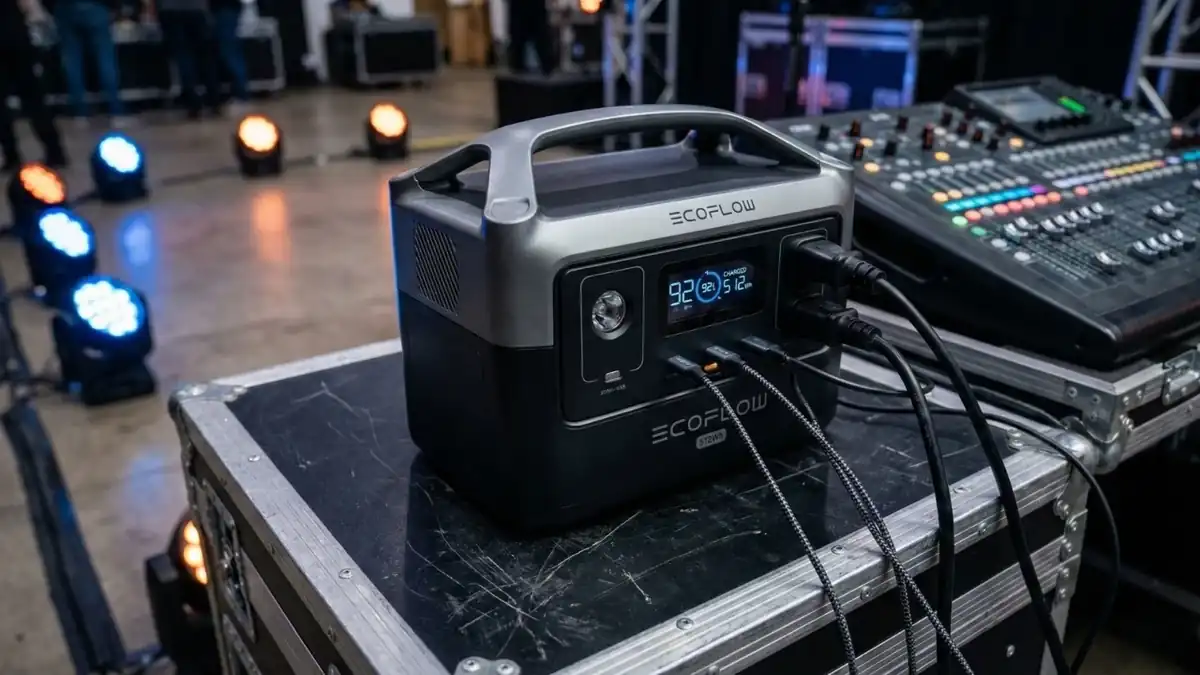
The power station has already replaced the classic generator on many floats. A power station is a mobile storage unit with large batteries and an integrated inverter that powers 230-volt devices. No noise, no exhaust, and stable voltage. Depending on the model, these powerhouses provide 1 to 7 kWh of storage, offering enough energy even for long parades. Larger storage models provide more capacity, while smaller units are easier to transport. For mobile power on a float, modern models are often the best power solution available in this size class.
Typical models on carnival floats:
For a float with a medium PA setup, an EcoFlow Delta Pro or a similarly sized model is usually enough for the entire parade. For larger setups, you can connect a second battery to double the stored energy. The main power station's storage remains the central unit, while the additional batteries simply expand the capacity.
| Criterion | Option 1: Gasoline generator | Option 2: Battery power station |
|---|---|---|
| Environment & Noise | Noise directly at the float Toxic exhaust fumes (often prohibited) | Completely silent Emission-free and permitted everywhere |
| Technology & Safety | Poor voltage can destroy DSPs High power in a compact space | Perfectly clean sine wave voltage Safe operation (LiFePO4) |
| Logistics & Runtime | Quickly refuelable on the go High weight (often >60 kg with gasoline) | Recharging takes time or solar power Lower weight without a fuel tank (approx. 45 kg) |
The third option uses the vehicle's existing onboard system: 12 volts from the vehicle, plus an auxiliary battery with a charger connected to the alternator. The vehicle's alternator provides a constant supply of energy while on the move, as long as the engine is running. This ensures a continuous 12-volt power supply in the vehicle.
When is a direct 12-volt setup worth it?
For 230-volt devices, you need a separate inverter to step up the 12 volts to 230 volts. When the vehicle is stationary and the alternator is not running, the battery level will drop quickly. 12 volts is usually not enough as a sole power source for several hours of sound and lighting. However, for mixed operation (power station plus 12 volts for small items), the 12-volt option is a good supplement that provides you with additional energy.
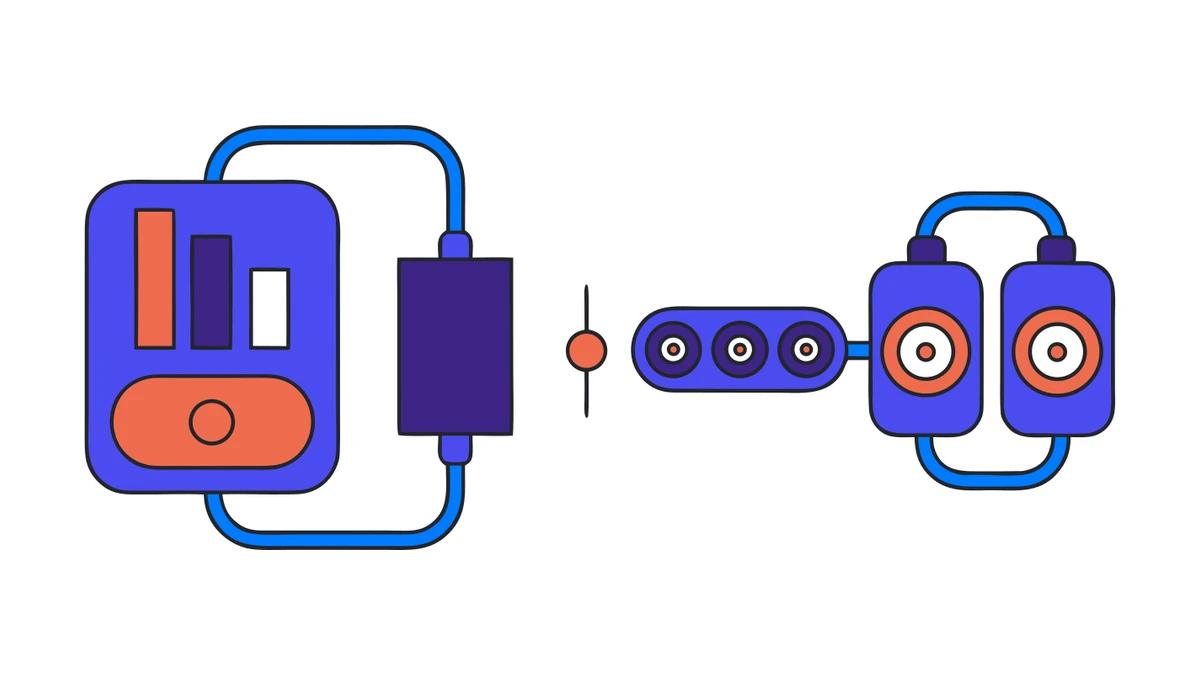
Two figures must be right when someone asks before buying or renting:
Power (watts) tells you what the power station can output at any one time. An EcoFlow Delta Pro with 3600 watts of continuous power is enough for a 2500-watt PA system plus lighting. For power spikes, the X-Boost mode helps up to 4500 watts. If you need more power, you can link two power stations or opt for larger models. For accessories like fog machines or additional lighting equipment, calculate the power separately.
Capacity (watt-hours) tells you how long the charge will last. A 3600 Wh station provides about two hours of power at a 1500-watt continuous load, and over seven hours at 500 watts.
Rule of thumb: Capacity (Wh) divided by continuous load (W) equals the runtime in hours. Include a buffer, roughly 20 percent for startup spikes and self-discharge. A little preparation helps when looking for the right model: measure the actual demand of all devices rather than just adding up the values on the nameplates. In practice, you almost never reach the full power of all devices combined. A short test phase before the actual event will show you whether the setup will truly hold up.
Modern power stations almost exclusively use LiFePO4 batteries. The difference compared to classic lithium-ion batteries concerns safety, weight, and longevity. LiFePO4 batteries are an evolution of classic lithium-ion batteries, featuring improved chemistry for stationary and mobile storage applications.
For annual carnival events, LiFePO4 batteries are the right choice. The batteries remain reliable even if the device sits in the basement for a year between events. The slightly higher weight of the LiFePO4 type is barely noticeable on a float, as the power station is in a fixed position anyway. Most manufacturers now use LiFePO4; old lithium-ion batteries are mainly found in older models or small power banks.
Regardless of the power source, a few basic rules are mandatory for protecting your equipment. Protection against short circuits, moisture, and overload go hand in hand.
Protection against vibration is also important. A rubber mat under the power station protects the housing and reduces the transmission of shocks to the battery cells. For longer distances, it is worth securing the mount with tension straps so that the weight does not shift when cornering. Protection against rain and splash water is particularly relevant on open carts: a transparent cover is often sufficient.
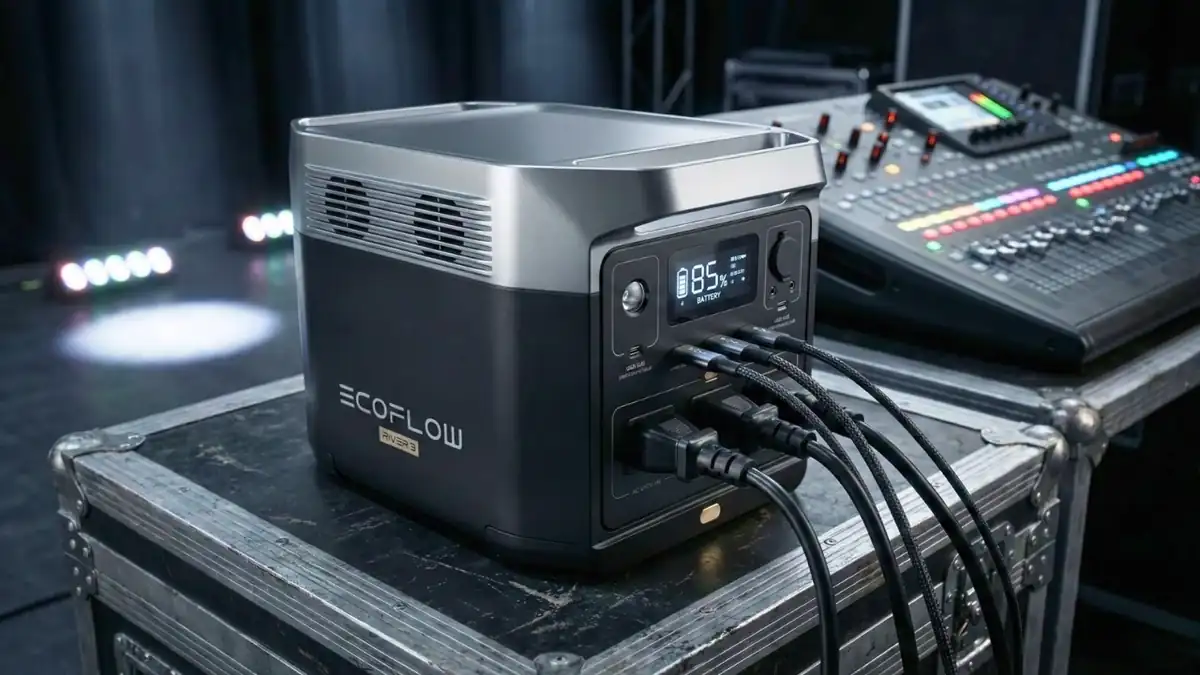
Modern power stations have many different outputs for all kinds of devices:
For larger setups, at least six sockets are recommended to avoid the need for additional power strips. The fewer distributors and power strips on the cart, the lower the risk of failure. A fixed arrangement of sockets around the power station makes cabling and quick changes during operation easier. It is better to connect small devices like smartphones, tablets, or Bluetooth speakers directly to the power station's USB-A ports rather than using an adapter for the 230-volt sockets. A separate USB port with fast charging is also helpful in everyday use. The variety of connections is just as important as the power output when choosing a power station, because the best solution is only as good as its connectivity options.
If you need more sockets, solar generators as a supplement, or additional USB ports, it is worth taking a look at the current model generation: new power stations often feature three to five USB ports, additional 12-volt connections, and some fast-charging technology via USB-C ports. A well-thought-out solution with appropriate 12-volt distribution in the vehicle rounds off the setup.
Before moving, the rule is: full charge. The EcoFlow Delta Pro charges to 80 percent in about an hour via a 230-volt socket; the last 20 percent takes about the same amount of time because the electronics throttle down to protect the batteries. This means: charge the day before, not at the last minute.
If multiple power units are in use, plan charging shifts overnight using separate sockets so that nothing is overloaded in parallel. Fast charging via pass-through (i.e., simultaneous operation and recharging) reduces battery life, so only use it in emergencies. When it comes to the ideal charging strategy, it is better to charge slowly and regularly than quickly and rarely. If you install a 12-volt charger in your vehicle before the season starts, you can recharge the power station on the go.
Solar generators combine a power station and solar panel into a single unit. For many users, a mini solar system is the ideal addition. During a carnival parade itself, solar power doesn't offer much (winter, low sun, little time on the route), but it is definitely worth it for the preparation. A 400-watt solar panel charges the power station between events, even without a wall outlet. Those who mount the solar panel permanently on their camper or the roof of their clubhouse have a small solar system that provides free energy throughout the year.
Especially when using the float multiple times in a row or for parallel use while traveling and camping, a solar panel provides a real boost to your available energy. Modern solar generators accept 200 to 800 watts of solar input, depending on the model. In cloudy weather, the yield drops significantly, often to below 30 percent of the summer value in winter. Most solar generators and solar systems can be connected using MC4 cables, and setup takes just a few minutes.
For annual use on a carnival float, renting is often more worthwhile than buying. At Renty, you can rent power stations without a deposit and with insurance included. This reduces the risk if the device happens to tip over on the float or a cable gets damaged during setup or teardown. If you don't have your own storage space, you also save yourself the hassle of storing it over the summer.
Buying is worth it if you also use the power station privately: for camping, in a motorhome or caravan, as emergency power at home, or while traveling. In that case, the investment pays for itself over several years, and having backup power at home is an added benefit. As an emergency power supply at home, the power station keeps your fridge, lighting, and communication running for one to two days during outages. For those who travel a lot or are frequently on the road in a camper, a solid power station is a solution that covers all your power needs at home and on the go for the entire year.
The most important manufacturers in the power station segment are EcoFlow, Anker, Bluetti, Jackery, ECTIVE, and Goal Zero. The major manufacturers cover the range from 500 Wh to 15 kWh, with each manufacturer having different strengths. Some focus on fast charging, while others prioritize long runtimes or modular expansion.
In the camping segment, German manufacturers like ECTIVE are strongly represented because they often have solutions specifically tailored to motorhome applications in their portfolio. Motorhome owners benefit from models with many 12-volt outputs and flexible solar connectivity. When it comes to motorhomes and travel, the mid-range segment with 1 to 3 kWh is often the best choice, while models with 3 kWh or more are better suited for carnival and professional events.
| Manufacturer | Typical models | Strength & focus area |
|---|---|---|
| EcoFlow | Delta 2, Delta Pro, Delta Pro 3 | Market-leading features: Fast charging and massive X-Boost mode for power surges. |
| ECTIVE | BlackBox 15, SBP 185, AccuBox | German manufacturer with a clear focus on robust camping and motorhome setups. |
| Anker | Solix F1500, F2000, F3800 | Very robust construction and an extremely high cycle count for years of continuous use. |
| Bluetti | AC200, AC300, AC500 | High modularity thanks to the simple connection of numerous additional batteries. |
| Jackery | Explorer 1500, 2000, 3000 Pro | Particularly beginner-friendly operation, ideal for private parties and travel. |
A power station is not just a solution for a parade. The same hardware serves well in many other areas.
The dual use as carnival technology and private emergency power supply makes a well-dimensioned power station a genuine investment. The annual usage is spread across parades, camping trips, garden wedding lighting, and home power outages. This gives you a power supply that is in use for several hundred hours each year, whether as a substitute for wall outlets on the go or as a power source for some light and music at a garden party.
The right accessories turn a power station into a flexible system. Most manufacturers offer suitable accessories directly, from solar panels and cables to special adapters for motorhomes and camping.
When it comes to solar generators, it is worth taking a look at the MPPT electronics inside the device. The better the MPPT controller, the more energy the solar panel will provide in low-light conditions. Solar generators with a modern MPPT controller can even make effective use of diffuse winter light.
A reliable power supply is the absolute heart of your carnival float. If you want to avoid the high purchase costs of a large battery, you can easily rent the right equipment for your parade. At Renty, you will find high-performance power stations tailored exactly to your energy needs.
► Rent a power station deposit-free now and have it delivered conveniently
How much power does a carnival float need?
Can I use a gasoline generator on the parade float?
How long does a power station last during a carnival parade?
Why are LiFePO4 batteries better for event power supplies?
How do I protect my power supply on the float from moisture?
Is it worth renting a power station for carnival?
Check event equipment, book in 90 seconds, and choose pickup or delivery. Deposit-free and insured throughout Germany and Austria.

Wir haben dir eine Mail geschickt, bitte bestätige sie um den Rabattcode zu erhalten.