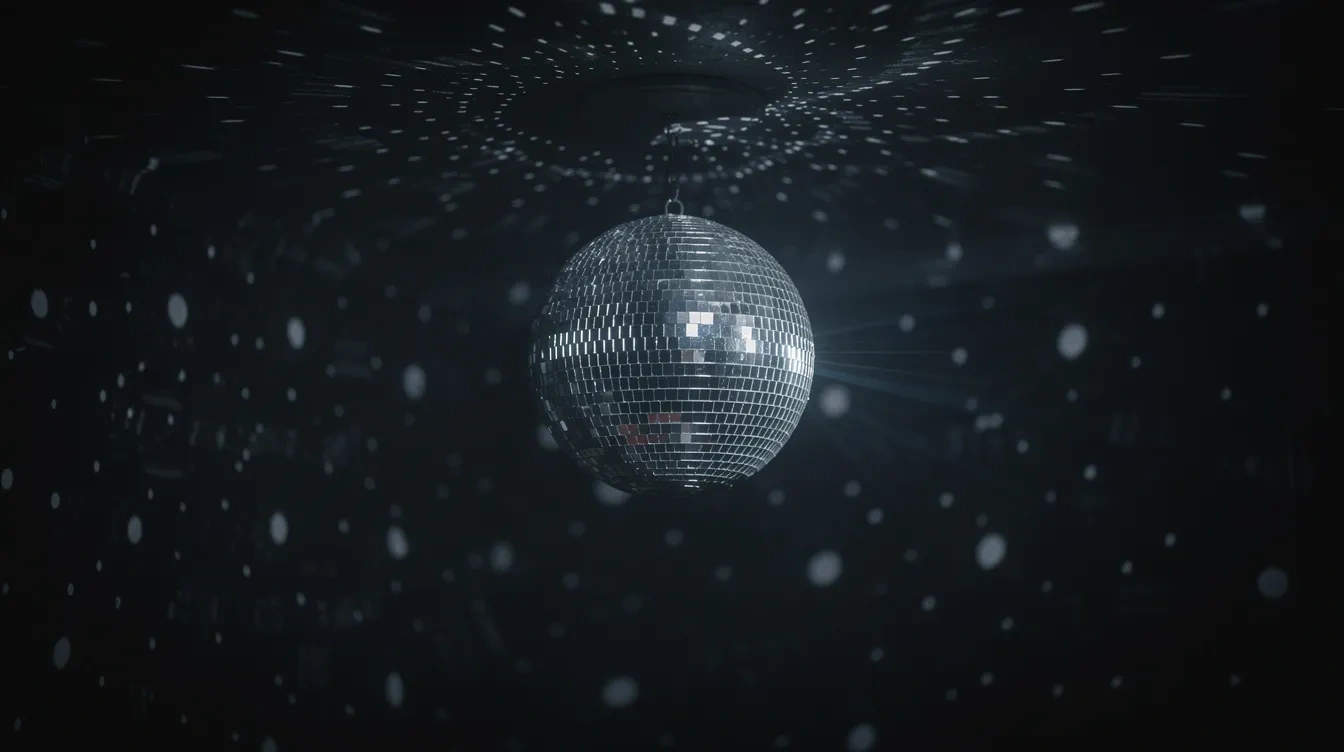
The right disco ball size depends on the room: 20-30 cm is enough for small rooms up to 20 m², 30-50 cm for living rooms and small event spaces, and 50 cm+ is club-ready. A classic mirror ball always requires an external spotlight and a motor, while an LED disco ball includes light and color changes. This guide shows you the size chart, technology comparison, safe installation, and when it pays to buy or rent.

A disco ball, also known as a mirror ball, is a sphere covered in hundreds of small mirror facets. When a beam of light hits the facets, it is scattered in all directions, creating the characteristic starry sky effect that has enchanted dance floors since the 1920s. In 2026, the disco ball is experiencing a true renaissance: not just as a party classic, but as a statement piece in home decor.
The key difference you should know: A classic mirror ball has no light source of its own; only an external spotlight creates the moving points of light. LED disco balls, on the other hand, have the light source and color-changing features integrated into one device. Which version suits you depends on the room, the occasion, and your requirements, and that is exactly what we will clarify step by step.
Disco balls come in diameters from 5 to 100 cm, ranging from tiny decorative spheres to impressive club installations. The right choice depends directly on where you plan to use it:
| Room size | Recommended diameter | Typical location |
|---|---|---|
| Up to 20 m² | 20-30 cm | Party basement, kids' room, small party |
| 20-50 m² | 30-50 cm | Living room, small event space, clubhouse |
| 50 m² and up | 50-100 cm | Hall, club, event venue |
As a rule of thumb: the effect should fill the room without overwhelming it. A practical tip from many events: several small spheres are often more flexible than one that is too large. Three 20 cm spheres in a 40 m² room create points of light from different angles and are much easier to mount than one heavy 50 cm sphere.

Construction and material directly influence the weight, stability, and lifespan of a disco ball. The three common core materials:
Quality features that make the difference: evenly glued mirror tiles without visible gaps, a robust suspension with a second safety eyelet (standard for spheres from 30 cm), and flame-retardant, B1-certified materials for event venues. Real glass facets reflect noticeably more brilliantly than plastic facets; the standard size is 10x10 mm, while finer 7x7 mm facets create a denser light pattern.
This is the most important technical decision. The classic mirror ball is a purely passive object; only an external spotlight creates the effect. LED balls integrate the light source and mirror effect into one device.
| Classic mirror ball | LED disco ball | |
|---|---|---|
| Light source | External spotlight required (pinspot ideal) | Integrated, often with color changing |
| Look | Authentic retro effect of the 70s/80s | Modern, colorful programs |
| Control | Full control over spotlight color and angle | Remote control, partial music control |
| Effort | Sphere + motor + spotlight as a system | Plug and play, ready to use immediately |
| Ideal for | Dance floor, hall, authentic light show | Spontaneous house parties, kids' disco |
For the full effect of the classic setup, aim a pinspot light at the sphere at an angle of about 30-45 degrees: this creates sharp, focused reflections that travel across the walls and ceiling. In a club, the mirror ball hangs above the dance floor and is illuminated by spotlights, whereas for a children's birthday party at home, a compact LED disco ball on a shelf is sufficient.
Sound-activated models: Many LED disco balls have a built-in microphone that translates the beats of the music into color changes and movement patterns—calmer for ballads, more intense for fast beats. This is perfect for kids' discos and club events because no manual control is required. A minor drawback: the microphone also reacts to background noise, and the programs are not very customizable.
You must always think of the mirror ball, rotating motor, and mounting as a single system. The motor rotates the ball slowly and continuously—about 1-3 revolutions per minute is typical—which is exactly what creates the moving points of light. Battery-operated motors can support small balls up to about 30 cm; for larger and heavier balls, you need a mains-powered motor with a clearly specified load capacity.
Mounting checklist:
For balls with a diameter of 50 cm or more: when in doubt, consult a professional for the installation; the weight and hanging height are no longer a DIY project.

Disco balls are long past being just party equipment. Under themes like "retro glamour," mirror elements are being used intentionally as accents in living spaces: a small mirror ball on a sideboard, as window decor where sunlight creates natural points of light without any motor or electricity, in a hanging setup above plants, or as a surprising statement piece in the hallway. For pure decoration, a static ball without a motor is perfectly fine.
The mirror ball also works wonderfully as a DIY project: mini balls with a 5 cm diameter can be strung together to create a sparkling garland for the balcony and garden, small gold or silver balls make great place card holders for wedding tables, and a retired ball can be turned into a hanging planter. If you are planning a disco ball as the centerpiece of a 70s or 80s party, you will find the perfect finishing touches in our guide to themed party ideas.
Whether it's worth owning your own disco ball depends on how often you'll use it:
Based on over 3,500 events per year, we’ve found that for one-off occasions like milestone birthdays, weddings, or company parties, the rented combination of ball, motor, and spot is almost always the more stress-free solution because the load capacity, safety features, and lighting angles are already perfectly coordinated. Our guide on themed party lighting and effects shows you how to combine the effect with other lighting ideas.
Proper care significantly extends its lifespan: clean glass facets only with a soft cloth and mild cleaner; avoid harsh chemicals. Regularly check the suspension, chain, and motor for a secure fit, especially in high-traffic areas. For longer periods of non-use, store the ball in a padded, dry place and re-glue any loose facets in good time.
What size disco ball do I need for 15 m²?
Do I always need a motor?
Is an LED disco ball bright enough for a party basement?
How high should the disco ball hang?
Silver or gold: which facets are better?
Can I use a disco ball outdoors?
Check event equipment, book in 90 seconds, and choose pickup or delivery. Deposit-free and insured throughout Germany and Austria.

Wir haben dir eine Mail geschickt, bitte bestätige sie um den Rabattcode zu erhalten.