At a festival, a power station covers your camp's power needs, while gasoline generators are often prohibited on large festival grounds in Germany and Austria. The key factor is capacity in watt-hours, not power output in watts. Here you will find the consumption calculation, the right size class for your camp, and what is actually allowed on the grounds.

Day 2 at the festival, 11 a.m. Your phone is dead, the beer in the cooler is warm, and the Soundboks from last night is completely out of juice. If you arrive at camp without a power plan, you'll spend the weekend making compromises. Power banks are enough for a day or two, but after that, you're out of luck. If you want to be self-sufficient for several days with power for smartphones, sound systems, lights, and coolers, you face the fundamental question: power station or generator?
The clear answer is: A power station is the only sensible and usually the only permitted solution. While traditional generators are strictly prohibited at almost all festival sites due to noise, toxic exhaust fumes, and fire hazards, modern power stations excel as a quiet, safe, and emission-free alternative for your camp. In this guide, you will learn in detail why mobile battery power stations have the edge, how to calculate your actual power requirements precisely, and which size class—from compact setups for smartphones to XXL solutions for coolers and sound systems—perfectly suits you and your crew.
Got your tickets? Don't let power stress ruin your second day. At Renty, you can rent power stations for festivals and camping, with no deposit required and delivery straight to your door.
Most campsites at large festivals have no power outlets, or only a few charging areas where 200 people crowd together in the evening. If you need more than just a single phone charging cable, you can't avoid having your own power source.
Everything that draws power at a typical festival camp:
A 20,000 mAh power bank helps with your smartphone, but it will be empty after just a few hours if you're running a Soundboks (30 to 80 watts continuous power) and a cooler (40 to 50 watts continuous power). If you really want to run your camp off-grid, you need more.
Pro tip: Use our power consumption calculator to check in under a minute whether your outlet or power station is enough for your event.

| Criterion | 🔋 Portable Power Station | ⛽ Generator |
|---|---|---|
🔇Noise Level |
Silent / under 40 dB | 60-90 dB |
💨Emissions |
None | Exhaust fumes, CO, odors |
⛺Indoor Use |
Yes, safe for use in tents | No, life-threatening |
🎫Festival Permitted |
Almost always allowed | Prohibited almost everywhere |
⚡Power Quality |
Pure sine wave | Fluctuating (inverter models are better) |
⏱️Runtime |
Until battery is empty (solar as a booster) | Theoretically endless (tank) |
💪Continuous power |
Up to 3,600 W (premium models) | Up to 7,000+ W with ease |
💶Purchase price |
€250–€4,500 | €300–€2,500 |
⚙️Maintenance |
Virtually maintenance-free | Oil, filters, fuel storage |
🔥Fire hazard |
Very low with LiFePO4 | Increased (heat, fuel) |
📦Weight |
5–50 kg | 15–50 kg |
The short answer first: At major festivals in Germany and Austria, a power station is the only permitted choice. Generators are banned on most festival grounds; they are loud, smelly, and dangerous in a crowded campsite. Here is the long answer.
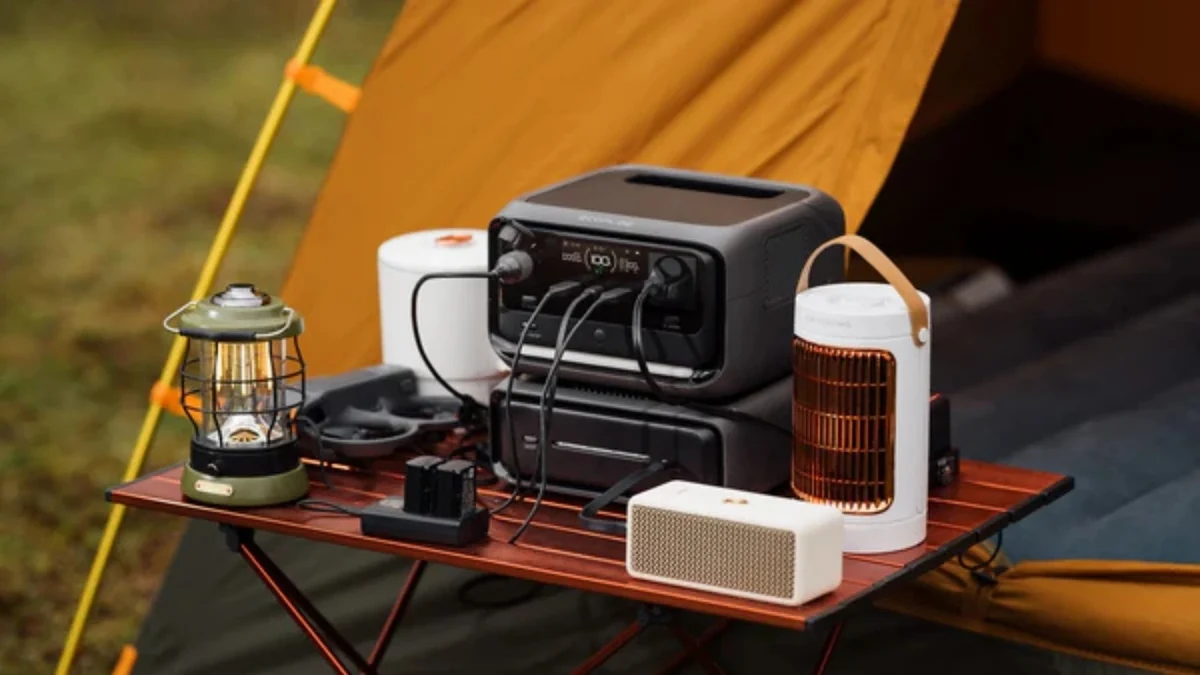
At its core, a power station is a large battery in a rugged housing, combined with an inverter that converts DC power into standard 230-volt AC power. On the front, you will find various ports: AC outlets, USB-A, USB-C with Power Delivery, and sometimes DC outputs for your car.
How a power station works:
Battery technology makes all the difference. Most new power stations use LiFePO4 (lithium iron phosphate) batteries. While slightly heavier than older NMC cells, they are significantly safer—with no risk of fire if damaged—and last for 3,000 to 6,000 charge cycles instead of just 500 to 1,000. For festival use, where the device might take a few knocks, LiFePO4 is the much better choice.
Advantages:
Disadvantages:
A generator (also known as a power generator) produces electricity using a small gasoline or diesel engine that drives an alternator. As long as there is fuel, the machine keeps running.
Inverter generator vs. classic generator: There are two types. Classic generators provide "dirty" power with fluctuating voltage, which can damage sensitive electronics like laptops or Soundboks chargers. Modern inverter generators, such as the Honda EU series, convert the generated power twice to provide a clean sine wave, comparable to household electricity. Inverter models are much quieter, but also more expensive.
Advantages:
Disadvantages:
Most major festivals in Germany and Austria have clear guidelines in their terms and conditions or camping rules. The following applies almost universally:
Prohibited or strictly restricted: Gasoline and diesel generators, open flames other than gas stoves, large gas cylinders over 11 kg, pyrotechnics.
Allowed: Power stations and power banks, small gas cartridges for camping stoves, battery-powered LED lighting, solar panels.
Specific examples of generator bans: Wacken Open Air, Rock am Ring, Hurricane, Highfield, Frequency, Nova Rock, and Fusion explicitly prohibit power generators with internal combustion engines. The reasoning is always the same: noise, fire hazard, odor, and safety in densely packed camping areas.
What happens at the entrance: Security staff spot generators immediately during car or wagon checks. They will either be confiscated at the entrance (to be returned on Sunday) or you will be turned away. Power stations look like large boxes with displays and are waved through without any issues.
The most important value for a power station is its capacity in watt-hours (Wh). Watts alone only indicate how much power the device can deliver at once. Watt-hours tell you for how long.
Rule of thumb: Device power in watts × usage time in hours = watt-hour consumption.
Example: A Soundboks draws an average of 50 watts. If you run it for 4 hours a day, it consumes 200 Wh per day. Over a 3-day weekend, that’s 600 Wh just for the speaker.
| Device | Output | Usage per day | Wh for the weekend |
|---|---|---|---|
|
📱
Charging smartphone
|
15 W | 2× 1 hr (per person) | ~ 90 Wh |
|
🔋
Power bank (20,000 mAh)
|
30 W | 1× full charge | ~ 240 Wh |
|
🔊
Soundboks 3 / 4
|
50 W | 4 hours at medium volume | ~ 600 Wh |
|
💡
LED string lights / lantern
|
10 W | 6 hours in the evening | ~ 180 Wh |
|
🧊
Battery-powered cooler (25 L)
|
40 W | 12 hours active (50% duty cycle) | ~ 720 Wh |
|
🎬
Mini projector (outdoor)
|
80 W | 2 hours movie night | ~ 480 Wh |
|
☕
Electric kettle (1.5 L)
|
1,500 W | 5 min coffee in the morning | ~ 375 Wh |
|
💻
Laptop
|
60 W | 2 hrs (e.g., DJ set) | ~ 360 Wh |
|
🔦
Headlamp / Flashlight
|
5 W | 1 hr charging time | ~ 15 Wh |
Realistic watt-hour profiles for a festival weekend:
Important: Always add a 20 to 30 percent buffer to your calculations. Inverters have energy losses, cold or hot weather reduces battery efficiency, and that one spontaneous need (electric kettle, hair dryer, sound system for the neighbors) is bound to happen.
Tip: Want to know more precisely? Try the power consumption calculator and find the right power station size for your camp in under a minute.
| Class | Suitability | Example models | Price range |
|---|---|---|---|
|
1
Compact
300-600 Wh
|
Solo or couple, for phones, cameras, and laptops only. No Soundboks, no cooler. |
EcoFlow River 2
Jackery Explorer 300
Bluetti EB3A
|
€250-500 |
|
2
Standard
700-1,500 Wh
|
4-person camp with Soundboks and occasional projector use. Enough for a 3-day weekend. |
EcoFlow River 3 Plus
Jackery Explorer 1000 Plus
Anker SOLIX C800
Bluetti AC180
|
€700-1,300 |
|
3
Power
1,500-3,000 Wh
|
Crew camps with cooler, sound, lighting, and projector. Also for house parties or outdoor public viewing events. |
EcoFlow River 2 Max
EcoFlow Delta 2 Max
Jackery Explorer 2000 Pro
Bluetti AC200 Max
|
€1,300-2,500 |
|
4
Beast Mode
3,000+ Wh
|
Large camps, small open-air events, outdoor DJ sets. Multiple units are often stackable. |
EcoFlow Delta Pro
Bluetti AC500
Jackery Explorer 3000 Pro
|
€2,500–€4,500 |
Class 1: Compact (300 to 600 Wh)For solo travelers or couples who only want to charge phones, cameras, and perhaps a laptop. No Soundboks, no cooler. Examples: EcoFlow River 2, Jackery Explorer 300, Bluetti EB3A. Price: 250 to 500 euros new.
Class 2: Standard (700 to 1,500 Wh)The comfort class for a group of 4 with a Soundboks and occasional projector use. Usually sufficient for a 3-day weekend. Examples: EcoFlow River 3 Plus, Jackery Explorer 1000 Plus, Anker SOLIX C800, Bluetti AC180. Price: 700 to 1,300 euros.
Class 3: Power (1,500 to 3,000 Wh)For larger crews with a cooler, sound system, lights, and projector. Also suitable for small house parties or public viewing events in the garden. Examples: EcoFlow River 2 Max, EcoFlow Delta 2 Max, Jackery Explorer 2000 Pro, Bluetti AC200 Max. Price: 1,300 to 2,500 euros.
Class 4: Beast Mode (3,000+ Wh)For large camps, small open-air events, or outdoor DJ sets. Multiple units can often be cascaded for even more capacity. Examples: EcoFlow Delta Pro, Bluetti AC500, Jackery Explorer 3000 Pro. Price: 2,500 to 4,500 euros.
The power station market has exploded over the last five years. Here is a neutral overview of the most important manufacturers, sorted by their typical strengths and price range:
| Brand | Strengths | Price Level |
|---|---|---|
|
EF
EcoFlow
China · since 2017
|
Market leader, X-Stream fast charging, well-designed app, wide product range | Medium |
|
JK
Jackery
USA · since 2012
|
Market pioneer, robust build quality, good solar integration | Premium |
|
BL
Bluetti
China · since 2019
|
Best price-performance ratio in the mid-range and high-end segments, many ports | Inexpensive |
|
AK
Anker SOLIX
China · new to the segment
|
Very good build quality, compact design, fair prices. Entry-level and standard class | Medium |
|
GZ
Goal Zero
USA · outdoor specialist
|
Robust, modular solar concept, outdoor professional. Less common in Europe | High |
|
HD
Honda EU Series
Japan · inverter generator
|
Quietest and cleanest inverter generators on the market. Still banned almost everywhere at festivals | High |
EcoFlow (Chinese, founded 2017): Market leader in many categories, known for extremely fast charging (X-Stream technology, 0 to 80 percent in under 60 minutes) and a well-designed app. Wide range from 250 Wh to 25 kWh. A solid choice for most use cases.
Jackery (US-based with Chinese manufacturing, founded 2012): Pioneer in the power station market. Robust build, classic yellow-black design, good solar integration via their own range of solar panels. Tends to be a bit more expensive, but very reliable.
Bluetti: Offers the best price-performance ratio in the mid-range and high-end segments. Many ports, large batteries at a fair price. App integration is not quite at the EcoFlow level.
Anker (SOLIX series): Known for power banks and chargers, new to the power station segment. Very good build quality, compact design, fair prices. A solid choice for classes 1 and 2.
Goal Zero: Outdoor specialist from the USA, focused on robustness and modular solar concepts. Less common in Europe, higher price point.
Honda EU series (for rare generator cases): The Honda EU22i and EU32i are the quietest and cleanest inverter generators on the market. If you must use a generator, these are the ones. However: still banned almost everywhere at festivals.
With a solar panel, a power station becomes a virtually infinite power source, provided the sun is shining. Most power stations have an integrated MPPT solar charge controller, allowing you to connect panels directly.
Realistic yields during the festival summer:
A 200W panel combined with a 1,000Wh power station is plenty for a standard campsite for the entire weekend, as it recharges during the day.
Solar tips for the field:
The most common mistakes that lead to power chaos at festivals:
Don't: Try to sneak in a generator. If discovered at the entrance, it will be confiscated, and in the worst case, you will be turned away.
Don't: Leave your power station in direct sunlight. Heat above 40 degrees Celsius permanently reduces battery capacity and can trigger an emergency shutdown of the battery management system.
Don't: Use high-load appliances like kettles (1,500 to 2,000 watts), hair dryers (1,500 watts), or electric grills without a power reserve. The inverter will go into protection mode or, in the worst case, burn out.
Don't: Charge your power station in a closed tent at night without ventilation. Even LiFePO4 batteries generate a small amount of heat while charging, and trapped heat can cause issues.
Don't: Run a generator inside a tent, gazebo, or car. CO poisoning is a silent killer; fatal accidents happen every year.
Do: Charge your power station to 100 percent on the day of arrival; ideally, calibrate it a week in advance.
Do: Pack a solar panel as a backup for longer festivals. Even with moderate sun, it is often enough to compensate for the power deficit.
Do: Prioritize your devices. Smartphones are the top priority (for meeting points and emergencies), followed by lighting, then sound and comfort items.
Do: Bring a car charging cable for the 12V socket. If you have your car running anyway, you can use it to recharge.
Do: Protect your power station from rain. Most are splash-proof, but not waterproof.
Buying is worth it if:
Renting is worth it if:
Rental costs for a class 2 power station at Renty range between 40 and 80 euros per weekend, and between 80 and 150 euros for a class 3. Compared to the purchase price (700 to 2,500 euros), this is a fair ratio for occasional users.
Renty tip: With us, you can rent power stations for any festival camp deposit-free and with delivery. From the EcoFlow River for solo trips to the Delta Pro for crew camps.
Power stations aren't bombs, but they are large battery storage units with high energy density. You should always follow a few rules:
Battery fire: With low-quality NMC batteries from no-name models, there is a residual risk if they are damaged or deeply discharged. LiFePO4 is significantly safer. Brand manufacturers like EcoFlow, Jackery, Bluetti, and Anker test their devices according to UN38.3 and IEC standards.
Water protection: Most power stations do not have an official IP rating. Splashing water is usually okay, letting rain run over them is bad, and submersion is fatal for the device. In the rain, place them under a pavilion or use a waterproof box for protection.
Grounding for generators: Anyone who uses a generator despite a ban must ground it properly, otherwise there is a risk of electric shock.
Fire extinguisher: A small CO2 or powder extinguisher for your camp can be bought for 20 euros and can save lives in an emergency, especially when using a generator.
CO detector: If you are using a generator or a gas stove in a pavilion at your camp, a CO detector is a must. It costs 25 euros and warns you of invisible dangers.

If you aren't just attending as a visitor but are organizing a small open-air event, a rave, or a festival-style house party, you will quickly reach the limits of a single power station. For a stage with a PA system, mixing console, lighting, and a few hundred guests, we are talking about 5 to 15 kW of continuous load.
Options for larger events:
You can read more about planning your own event in our guide: Planning your own rave and open air. And if you're on a tight budget, our article Finding sponsorship for small festivals and raves will help.
Solo or couple: Power bank plus class 1 power station (300 to 600 Wh). Easily enough for phones, a camera, and some lighting. No generators needed.
Standard 4-person camp: Class 2 power station (700 to 1,500 Wh) with an optional solar panel. Soundboks, smartphones, some lighting, and comfort. The most common and sensible choice.
Crew camp with cooler and sound: Class 3 power station (1,500 to 3,000 Wh), ideally with a 200-watt solar panel. Enough reserve for a cooler, Soundboks, projector, and all the guests who want to charge their phones.
Your own mini open air or DJ set: Class 4 (3,000+ Wh) or several cascaded power stations. For really large events, use professional power distribution and, if necessary, an inverter generator.
The basic rule remains: Generators are almost always banned at festivals, while power stations are almost always allowed. If you don't want constant trouble with noise, fumes, and the festival crew, you're much better off with a power station.
Are you planning your next festival and need other equipment besides power? At Renty, you can get Soundboks, PA systems, and power stations for festivals with no deposit and delivery throughout Austria and Germany. You can find a full overview of festival preparation in our Festival Preparation Guide, and the complete checklist in the 2026 Festival Packing List.
How long does a 1,000 Wh power station last at a festival?
Am I allowed to bring a generator to a festival?
Which power station is suitable for a Soundboks?
Can I run a cooler with it all night?
Which is better: solar or a power station?
How much does it cost to rent a power station for a weekend?
Check event equipment, book in 90 seconds, and choose pickup or delivery. Deposit-free and insured throughout Germany and Austria.

Wir haben dir eine Mail geschickt, bitte bestätige sie um den Rabattcode zu erhalten.