Event insurance is not a single product, but a modular system consisting of four services: organizer liability for third-party damages, event cancellation for called-off events, equipment protection for technology, and weather coverage for outdoor events. Which ones you need depends on the risk, not the size of the event. For small to medium-sized events, costs are usually in the low three-digit range per event. If you are renting event technology, it is worth checking the rental terms first, as an included all-risk insurance policy may make equipment protection redundant.

At a glance
Event insurance is not a single product, but a modular system consisting of four services: organizer liability for third-party damages, event cancellation for called-off events, equipment protection for technology, and weather coverage for outdoor events. Which ones you need depends on the risk, not the size of the event. For small to medium-sized events, costs are usually in the low three-digit range per event. If you are renting event technology, it is worth checking the rental terms first, as an included all-risk insurance policy may make equipment protection redundant.
Event insurance protects you as an organizer against risks that can quickly become expensive during an event: personal injury, property damage, last-minute cancellations, or damage to technology. Instead of bearing such costs yourself in an emergency, you can make them predictable with the right modules.
Insurance for events, often called event liability insurance, is not a one-size-fits-all product. It is tailored to the type, size, and location of your event, and that is exactly where the difficulty lies: those who insure everything pay too much, while those who insure too little only realize it when a claim occurs.
Events have an unpleasant characteristic: a single incident can trigger costs that far exceed the budget for the venue, technology, and catering. Event insurance absorbs exactly these spikes by covering defined damages or settling legitimate claims, rather than you having to pay for them privately or out of the club treasury.
A practical example is the classic cable bridge incident: a guest trips, gets injured, and medical costs as well as potential compensation claims follow. Property damage is just as common, for example, if a drink is spilled over someone else's mixing console. If an event is held outdoors, the weather becomes an uncertainty factor.
When you plan your event in a structured way, the question of insurance quickly becomes more concrete: How many participants, what are the risks during setup, what external services are involved? From this, you can derive which modules are actually relevant for your insurance coverage.
Good event insurance consists of several services that you combine individually and use only where a real risk exists.
Organizer liability is the module that almost every event needs. It covers third-party claims if someone is harmed during the event: a knocked-over spotlight hits a parked bicycle, a visitor slips in a wet entrance area, or a helper damages a door frame while carrying equipment. The coverage limits of standard policies are in the millions because personal injury is the deciding factor for real risk.
What this organizer liability insurance covers, where the exclusions lie, and whether a single-event policy or an annual policy is more cost-effective can be found in our detailed guide to event liability insurance.
The second major cost block is event cancellation. A cancellation often occurs even though no one did anything wrong: severe weather makes an outdoor concept impossible, a key person falls ill, or an important service provider drops out. Whether and when event cancellation insurance pays depends heavily on the terms. Read the triggers and exclusions carefully and check whether cancellation costs from service providers are also covered.
The third module secures the technology itself. Equipment insurance and electronics insurance cover damage, theft, vandalism, and transport damage to lighting, sound, stage technology, and displays, usually with an agreed deductible. It is important to distinguish this from liability insurance: these services protect the equipment, not the consequences if third parties are harmed.
For open-air formats, tent events, and exhibitions, the weather is the one factor you cannot control. Weather coverage applies in the event of cancellation or abandonment due to severe weather, but it is almost always tied to specific trigger criteria, such as measured wind speeds or an official weather warning.
| Module | What it covers | When it makes sense |
|---|---|---|
| 🛡️ Event liability insurance | Personal injury and property damage to third parties | The basic component that almost every event needs |
| 📅 Event cancellation | Costs already incurred despite cancellation | For high upfront investments in venue, equipment, and catering |
| 🎛️ Equipment protection | Damage, theft, and transport damage to technical equipment | Only if the rental terms do not include all-risk insurance |
| 🌦️ Weather coverage | Cancellation or abandonment due to severe weather | For outdoor events and tent setups |
Four components, four different risks. None of them replaces another.
Lighting, sound, and media technology are the items that make most organizers feel uncertain. The answer depends on a single question: Who owns the equipment?
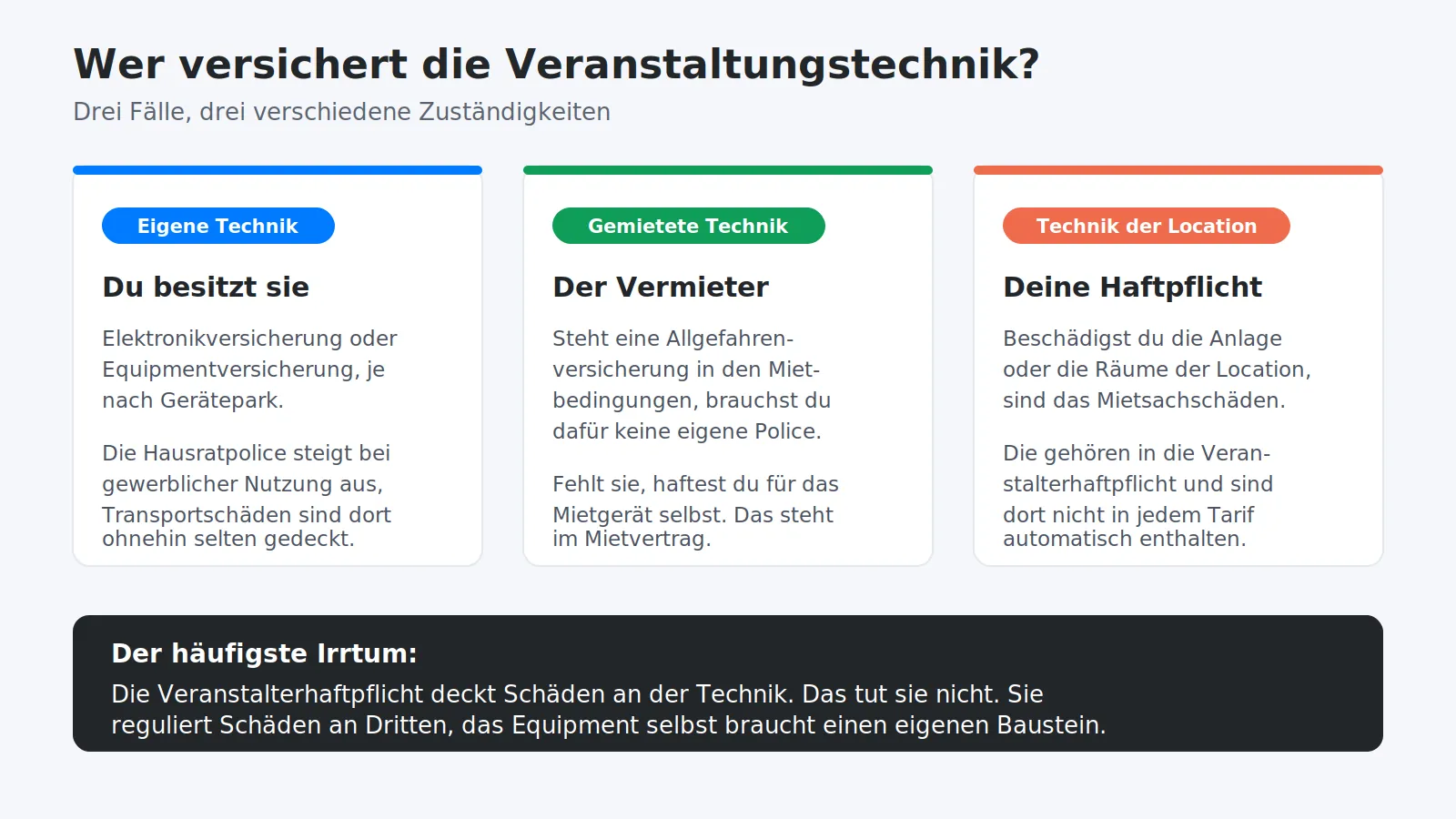
If you own event technology—such as event technicians, agencies, or clubs with their own inventory—you need event technology insurance or electronics insurance. This covers lighting, sound, stage equipment, projectors, cables, and operating equipment, usually based on an itemized list at replacement value. Private home contents insurance does not apply once the equipment is used for commercial purposes.
It is worth taking a close look at three points: whether transport damage is included, whether the coverage also applies abroad, and the amount of the deductible per claim. The same questions apply to musicians and DJs with their own equipment, just on a smaller scale.
For rented equipment, the lessor usually provides the coverage. If an all-risk insurance policy is included in the rental terms, you do not need your own policy, and the equipment protection from the modular system mentioned above is not required. If it is missing, you are liable for the rented item yourself to the extent specified in the rental agreement.
The third case is the most frequently overlooked: the venue's permanently installed equipment. If you damage lighting, sound, or the premises themselves, these are considered damage to rented property, which falls under event liability insurance, not technology insurance. In many plans, this is only included as an add-on.
Rented event technology is often already covered by the lessor. At Renty, based on over 3,500 events per year, we know that this is exactly where the most uncertainty lies, even though the situation is usually simpler than expected.
An included all-risk insurance policy covers typical risks such as damage, theft, or transport damage, depending on the agreed deductible. You therefore do not need to organize a separate policy for every spotlight and mixing console. However, this coverage does not replace event liability insurance: technology coverage protects the equipment, not the consequences if a knocked-over speaker injures someone. In practice, the ideal combination is insured equipment rental plus your own liability insurance for the event.
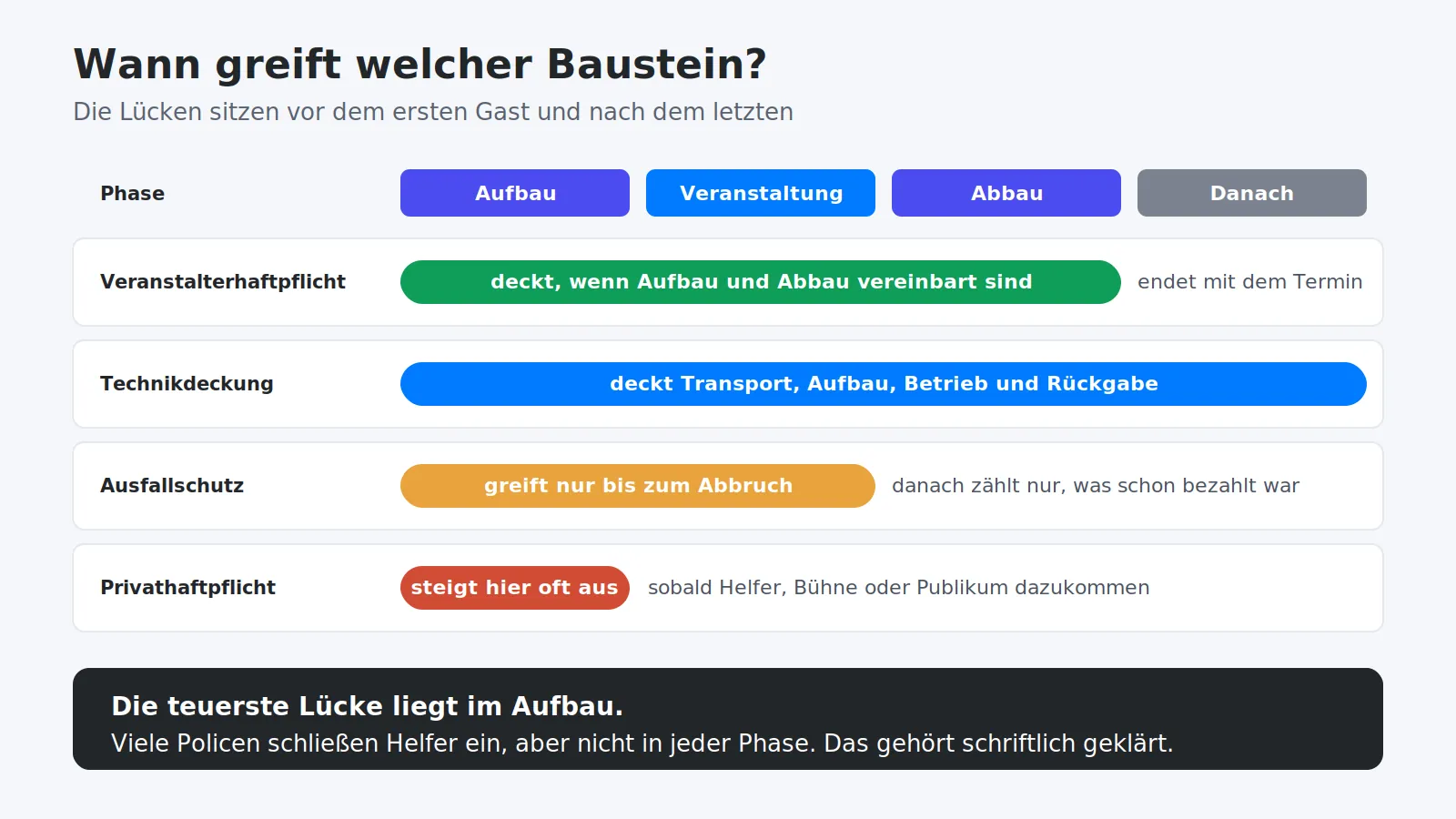
The limitations are just as important as the benefits. These points are missing from most offers, even though they are among the more frequent types of claims.
For exhibitions and trade fairs, there is another point to consider: stand construction and third-party operating equipment at the venue are often regulated by the organizer of the overall event, not by you as an exhibitor. Anyone who assumes both are covered may end up with no coverage at all.
The costs depend primarily on which modules you combine. As a rough guide, event liability insurance for a small to medium-sized event is often in the low three-digit range per event. If cancellation protection or equipment protection is added, the premium increases accordingly.
These factors drive the price: the type of event, the number of participants, the coverage amount, the duration, and any deductibles. Outdoor elements, the serving of alcohol, or pyrotechnics also noticeably change the premiums. For regular event organizers, an annual policy is often worthwhile because it automatically covers multiple dates and is usually cheaper over the course of a year than many individual tariffs.
Whenever a single claim would be greater than what you could pay out of your own pocket. This is not a question of event size, but of risk distribution. With 30 invited guests in your own garden, this calculation looks different than with 300 visitors at a rented venue.

Private organizers also benefit. For weddings, milestone birthdays, or larger family celebrations, liability risks arise as soon as outside visitors are invited, service providers are involved, or you rent premises.
This applies even more to commercial organizers. Corporate events, trade fairs, exhibitions, club festivals, and concerts have many visitors and complex processes. Coverage becomes particularly useful for rented equipment, large numbers of guests, and outdoor events with temporary structures. There is also a practical point: many event venues require proof of liability as a prerequisite for booking. If you are also planning to serve alcohol, clarify the permit early on.
Use these points to get comparable quotes instead of vague information.
What is event insurance?
Which components does my event need?
Who insures the event technology?
How much does event insurance cost?
What does event insurance not cover?
Is event insurance mandatory?
Check event equipment, book in 90 seconds, and choose pickup or delivery. Deposit-free and insured throughout Germany and Austria.

Wir haben dir eine Mail geschickt, bitte bestätige sie um den Rabattcode zu erhalten.