GEMA registration is handled online via the GEMA online portal: create an account, enter the event details including date, location, area, admission, and type of music, then submit. There is no fixed deadline in days, but the registration must be received before the event. For live music, the setlist is added afterward; GEMA sets a six-week deadline for this following the event.

GEMA registration is handled online via the GEMA online portal: create an account, enter the event details including date, location, area, admission, and type of music, then submit. There is no fixed deadline in days, but the registration must be received before the event.
In practice, it is not the form that takes time, but the information missing beforehand. Those who do not have their area, visitor numbers, and music type clearly organized will end up entering estimates and receiving follow-up questions. That is why this guide covers not only the process but also what the portal actually asks for and which special cases frequently cause issues.
Public performance of copyrighted music must be registered, regardless of whether it is played via a sound system, a DJ set, a live band, or a stream. "Public" does not mean large or commercial; it means that the group of people is not closely personally connected. A birthday party in a living room is private, but a club event, a company party with business partners, and an advertised DJ night are not.
Three assumptions often lead to late registrations. The first is "no admission, no GEMA": while admission fees influence the cost in many tariffs, they are not what triggers the obligation. The second is "we have a music subscription": a subscription for private individuals covers private use, not public performance. The third is "privately organized means free": the deciding factor is the overall situation regarding access, the guest list, and promotion, not who organizes the event.
The person or organization acting as the event organizer and taking responsibility for the event must register it. If renting a venue, it is worth checking the contract: some venues have their own framework agreements, but generally, the registration remains the responsibility of the organizer. Anyone relying on the venue to handle it should get written confirmation.
Guidance, not legal advice. Whether an event is considered public is decided on a case-by-case basis, not by a fixed number of people. The information here reflects the standard procedure. In borderline cases, such as company parties with invited external guests, a quick inquiry to GEMA is faster than any retrospective interpretation.
Registration is handled in five steps via the GEMA online portal. Paper forms are generally no longer needed; the entire process from registration to invoicing takes place there.
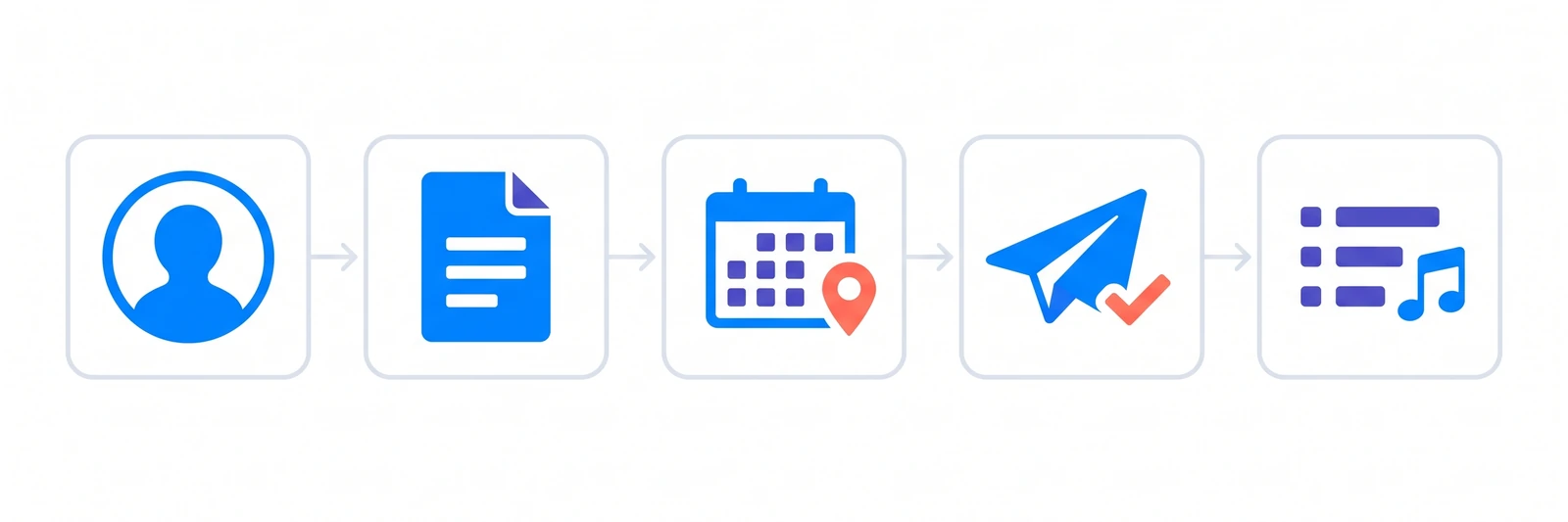
The starting point is the official GEMA portal for music users. Price calculators and registration are located there together, and the price calculator can be used without an account. In practical terms, this means: run through the classification in the calculator first, then register, and you won't face any surprises before submitting.

Before the event. GEMA does not specify a fixed deadline in days or weeks; they phrase it as "the sooner, the better" and emphasize that the registration must be received before the event takes place.
It makes sense to register as soon as the date, location, and approximate area are confirmed. Correcting individual details later in the portal is straightforward, whereas a late initial registration is not. Experience shows that those who wait for the final guest count often end up waiting until the week before the event, at which point the registration competes with everything else on your to-do list.
For recurring events, it is worth linking the registration to a fixed point in your planning process, such as when the venue is confirmed. That way, it no longer falls into the category of tasks that everyone forgets about at the end.
Eight pieces of information cover the standard case, and all of them come from documents that you will already have at the time of registration. The following overview shows where each piece of information comes from and what happens if it is missing.
| Detail | Source | If missing |
|---|---|---|
| Date and time | Event schedule | The registration cannot be completed |
| Exact address | Rental agreement or venue confirmation | Assignment in the portal is delayed |
| Area of the event space | Floor plan, rental agreement, or measure it yourself | Classification is based on estimates, usually to your disadvantage |
| Expected number of attendees | Confirmed attendees, not the number of invitations | Same consequence as with the area |
| Admission: free or ticketed | Ticketing or self-calculation | Query. For tiered tickets, the highest admission price applies |
| Type of music: DJ, playlist, or live music | Contract with DJ or band | Incorrect tariff classification; for live music, the setlist is missing later |
| Organizer and billing address | Association register, commercial register, or your own data | The invoice is being sent to the wrong place |
| For live music: performers | Contract or written confirmation | The setlist cannot be assigned |
Experience shows that the area is the detail most frequently estimated rather than measured. It determines the classification for several tariffs and simultaneously the size of the sound system required to cover the room. Once accurately determined, it covers both requirements.
A second point only becomes apparent during the review: the information must be consistent. "Background music only" does not align with a rented DJ booth and an advertised program. Contradictions between the registration and what is publicly visible are the most common reason for queries.
Five scenarios regularly appear as queries in the portal because they cannot be answered with a single field.
Private event versus public event. The term "private event" alone does not make an event private. The deciding factor is whether the attendees are personally connected to each other or to the organizer. A wedding with family and friends qualifies, whereas a company party with invited customers and suppliers generally does not, even if admission is by invitation only.
Club event. Clubs register like any other organizer. However, many umbrella organizations have collective agreements with GEMA that provide discounts for their member clubs. Whether your own club is covered is something the state association or umbrella organization knows, not the portal. This question should be addressed before registration, as membership is indicated in the form.
Live music versus playback of recorded music. Both require registration, both use different tariffs, and only for live music is a setlist required after the event. Anyone having both—for example, a band in the evening followed by a DJ—should declare both. Registering an event with two types of music under only one type leads to the exact correction you wanted to avoid.
Multiple rooms. If music is playing in two rooms simultaneously, area-based tariffs count the sum of the sound-covered areas, not the area of the largest room. Therefore, an adjacent room with speakers is included, while an adjacent room without sound coverage is not.
Multi-day event. A three-day festival is not an event with triple the duration; it is recorded per event day. This is quickly handled in the form and prevents two-thirds of the usage from being missing later.
At this point, the floor space pays off a second time: if you select the sound system based on square footage and guest count, you have already determined the figures needed for registration. At Renty, the sound systems are tiered by floor space and guest count, so the information fits directly into the registration form.
Both are handled in the portal via the existing record. If the floor space, admission fee, or type of music changes, the registration is corrected rather than created anew. If the event is cancelled or postponed, this should also be updated there with the date and a brief reason.
Timing is important: a correction made before billing is a simple administrative task, whereas a discrepancy discovered only during invoice review leads to a dispute. If you cancel an event, you shouldn't wait until the invoice arrives; do it as soon as the cancellation is confirmed.
For live music, one step remains after the event: the music report, i.e., the list of titles actually played. GEMA requests this no later than six weeks after the event and offers the option to forward the task directly to the performing musicians via a link. This is the more practical approach, as the band already has their setlist.
If music is played that was not previously registered, the usage will be licensed retroactively. GEMA imposes a surcharge and additional costs as a consequence, without publishing a fixed percentage for this. If you see a specific figure mentioned, you should verify its source.
The more practical disadvantage is the burden of proof. Without your own registration, the assessment is based on assumptions, such as floor space or visitor numbers. If you believe these assumptions are too high, you must provide evidence for an event that took place long ago. Photos, floor plans, and ticket sales records are what you would need, but rarely have on hand.
On top of that, there is the effort involved: inquiries, documentation, and corrections, usually dragging on for several weeks. Registering in advance is the cheaper and significantly faster option in almost every scenario.
The registration itself is free. You pay for the license to use the music, and the amount depends on the tariff that matches your type of usage. Depending on the tariff, the calculation takes into account floor space, visitor numbers, admission fees, and the type of music.
The GEMA calculator provides an estimate for your specific case with just a few inputs. Information on which tariffs exist, how they differ, and where discounts are possible can be found in the guide to GEMA fees. Both should be consulted before registering, not after.
Three types of levies are regularly confused, even though they concern different things and do not replace one another.
GEMA. Responsible for the public performance of copyrighted music in Germany. It represents the rights of the creators, i.e., composers and lyricists. Registration is carried out as described above.
AKM. The Austrian counterpart. If the event takes place in Austria, registration is handled there and not through GEMA. If you are organizing events in both countries, you must register twice. The AKM calculator provides an initial orientation regarding the costs.
Artists' Social Security Contribution (Künstlersozialabgabe). This has nothing to do with music rights. If you are a company or association hiring freelance artists or publicists, such as a band or a photographer, you pay a levy on these fees to the Artists' Social Security Fund (Künstlersozialkasse). This is in addition to GEMA, not instead of it.
And there is one more obligation for the same event in the same timeframe: as soon as drinks are served, a permit is required depending on the federal state and the occasion. What is necessary for this can be found in the guide to liquor licenses.
Is my Spotify subscription enough for music at an event?
Who needs to register, me or the venue?
Do I have to register if no admission fee is charged?
What is a music setlist and when must it be submitted?
How much does a GEMA registration cost?
Does a GEMA registration also apply to events in Austria?
Check event equipment, book in 90 seconds, and choose pickup or delivery. Deposit-free and insured throughout Germany and Austria.

Wir haben dir eine Mail geschickt, bitte bestätige sie um den Rabattcode zu erhalten.