Party lighting works on three levels: ambient light for the room, accent light for walls and decor, and effect light for the dance floor. Uplights and PAR cans provide coverage, an LED bar covers multiple effects on one stand, and moving heads add movement. For a standard party, two levels are sufficient, such as uplights on the walls and an LED bar for the dance floor.

If you are looking to rent lighting equipment, Renty is the right place for you. Whether you need battery-powered floor spots for the perfect atmosphere at your wedding or moving party lights and lasers to really get your dance floor going, we have both in our range. Our lighting systems usually run fully automatically in sync with the music. Just plug them in and enjoy. Choose the perfect lighting setup for your event now. Our primary goal is to ensure that you can plan and book your next event as smoothly and easily as possible. And the best part: at Renty, you rent your equipment deposit-free and fully insured. Most of our technology is plug-and-play, making it simple enough for anyone to operate. For everything else, we provide easy step-by-step video tutorials. Plus, we won't leave you on your own, as our team is available for you every day. Reach us by phone from 8 a.m. to 10 p.m. or in person at one of our over 25 locations near you. The process is super easy. Simply select your location and rental period. Check availability and prices in real-time and book your setup online directly on our website in under 90 seconds. So, what are you waiting for? Book the equipment you need for your next event today.
If you search for party lighting, you will almost exclusively find shops. They sell individual devices—sometimes as a DJ projector, sometimes as a disco light or party light: many lenses, one remote control, and then it sits alone in a dark room, blinking. What is missing is the answer to the question of which light type actually performs which task.
That is exactly what this is about: first the types, then the devices. For each type, you will find what it is built for, which models at Renty fall into that category, and what it looks like.
Party lighting is divided into three levels and six light types. Ambient light makes the room visible, accent light colors walls, pillars, and decor, and effect light provides movement on the dance floor. A lighting concept that works uses at least two of these levels. If you only use one, you will end up with either a bright room without atmosphere or a blinking corner in the dark.
| Type | Level | What it does | Examples from our rental range |
|---|---|---|---|
| Uplight | Accent | colors walls, pillars, and corners; battery-powered model without cables | BeamZ BBP94 Uplight, Ape Labs LightCan V2, Cameo DROP B4 |
| PAR light | Ambient, accent | broad beam of color on a surface, stage, or wall | Varytec Event Par 14x8W, Cameo CLMPAR 1, Stairville Outdoor Stage Par |
| LED Bar | everything in one | multiple effects on one stand, one power cable | Stairville LED BossFX-2 Pro, Chauvet GigBAR Move, Cameo MULTI FX BAR EZ |
| Moving Head | Effect | moving beams, color changes, and patterns | Cameo HydraBeam 400, Betopper 19x15W Wash, Cameo MOVOBEAM 200 |
| Effect lighting | Effect | Derby, strobe, laser, and mirror ball | Showtec Techno Derby, Eurolite LED Mega Strobe 768, BeamZ Radical 2 |
| Decorative lighting | Ambience | illuminates itself rather than lighting up something else | Eurolite Light Tube Set, ApeLabs Neon Tube Pix, Stairville The Tube I |
The impact on the dance floor increases from top to bottom, while the impact on photos increases from bottom to top.
These terms overlap significantly in retail. What is marketed as disco light or party light is usually a light effect from the fifth row, and what manufacturers call a light show is often an LED bar. It is therefore worth comparing across categories rather than between two devices in the same row. The atmosphere at a party is created by the combination, not by a single device.
PAR stands for Parabolic Aluminized Reflector and today primarily describes the design: a short, round spotlight with many LEDs that casts a wide beam of color. It is the workhorse of any party lighting setup because it can fill an entire wall with a single color.

An uplight is essentially the same spotlight in a flat design, available as a battery-powered or plug-in version. It sits on the floor and shines upward. As a battery-powered model, it requires no outlet, making it the most convenient device for weddings and events in rented venues. As a rule of thumb, place a spot every 3–4 meters along the wall you want to color.

The most common mistake is the direction of the light. A spotlight shining into the room at eye level will dazzle your guests all evening. Instead, aim the light at a wall or ceiling and let it bounce back into the room. This indirect lighting is softer and makes the room look larger than it actually is.
Stick to color, not white. Cold white light is in the 5300-6000 Kelvin range and makes any room feel like a doctor's office. Warm white is 2100-3000 Kelvin and is the only white setting that works for a party. Everything else should be colored. Our step-by-step tutorial on ambient lighting shows you how to distribute battery-powered spots around the room.
An LED bar is a rail with multiple effects mounted on a stand and connected to a single power cable. Typical setups include two PAR spots for coverage, a derby for colorful beams, and a strobe, along with a foot switch or remote control.

This is the fastest way to get decent lighting: set it up, plug it in, and you're done. Models like the Stairville LED BossFX-1 Pro and BossFX-2 Pro, the Chauvet GigBAR Move, or the Cameo MULTI FX BAR EZ can handle a party of up to about 100 people on their own. The limitation is the direction: everything comes from one point, so the rest of the room remains dark. If you want to color the walls, combine the bar with two to four uplights.
A moving head is a spotlight mounted on a motorized head. It pans and tilts, changes color, and, depending on the design, casts a sharp beam, a pattern, or a soft cone of color. Four types are common, and they look completely different in a room:

A bar with four small heads often beats one large one. Devices like the Cameo HydraBeam 400 or HydraBeam 4000 place four miniature moving heads side-by-side on a rail. They fan out, move in opposite directions, and fill the room more broadly than a single large head ever could, and they fit on a standard lighting stand.
A point where many fail: a light beam is only visible if there is something in the air for it to refract off of. Without fog or haze, a beam just looks like a dot on the ceiling, not a beam of light. A hazer, which works finely and continuously, is more effective than a fog machine that blasts out a cloud every few minutes.
Effect lighting doesn't cover an area; it creates movement. A derby casts colorful beams from multiple lenses that move in a circle, such as the Showtec Techno Derby or the ADJ Revo Rave. A strobe like the Eurolite LED Mega Strobe 768 flashes and should be used sparingly, while a laser like the BeamZ Radical 2 draws sharp patterns in the fog.

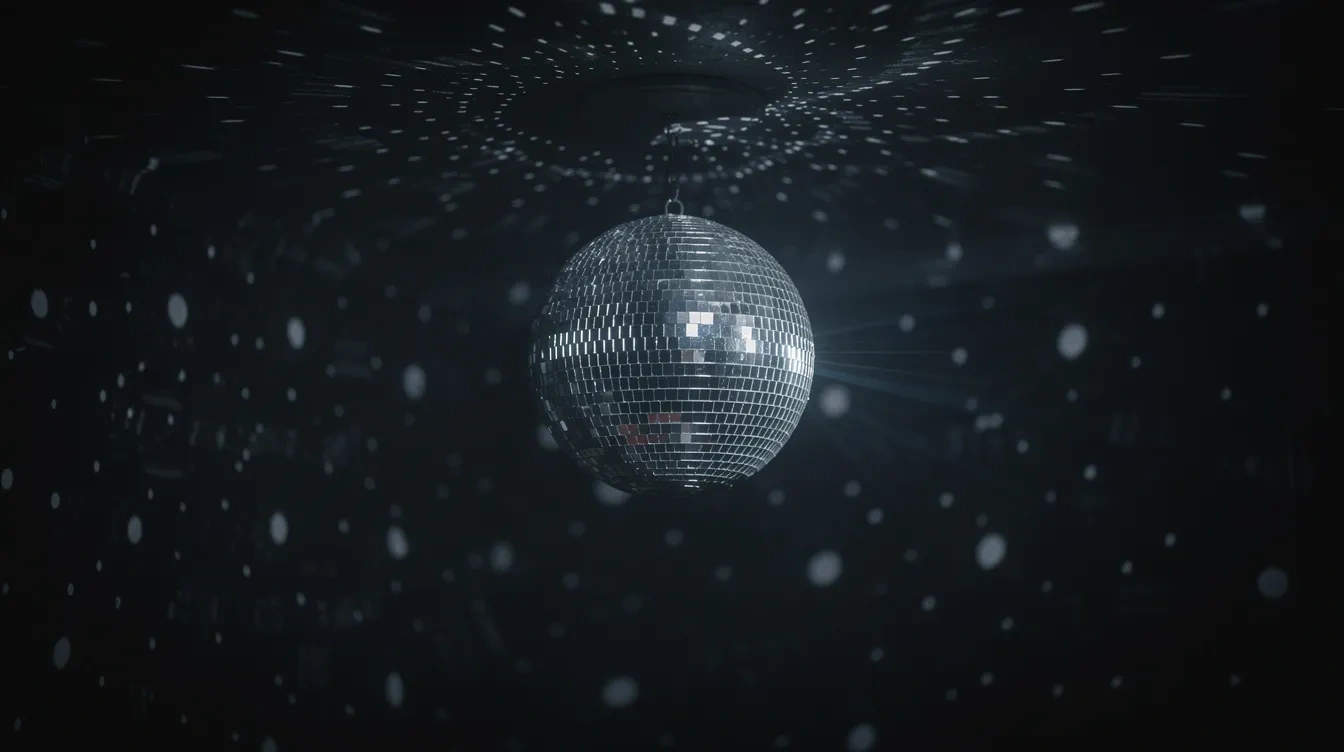
The mirror ball is a special case in this series: it doesn't light up on its own but requires a tightly focused spot to shine on it. For rentals, it therefore comes as a 50cm mirror ball with a stand and a matching spotlight. Sparks, confetti, and foam are not considered lighting, but rather special effects.

Disco ball and mirror ball mean the same thing. The difference is only in terminology; technically, both are a mirrored sphere with a motor. If you want to bathe an entire wall in blacklight, however, you need to use UV spotlights, and your decor needs to be compatible.
Decorative lighting is the fourth category and the most frequently overlooked. Tubes like the Eurolite Light Tube Set, the ApeLabs Neon Tube Pix, or the Stairville The Tube I don't illuminate anything; they are the object themselves. In photos, they look more powerful than any effect because they are part of the scene rather than just shining on it. Our guide to themed party lighting explains which colors suit which theme.
There are three ways to run party lighting. Sound activation uses a built-in microphone to switch to the beat of the bass without anyone needing to operate it. The remote control maintains a fixed color or program, which is usually the right choice for uplights. DMX connects all devices via cable to a console, allowing them to run synchronously and on command.
Practical insights
For most celebrations, sound-activated effects and a static color for uplights are sufficient. DMX is only worth the effort if someone is at the console all evening managing scenes. If you still want control, use a device like the Wolfmix W1 Mk2 or the Cameo IDMX Core, which allow you to pre-program scenes and trigger them at the touch of a button.
Lighting should change throughout the evening. Bright and warm for the reception so everyone can see and find each other, then darker and more colorful once the dance floor opens. This simple progression costs nothing but two adjustments and makes more of an impact than any additional piece of equipment.
For a party at home, automatic mode is almost always enough. If a DJ is playing, they usually handle the lighting as well, and that’s when DMX becomes worthwhile even for smaller setups, as color and tempo can be synced to the set.
Three questions are best clarified in advance: How many devices are connected to one power source, what type of connector does the device have, and does everything fit in the car? Transport is rarely an issue with lighting equipment—most devices weigh less than a sound system—but stands require length.
Two things belong before the first power outlet: route cables so no one trips over them, and do not place spotlights directly in front of curtains or decorations. While LED devices get significantly less hot than old halogen lamps, they still generate heat.
You can see which devices are currently available at your location in the lighting equipment overview, deposit-free and fully insured.
What is a moving head?
What does PAR mean for spotlights?
How many watts should a moving head have?
How many lights do I need for my room?
Does party lighting work outdoors in the garden?
How do you control party lighting without a lighting console?
Check event equipment, book in 90 seconds, and choose pickup or delivery. Deposit-free and insured throughout Germany and Austria.

Wir haben dir eine Mail geschickt, bitte bestätige sie um den Rabattcode zu erhalten.