A carnival party stands or falls on two decisions: how to get sound onto the float or into the hall, and where the power comes from. Both need to be sorted out before decor and programming. Here you will find setups for the parade float, lighting concepts for the hall, music selection, and a checklist for the final 48 hours.

To plan a successful carnival party or a loud parade float, you absolutely need a secure technical foundation consisting of vibration-resistant PA systems, mobile power stations for electricity, and stable wireless microphones for clear speeches. For atmospheric parties, strategically placed LED spotlights and colorful floodlights ensure the perfect vibe on the dance floor. A well-thought-out decoration concept, age-appropriate games for young children, and biodegradable confetti round off the professional organization. This guide provides you with all the essential tech tips and checklists for an absolutely safe and unforgettable celebration.
Carnival, Mardi Gras, or Fastnacht: These are three well-known names for the colorful season when the merry revelers in Germany and Austria take the reins. Whether at the big street parade in Cologne, the traditional session in Villach, or the classic fire department ball in the local village hall: behind every truly successful party is a detailed concept that brings perfect sound, bright light, and reliable power under one roof. This guide is aimed specifically at local clubs, dedicated organizing teams, and motivated private organizers who want to plan an impressive float or put on an unforgettable ball. You will get the absolute best inspiration here for both worlds of the fifth season.
👉 To ensure your event runs smoothly from a technical perspective, you can always rent the right event technology conveniently and without a deposit at Renty.
The most beautiful decoration remains ineffective if the sound on the float cuts out after 500 meters. And the best carnival speech falls flat if no one in the hall can understand the microphone. While costumes, snacks, and garlands create the mood, technology determines the atmospheric impact of your party:
These two worlds require different hardware. Anyone who improvises here risks the entertainment failing and all guests leaving earlier than planned. The following points go through both worlds step by step, with concrete recommendations and references to in-depth cluster articles. This way, you get the best approaches for every carnival party.

Anyone planning a parade float thinks of the motif first: witch, pirate ship, pop culture parody. But the technical equipment determines whether the float is actually noticed along the route. A silent float is only half a float, no matter how creative the theme is.
Speakers and light chains should be firmly bolted, not provisionally fixed with tape. On wooden platforms, tension straps with damping pads are suitable; for trailers, L-brackets are the cleanest solution. A speaker that falls off the float is not just property damage, but also a liability risk for the club. In parade planning, this question belongs at the very top, even before costumes and equipment.
Experience shows: while streamers and a few balloons on the float are replaceable, a fallen subwoofer can mean the end of the carnival party, in the worst case with personal injury.
A normal home theater speaker will not survive a three-hour parade route. Constant vibrations loosen solder joints, damage chassis suspensions, and cause cable connections to wobble. For the parade float, the industry therefore relies on robust PA systems or battery-powered speakers like Soundboks, which are designed for mobile use. This technology survives not only the route but also the subsequent party at the clubhouse.
👉 Detailed tips on mounting, volume guidelines, and suitable hardware setups can be found in the article Planning sound for the carnival float correctly.
Many cities now ban traditional gasoline generators on parade floats. The reasons: noise, exhaust fumes, and fire hazards near crowds. At the same time, sound systems, fog machines, and light strings require reliable energy for several hours—ideally without a tangle of cables or the need to stop for refueling.
Battery-powered stations have filled this gap. Models like the EcoFlow Delta Pro provide 3,000 to 7,000 watts of continuous power without exhaust, noise, or voltage fluctuations. For a complete float, one station is usually enough, paired with a solar buffer or a secondary battery for extra safety. Those planning a carnival party that starts on a float and continues in a hall can later use the same power stations for mobile DJ setups and indoor lighting.
👉 The article Power Supply for Carnival Floats explains which power station is right for your float.
On the float, battery life determines the success of the parade. Not all models can handle three to four hours of continuous operation at high volume, and the wattage rating doesn't tell the whole story. Therefore, pay attention to the specified runtime at full volume. You can find this information for each of the battery-powered speakers for parades listed here.
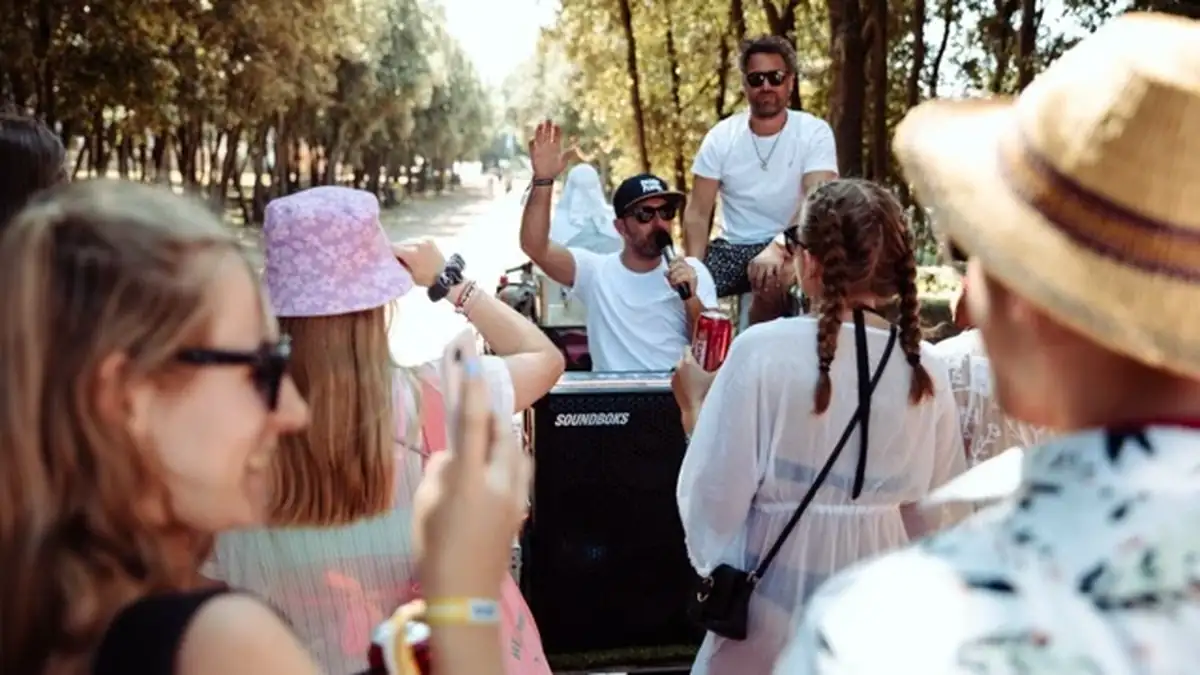
A carnival ball is in a different league than a parade. It involves a seated audience, comedic speeches, dancing, and long spoken segments. Organizing such events relies on details that are often underestimated in village halls, inns, or community centers. Traditional balls—such as fire department dances, cultural events, or formal carnival sessions—all have their own character but share the same basic technical requirements. Private parties on a smaller scale follow these same rules.
A single pair of stereo speakers on stage isn't enough for a 25-meter-long hall. Guests in the back rows will hear a muffled echo, while those at the front tables will be overwhelmed by the volume. The professional solution is a delay line: additional speakers placed in the middle of the hall that play with a slight time delay to ensure even sound coverage. This makes the difference between a noisy, muffled mess and an evening where every word is heard clearly.
Nothing kills the mood faster than a speech interrupted by feedback squeals or audio dropouts. For formal sessions and larger balls, wireless microphones are the standard. It is important to have at least two wireless channels so that the host and the speaker can work simultaneously, as well as UHF systems with separate frequencies to avoid interference. A feedback suppressor on the mixing console helps if speakers step too close to the monitors. For classic carnival sessions with stage performances, headset microphones are also needed for the performers, leaving the handheld mics reserved for the host and guests of honor.
Basic sound equipment by hall size:
| Component | Small hall (up to 150 guests) | Large hall (150 to 400 guests) |
|---|---|---|
|
Main speakers
|
2x active tops | 2x tops + 2x subwoofers |
|
Delay line
|
Not necessary | Recommended for rooms 20 meters deep or moreRequired |
|
Wireless microphones
|
2 handheld transmitters | 4 handheld transmitters + 1 headset |
|
Mixing console
|
12-channel digital mixer | 16 to 24-channel digital mixer |
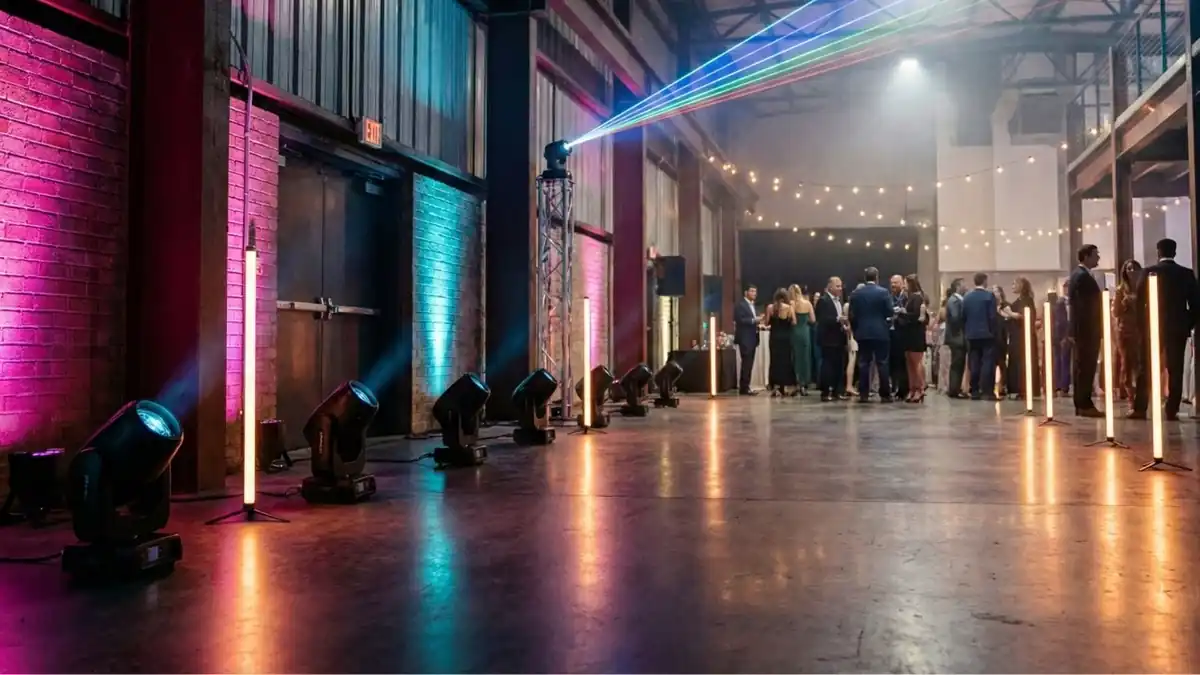
Most event venues are gyms, community halls, or multipurpose rooms during the day. Without a lighting concept, the space remains exactly that: functional, sterile, and lacking atmosphere. A well-thought-out setup changes the perception of the entire evening, turning an empty hall into the stage for your carnival celebration. The best positions for lights are along the walls and in the corners.
Uplighting for a quick room transformation: Six to ten battery-powered LED spots along the side walls, set to warm white or themed colors, turn any room into a stage. This works just as well for a classic ball as it does for a themed carnival event or a small party at the clubhouse.
UV light and blacklight for neon parties: Neon parties are a perennial favorite, especially with younger crowds. White costumes, colorful body painting, and DIY decorations glow magically under UV light. Three to four UV floodlights are enough for a medium-sized hall, creating an atmosphere that cannot be achieved with standard lighting alone.
👉 To see which lighting combinations suit which theme, check out the section on using theme party lighting and effects effectively.
In a hall, there is almost always an announcement to be made alongside the music, from the welcome speech to the carnival address. This rarely works well through a standard music system, as speech intelligibility is the first thing to suffer. A wireless microphone solves this and allows the person on stage to move freely. The overview of wireless microphones by range shows which model fits which room.
The technology provides the stage, but the music provides the emotion. A well-planned flow ensures that all guests get into the mood early, jump up to sing along to the best hits, and don't want to leave the dance floor by midnight.
Classics like "Viva Colonia," "Polonäse Blankenese," or "Anton aus Tirol" belong at every carnival party. Alongside these, regional songs, current chart hits, and Schlager music serve as a bridge between generations. For a celebration with a mixed audience, we recommend three blocks:
👉 Our article Building a Carnival and Mardi Gras Playlist provides songs for every stage of the party.
A clear common thread turns a collection of ideas into a cohesive celebration. The key is choosing a theme that runs through the decorations, costumes, and invitations. The following tips will help with your planning.
Classic elements like balloons, streamers, and garlands form the foundation. If you want more depth, work with a consistent theme and recurring motifs:
Confetti is as essential to a carnival party as the revelers are to the parade, but it should be biodegradable. This makes cleanup in the hall easier and is better for the streets during the parade.
Costume examples range from clowns, pirates, and princesses to thematic worlds like space, the 1920s, or gothic. Choosing a shared theme takes the pressure off guests when deciding what to wear and creates visual uniformity. For club balls, a competition with clear categories has proven successful, for example: best group, most original individual costume, or best DIY entry. This boosts the mood and provides an additional program highlight between dance sets.
If guests are informed about the theme early on, they have time to get creative with their costumes. The content on invitation cards or digital invites should always include the date, time, location, dress code, and an RSVP deadline. For larger events, it is worth adding extra organizational details: parking options, cloakroom information, and entry times. Printed cards build anticipation, while digital versions save time and money. Both formats have their merits; the key is clear communication in advance.
Next, we look at the special requirements for a party with the little ones. Much more relaxed standards apply to the next chapter.
Not everything takes place in a large hall. Many families celebrate with children at home, often with a small carnival party in the afternoon. Different rules apply here than at an evening ball, and the organization is simpler than for your next big event. With a few ideas and a little preparation, everything is set up in no time.
Two to three hours is enough for most children; any longer and the mood can quickly turn. The afternoon, after nap time, is ideal. A good rule of thumb is one adult supervisor for every five to eight children. This ensures enough attention for individual kids without sacrificing the fun. For larger groups, it’s worth setting up fixed stations where an adult oversees a specific activity, such as face painting, crafts, or movement games.
At a carnival party or celebration for children, jelly doughnuts and "Amerikaner" (black-and-white cookies) are classic staples. Kids especially love the Amerikaner for their colorful icing. Aim for a mix of sweet and savory to keep the sugar intake in check. Too much sugar in the afternoon leads to a short-lived burst of energy followed by crankiness. Water, diluted juices, and non-alcoholic mocktails are better choices than sodas, where the sugar content is often underestimated.
A small selection of finger food also helps: cucumber and carrot sticks, mini pizzas, and sandwiches decorated with funny faces made from olive slices and bell peppers. If you're looking for more ideas, parenting forums and daycare blogs are great sources of inspiration.
Confetti, colorful garlands, and balloons are enough for the basics. A table with craft supplies for making masks is always a big hit with the little ones. There are plenty of game ideas: musical statues, a balloon obstacle course, "pot tapping" (a traditional blindfolded game), or a simple costume contest provide fun without much effort. Other ideas like a treasure hunt or a memory game also work well.
For a bit more variety, a face-painting station, a craft table with confetti jars, or a small photo booth with fun props are great additions. Hiring a clown or magician is a highlight, but not a must. Ultimately, it’s not the equipment that makes the difference for the kids, but the attention of the supervising adults and a varied selection of games.
Technically, a solid Bluetooth speaker is enough for 20 to 40 children at home. Microphones are unnecessary in a private setting; a good music setup at a comfortable volume is more important than high wattage.
Two days before the event is when you decide whether everything will run smoothly. With this checklist, nothing will be overlooked, and all the essentials will be sorted out before the next event kicks off:
48 hours before
24 hours before
On the day of the event
| Timing & Phase | Important to-dos | Focus area |
|---|---|---|
|
48 hours before
|
Charge power stations Confirm equipment Test frequencies
|
Logistics & Power Important |
|
24 hours before
|
Back up music Pack backup cables Coordinate timing
|
Backup & Coordination |
|
On the day of the event
|
Setup 3 hours prior Soundcheck Save lighting scenes
|
On-site execution |
Carnival thrives on atmosphere, costumes, and having fun with friends. For a carnival celebration to truly work—whether on a parade float or inside a hall—you need a technical foundation that matches the scale of the event. Planning sound, power, lighting, and microphones early on provides peace of mind and saves you stress on the day of the event.
The following articles explore each area in depth, step by step: Sound on the parade float, Power stations instead of generators, Themed party lighting and the right carnival music selection. Together, they form a complete guide for the carnival season, whether it's your club's first party or your tenth ball in a row.
How many watts does a carnival float need for a parade?
Why are gasoline generators often banned on carnival floats?
What sound equipment do I need for a carnival ball in a large hall?
How do I ensure the right lighting for a carnival party?
How do I organize a kid-friendly carnival party at home?
When should I start the final technical check before the event?
Check event equipment, book in 90 seconds, and choose pickup or delivery. Deposit-free and insured throughout Germany and Austria.

Wir haben dir eine Mail geschickt, bitte bestätige sie um den Rabattcode zu erhalten.