A humanist wedding is a symbolic ceremony with no legal standing; a visit to the registry office remains necessary. The ceremony almost always follows the same sequence: entrance, welcome, wedding speech, ritual, vows with the "I do," ring exchange, and exit, lasting 30–45 minutes. Here you will find the timeline, cost breakdown, six rituals, and the technology needed for an outdoor ceremony.

There are no rules for a humanist wedding, which is exactly what makes planning it harder than a church or registry office ceremony. This guide shows the proven order of service with a timeline, which rituals really work, what the costs consist of, and what outdoor technology you need.
A humanist wedding is an individual, symbolic ceremony led by a wedding officiant. In Germany and Austria, it has no legal significance: the marriage is concluded exclusively at the registry office. The humanist wedding does not replace the official paperwork, but rather complements it.
Most couples separate the two events. First, the civil marriage in a small circle, often days or weeks beforehand, then the humanist wedding as an emotional highlight in front of all guests. The advantage lies in the freedom: no denomination required, any location possible, no prescribed text, no time limit. For non-denominational couples, same-sex couples, and couples of different religions, it has long been the most popular alternative to a church wedding.
A church wedding follows a liturgy; a humanist ceremony follows your story. In church, the focus is on the order of the congregation; in a humanist wedding, it is on the couple. The bride and groom determine the location, sequence, music, and words themselves, and no one asks about a denomination.
The second difference is the location. A church wedding is tied to the building, while a humanist wedding takes place wherever you want: in a garden, on a meadow, by a lake, or under the open sky. Only one thing remains the same: without the appointment at the registry office, you are not legally married. This very freedom explains the trend toward humanist weddings, as you can mix elements from both worlds, such as a blessing alongside self-written vows.
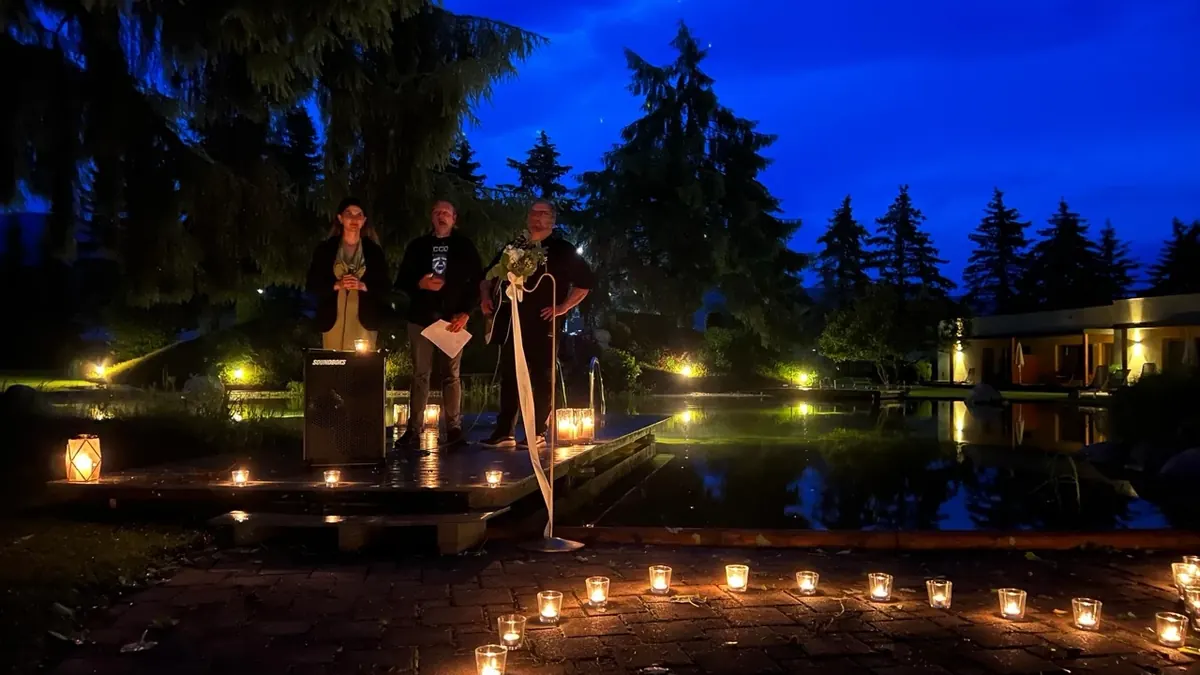
There are no rules for the order of a humanist wedding. Nevertheless, a sequence has become established that almost all ceremonies follow. Use it as a basic framework, not a mandatory program.
1. Entrance. It sets the tone. Common options include entering together side-by-side, the classic version accompanied by the father, or something unique like a guard of honor formed by guests. The music chosen for this influences the mood more than any decoration.
2. Welcome. The officiant welcomes the guests and briefly explains what a humanist wedding is. This helps anyone who is not yet familiar with the format.
3. The wedding speech. The centerpiece. A good speaker tells your story: how you met, what connects you, and what defines you as a couple. Ten to fifteen minutes is the right length. This is the moment when most guests get emotional.
4. Reading or music. A poem, a text, or a song performed by friends or family. This lightens the mood and turns the ceremony into a shared experience rather than a performance.
5. Vows and "I do." The emotional climax. The questions can be formulated classically or contain your own words. Those who write their own vows experience the most moving moment of the entire ceremony here.
6. Ring exchange. Follows directly after the "I do." Clarify beforehand who is carrying the rings and practice the moment once. It sounds trivial, but it noticeably reduces nervousness.
7. Conclusion and exit. Closing words, then the exit with music, applause, and flower petals or soap bubbles.
A secular wedding ceremony lasts between 30 and 45 minutes. Anything under 25 minutes feels rushed, while anything over an hour becomes tiring for guests, especially if they are standing or in the sun. Here is how a 35-minute ceremony is typically structured:
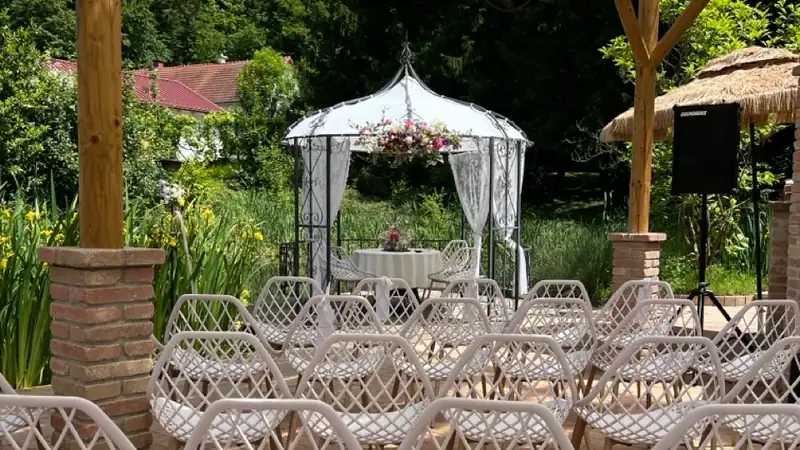
Costs depend on seven items, one of which accounts for the majority of the budget. Knowing which one allows you to save strategically without compromising the quality of the ceremony.
For an experienced wedding officiant, 800 to 1,500 euros is standard; this includes the initial consultation, a personalized speech, rehearsal, and the ceremony itself. Most couples spend between 1,500 and 3,500 euros in total for the ceremony, excluding the reception. The exact amount is primarily determined by the music: a live band for the processional costs more than all other items combined.
Our guide on wedding planning breaks down how the ceremony fits into your overall budget.
Rituals provide emotional anchors for the ceremony. They make the love between you visible to everyone in the room and give guests a moment to share their well-wishes. These six are the most reliable because they are easy to understand without explanation and look great in photos.
The officiant shapes the ceremony more than the venue and decorations combined. Popular officiants are booked nine to twelve months in advance, so this search should be at the beginning of your planning, not the end.
Pay attention to four things: Does the officiant’s style—humorous, poetic, or down-to-earth—match yours? Do they invest two to three hours in a consultation before they start writing? Are there references or videos available? And are you free to customize the ceremony, or do they work from a fixed template? The answer to the second question is the most important, because a personal wedding speech comes from your story, not a questionnaire. Whoever carries the emotions in the room must know the couple.
Alternatively, a friend or family member can lead the ceremony. This is more personal and cost-effective, but don't underestimate the effort involved: writing a speech and delivering it confidently in front of 80 guests is very different from a dinner toast.
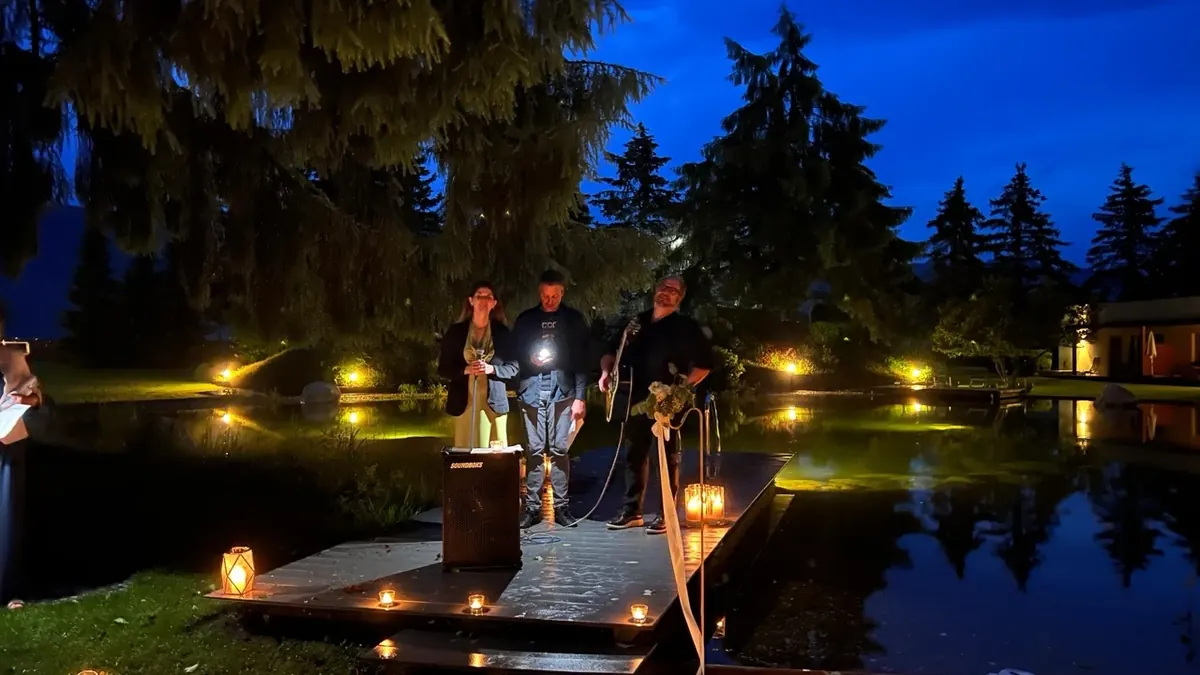
Outdoors, there is usually no power, and open spaces absorb sound. Wind and background noise do the rest. Without a microphone, no one beyond the third row will be able to hear what is being said—and the speech is the very reason everyone came.
You need three things: a wireless microphone for the officiant and readings, a portable speaker for the processional and recessional, and a power source if there is no outlet nearby. Battery-powered speakers solve all three issues at once, without cables running across the grass or generator noise in the background.
Schedule a soundcheck at least an hour before the processional with the person who will be speaking. A microphone that starts feeding back during the vows will be heard on every video. At Renty, you can rent wireless microphones and battery-powered speakers sorted by range, with no deposit required. For music selection, our guide to wedding music and entertainment can help.
What if the weather turns? A ceremony under the open sky always needs a backup plan. Clarify early on which room, tent, or covered area is available on short notice, and who makes the final call on the day. It makes sense to decide in the morning rather than an hour before, as chairs, equipment, and decorations take time to set up. Sun is just as much of a factor as rain: if you leave your guests in the midday sun for 40 minutes, you will lose their attention faster than during a downpour.
For everything else regarding the schedule, equipment, and program for your wedding day, check out our overview of weddings.
Is a secular wedding ceremony legally binding?
How long does a secular wedding ceremony last?
What is the total cost of a secular wedding ceremony?
Can a friend officiate the secular wedding ceremony?
Are witnesses required for a secular wedding ceremony?
When should you start planning a secular wedding ceremony?
Check event equipment, book in 90 seconds, and choose pickup or delivery. Deposit-free and insured throughout Germany and Austria.

Wir haben dir eine Mail geschickt, bitte bestätige sie um den Rabattcode zu erhalten.