A wedding day consists of five blocks: getting ready, the ceremony, the champagne reception with a photo shoot, dinner, and the party. You need 15 to 30 minutes of buffer time between each block, otherwise a single delay will push through the entire day. Here you will find sample schedules with times for three different types of weddings.

For a smooth wedding day, structure the day into logical blocks: getting ready starts three to four hours beforehand, the actual ceremony lasts 30 to 60 minutes depending on the type, and the subsequent wedding dinner takes about two to three hours. The most important rule for a relaxed celebration is: plan at least 15 to 30 minutes of buffer time between every single program item for unforeseen delays and congratulations. This guide provides you with concrete schedules and templates for completely different wedding types and shows you exactly how to elegantly bridge waiting times during the couple's photo shoot with photo booths and yard games.
The big wedding day has probably been perfectly planned in your head for a long time. But what does a truly realistic daily schedule actually look like when you put it down on paper in black and white? When exactly does getting ready start, how much buffer do you absolutely need between the ceremony and the champagne reception, and what time should you ideally open the dance floor? That is exactly what this article is about: a crystal-clear schedule with reliable times, all important program items, and relaxed buffer times so that your day runs absolutely smoothly.
👉 Are you still in the middle of the overall planning? Then start with our guide Planning a Wedding: Guide & Checklist (2026).
Most bridal couples underestimate how many program items overlap on a wedding day. Getting ready, first look, ceremony, champagne reception, photo shoot, dinner, speeches, wedding cake, opening dance, all of this has to fit into the timeline without creating time pressure.
A well-thought-out schedule helps you with three things:
Golden rule: Plan at least 15-30 minutes of buffer for every time block. Weddings never go exactly according to plan, and that is perfectly okay as long as your schedule has the flexibility for it.
Here are the typical building blocks that make up a wedding schedule, in chronological order.
Getting ready is more than just styling. It is the emotional start of your wedding day. Plan plenty of time for it:
Tip: Have breakfast together with your bridesmaids or groomsmen. It provides energy and creates special moments before the hustle and bustle begins.
More and more couples are opting for a first look—the moment you see each other for the first time before the ceremony. The advantage: You get an intimate, emotional moment to yourselves, and the photographer can capture the most beautiful couple photos in natural light.
Not a must, but for many, it is the most emotional highlight of the day, even before the actual ceremony.
The ceremony is the heart of the wedding schedule. The duration varies depending on the type:
Buffer rule: Plan for at least 30 minutes between the end of the ceremony and the start of the next program item. Just greeting all your wedding guests often takes 15-20 minutes.
The champagne reception is the transition between the ceremony and the party, and it is more important than many think. This is where guests offer their congratulations, laugh, and toast to the couple.
Important: Think of activities for your wedding guests, especially if the couple disappears for their portrait session. Games, a photo booth, or a wishing tree are perfect ways to bridge the waiting time.
The photo session is one of the points where many couples don't plan enough time. Remember to account for travel time between the venue and the photo spot, changing clothes, and freshening up—it's better to have too much of a buffer than too little.
If you prefer to have the cake cutting in the evening (e.g., before the party), that works perfectly fine too. There are no hard and fast rules; decide what fits your schedule best.
Aside from the ceremony, the wedding dinner is the longest part of the day. Plan generously:
Scheduling tip: Inform the speakers (best man/maid of honor, parents, bridesmaids) about their time slot and the maximum speech length in advance. A quick briefing the evening before prevents 20-minute monologues.
The wedding dance marks the transition from the formal part of the evening to the party. Usually, the couple dances the first dance alone before all the guests storm the dance floor.
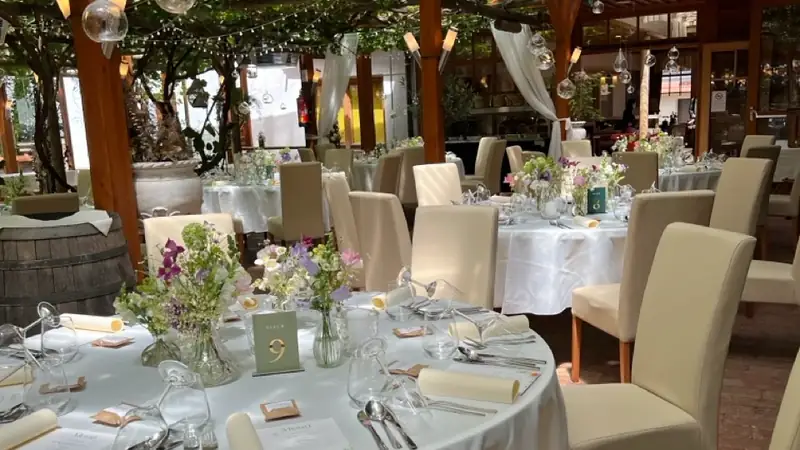
From getting ready in the morning to the end of the party, a classic wedding takes about 14 to 16 hours. The actual celebration, starting from the ceremony, lasts about 8 to 10 hours. The following schedule shows the most common timeline for weddings in Germany and Austria, with a humanist ceremony in the afternoon:
| Time | Program item | Duration | Buffer |
|---|---|---|---|
09:00 |
💄Getting ready starts (bride + team) |
3 hrs. | - |
10:00 |
🤵Groom getting ready |
1.5 hrs. | - |
12:00 PM |
📸Photographer arrives (getting-ready photos) |
1 hr. | - |
1:00 PM |
💕First look + couple photos |
1 hr. | 30 min. |
2:30 PM |
💒Humanist ceremony |
45 min. | - |
3:15 PM |
🤗Congratulations + transition |
- | 15 min. |
3:30 PM |
🥂Champagne reception + group photos |
1.5 hrs. | - |
5:00 PM |
🎂Coffee & cutting the wedding cake |
1 hr. | 30 min. |
6:30 PM |
🍽️Dinner (speeches between courses) |
2 hrs. | - |
8:30 PM |
🌬️Buffer / fresh air break |
- | 30 min. |
9:00 PM |
💃First dance |
5 min. | - |
9:05 PM |
🎉Party & dancing |
Open end | - |
11:00 PM |
💐Bouquet toss |
10 min. | - |
12:00 AM |
🌙Midnight snack |
30 min. | - |
You can use this schedule as a template and adapt it to your own timeline. Adjust the times based on when your ceremony starts. The rest will pretty much fall into place on its own.
Perfect if the civil ceremony is early and the reception takes place at a different location:
Fewer scheduled events, more relaxation:
Two parts of the schedule are technically linked: the first dance and the transition to the party. If you play both from the same source, you lose time every time you have to switch. A two-channel mixer solves this without a DJ. The overview of DJ equipment for the evening shows what you need for this.
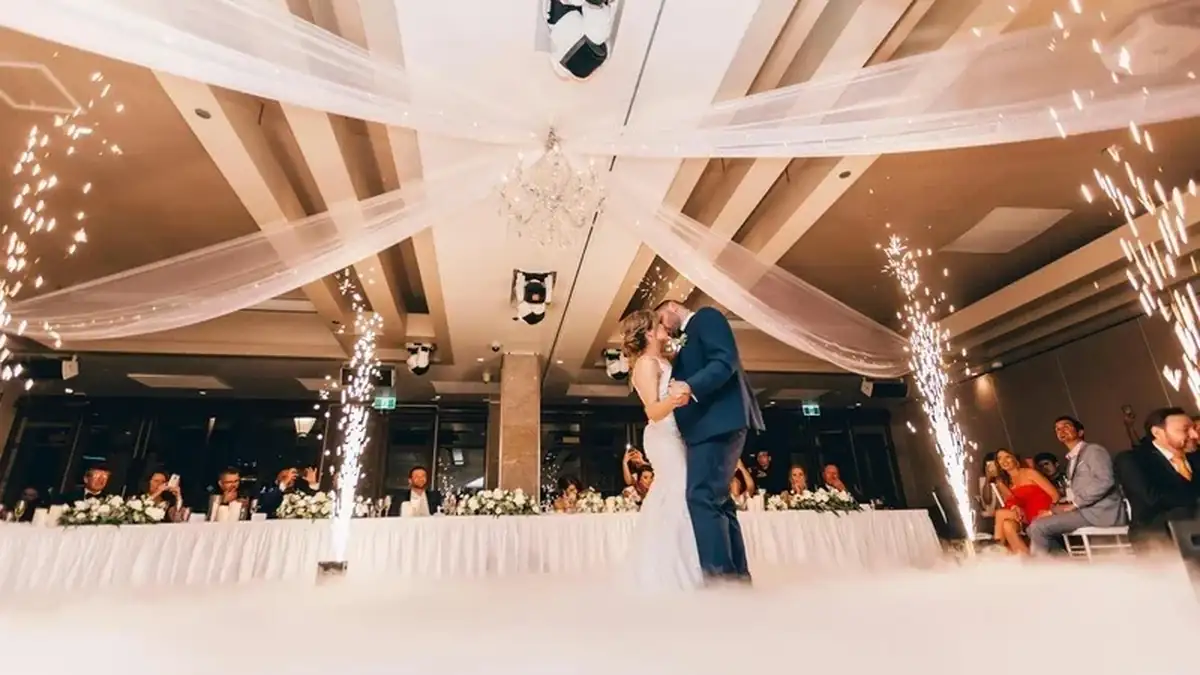
1. Buffer, buffer, buffer The most important rule: build in at least 15-30 minutes of buffer time between every scheduled event. Weddings never run exactly to the second, and they shouldn't have to.
2. Appoint a master of ceremonies Choose one person (best man, maid of honor, or a friend) who knows the plan and ensures everything stays on schedule on the wedding day. You shouldn't have to worry about a thing yourself.
3. Briefing on the eve Go through the schedule with everyone involved: witnesses, photographer, DJ, and caterer. This ensures everyone knows their role and timing.
4. Don't forget travel times The classic mistake: the church is 25 minutes from the venue, but the schedule only allows for 10. Calculate travel times realistically, including a buffer for traffic and parking.
5. Plan activities for waiting times There is often some downtime between the champagne reception and dinner, especially when the couple goes off for photos. Lawn games, a photo booth, or a quiz will keep your guests entertained.
6. Communicate the schedule clearly Print a timeline on your wedding stationery, place schedule cards on the tables, or set up a welcome sign at the entrance showing the day's events. This way, your guests will always know what's coming next.
7. Learn to let go The best plan is the one you are eventually willing to let go of. If something runs 20 minutes late, it’s not the end of the world. Enjoy the moment—that’s what your wedding day is all about.
Is your schedule ready? Perfect. You can find all further steps for wedding planning, from the venue and guest list to the technical details, in our Wedding Planning: Guide & Checklist (2026). And for music, games, and party vibes, check out our Wedding Music & Entertainment Guide.
How long does a wedding last in total?
How much buffer time should you plan for?
What should you do if the schedule goes off track?
When should the photographer arrive?
Do we need a wedding planner for the schedule?
How can you keep guests entertained during waiting times?
Check event equipment, book in 90 seconds, and choose pickup or delivery. Deposit-free and insured throughout Germany and Austria.

Wir haben dir eine Mail geschickt, bitte bestätige sie um den Rabattcode zu erhalten.