Public viewing requires a license as soon as it is accessible to the public. You will need a broadcast license from the rights holder, registration with GEMA or AKM for music, and, depending on the size, a municipal permit. For non-commercial events, the broadcast license is usually free, but GEMA and AKM fees still apply. This guide covers all items, deadlines, and the distinction between private and public events.

This guide applies regardless of the tournament. It describes what is required for any public broadcast of a football match, whether it is the World Cup, European Championship, Champions League, or Bundesliga. It serves as a guide and does not replace legal advice, as tariffs and regulations change.
There are four potential cost items. Whether they apply to you depends on whether the event is public or private and whether you are earning money from the broadcast.
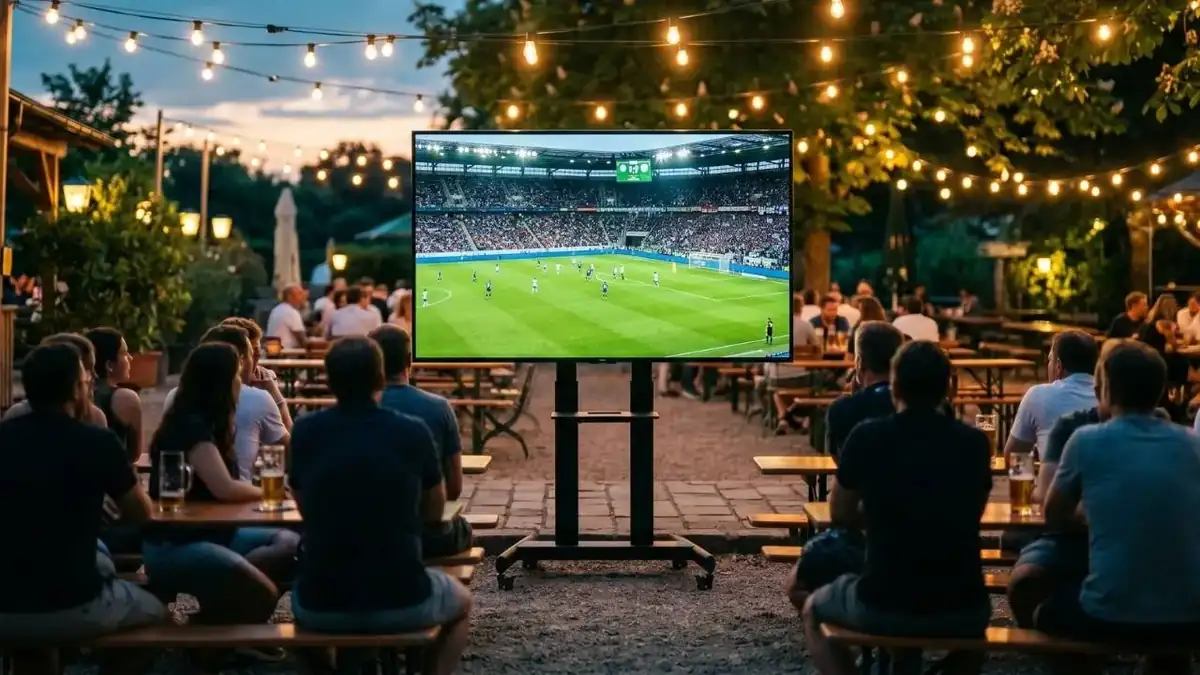
Before you worry about a license, clarify this one question. Licensing and fee requirements only apply to public events, and this classification determines everything else.
Legally, an event is public if it is accessible to an undefined group of people. In practice, five questions help: Can anyone theoretically attend, even without a personal invitation? Do the guests barely know each other? Did you advertise with posters, a social media post, or an ad? Does it take place in a location with public foot traffic, such as a beer garden, restaurant, club house with an open door, or a town square? And how many people do you expect? From about 30 guests, the argument for a private event becomes difficult. A "yes" to any of these questions is often enough.
Sports club. If a club shows matches in its clubhouse exclusively for members, it may be considered non-public. As soon as non-members are allowed in or drinks are sold, the classification changes.
Gastronomy. A bar showing matches during normal operations is generally public. For licensing purposes, the question is whether the broadcast generates additional revenue, such as through admission fees, sponsorship, or price surcharges.
Company premises. A staff-only event without external guests can be private. As soon as customers or the public have access, it is public.
The rights to the match itself do not belong to the broadcaster, but to the competition organizer: FIFA for the World Cup, UEFA for the European Championship and Champions League, and the DFL for the Bundesliga. Anyone showing a match publicly needs their permission, regardless of the fact that the program is being broadcast anyway.
For major tournaments, the rights holder usually sets up a dedicated registration portal. For the 2026 World Cup, this was handled via publicviewing.fifa.org. Before every tournament, it is worth checking the official website of the respective association, as categories and deadlines change from tournament to tournament.
Non-commercial means: no admission fee, no sponsorship, no price surcharges. This applies to clubs, schools, municipalities, and restaurateurs showing matches during normal operations. As a rule, no license fee is charged here, provided the conditions are met: live broadcast via the official signal, no image manipulation, and no use of association logos.
Commercial applies as soon as you charge admission, involve sponsors, set a minimum consumption, charge reservation fees, or specifically advertise the broadcast. In this case, a paid license is required, the cost of which is usually based on spectator capacity. The standard sale of food and drinks usually does not count toward this.
A third category concerns very large non-commercial events. For events expecting several thousand spectators, the associations require a formal license even if it remains free of charge.
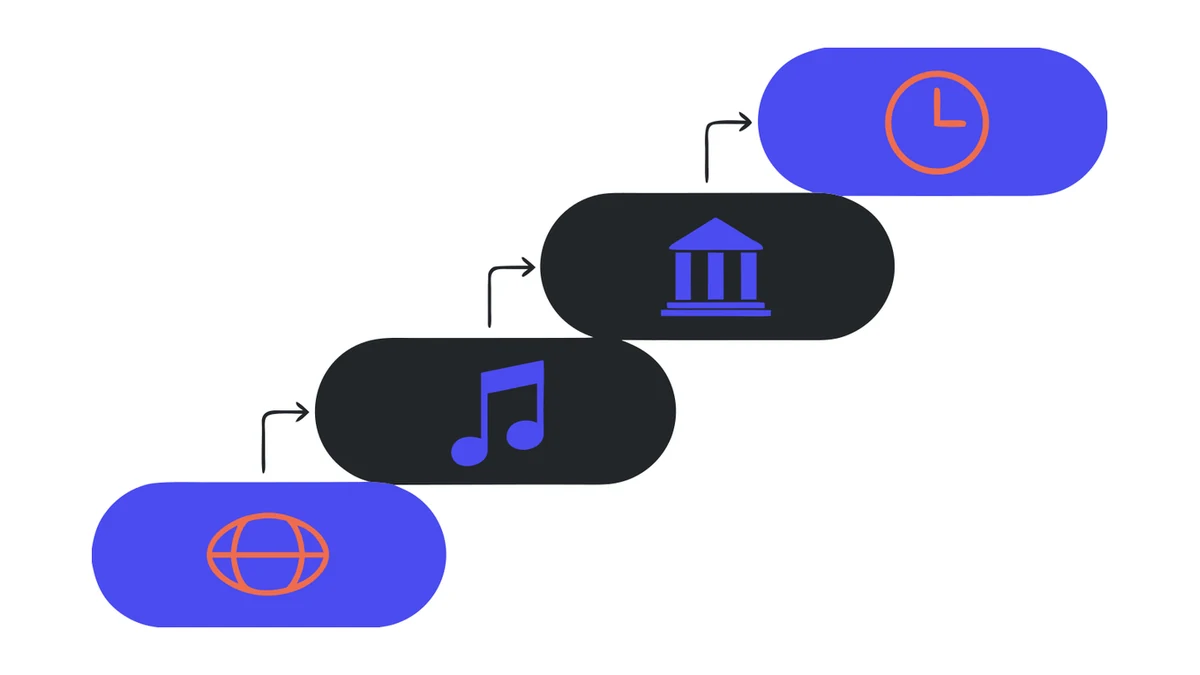
If a game is only available through a paid streaming service, you will need an additional contract that explicitly permits public performance. A private streaming subscription does not cover this, even in a club house or if no admission fee is charged. Providers have specific commercial rates for hospitality businesses that are significantly higher than private prices and must be purchased separately. This is not an issue for games broadcast on free-to-air television.
In practice, this is the most common reason why a planned public viewing falls through at the last minute: the authorities have been notified, the equipment is set up, and then it turns out the decisive game isn't being shown on free-to-air TV after all. Therefore, check early on which channel is showing which match.
GEMA fees apply as soon as you show a broadcast in public, as the program contains copyrighted music. This is independent of the broadcasting license and still applies even if the broadcast itself is free. You can calculate the exact amount in advance using the GEMA calculator.
Two tariffs are relevant. The FS tariff applies to the public performance of television broadcasts and is the standard case. For screens up to 106 cm diagonally, billing is per device; for large screens and projectors, it is based on the event area. The U-ST tariff applies to outdoor events without an admission fee and is also calculated based on the area.
The scale: A single TV set in a bar for the duration of a tournament will cost in the low double-digit range, while a projector screen will cost in the double- to triple-digit range depending on the size. For major tournaments, industry associations like DEHOGA regularly negotiate special rates for the hospitality sector, so it is worth calling your association. Those who do not register and get caught will pay significantly more than the regular rate according to GEMA terms.
In Austria, AKM performs the same role as GEMA. Every public performance of copyrighted music must be reported, and this includes the music within a TV broadcast. You can use the AKM calculator for your calculations.
AKM distinguishes between recurring events and single events. If you are a restaurant owner who already has an existing contract for TV playback, you only need to report changes, such as switching from a screen to a projector. For a single event, the standard tariff requires registration at least three days before the date.
In Switzerland, SUISA is the responsible body. The structure is similar to GEMA and AKM, though the rates differ.
In addition to rights, you must deal with the authorities. In Germany, this is the local regulatory office (Ordnungsamt); in Austria, it is the municipality, the magistrate, or the district authority. Larger outdoor events usually require event registration, often a safety concept, and coordination with the fire department and police. Regarding fire safety, the same rules apply even for small events: keep escape routes clear and ensure fire department access.
The point at which most public viewings fail is the time. Nighttime quiet hours begin at 10:00 PM, and games with late kick-offs regularly end after this time. For this, you need an exemption permit from the municipality, which requires four to eight weeks of lead time. Details on which decibel levels apply, what the application looks like, and what else you can do to prevent complaints can be found in our guide on music after 10:00 PM and exemptions from nighttime quiet hours.
Demand for public viewing follows the tournament calendar. Those who plan early have the best options when it comes to authorities and technology.
Once the formalities are sorted, you can focus on the location, technology, and schedule. How to plan a public viewing from the venue to the match day is covered in our guide to organizing a public viewing. The right technology for public viewing is available from Renty without a deposit and with insurance included.
Do I need a license for 30 people in my garden?
Do I need to register a public viewing event?
What happens if I forget to register with GEMA?
What are the fees for a public viewing event?
At what point is a public viewing considered commercial?
Can I show a public viewing using my streaming subscription?
Check event equipment, book in 90 seconds, and choose pickup or delivery. Deposit-free and insured throughout Germany and Austria.

Wir haben dir eine Mail geschickt, bitte bestätige sie um den Rabattcode zu erhalten.