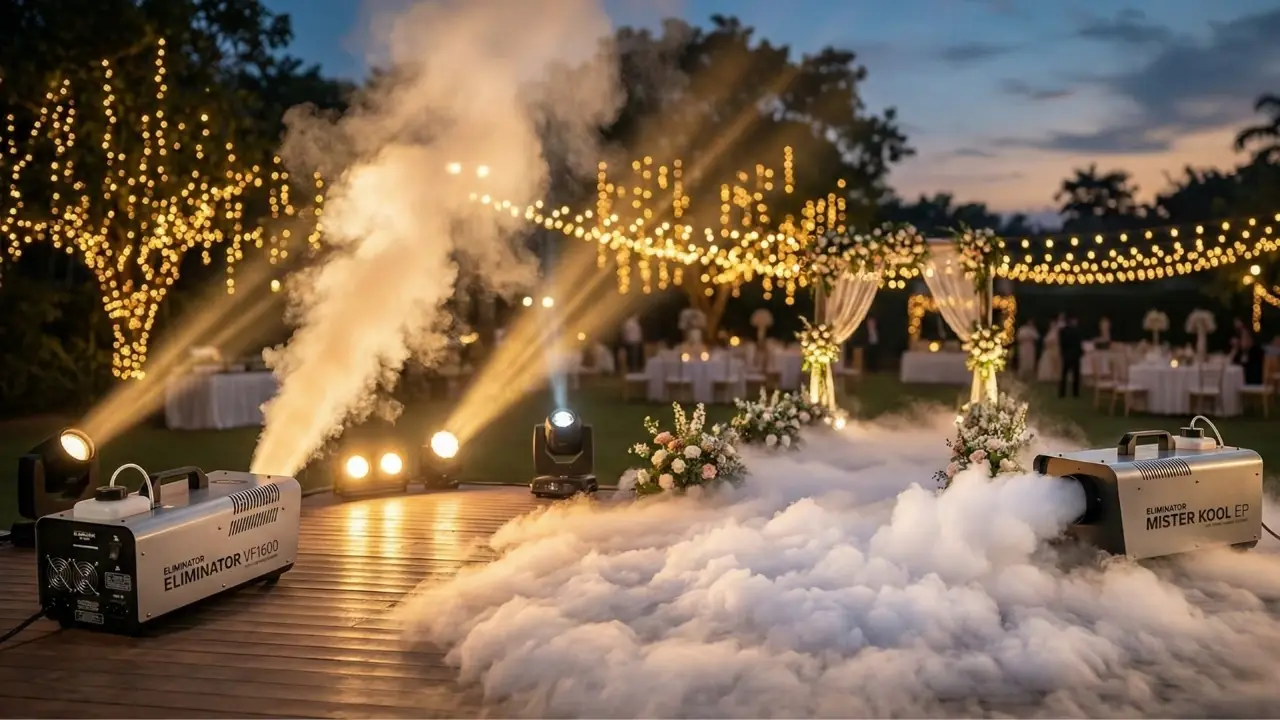
A fog machine vaporizes a special fluid and expels the steam, which condenses into visible fog in the cooler ambient air. The type you need depends on the desired effect: A classic machine fills the room with clouds, a hazer only makes light beams visible, and a low-fog machine keeps the fog at about 50 cm above the ground. For rooms with up to 50 people, 700 watts is sufficient.

A fog machine heats a special fluid until it vaporizes and then blows the steam out. In the cooler ambient air, it immediately condenses into tiny droplets, which is exactly what you see as fog. Nothing is burned, so no smoke is actually produced.
Inside, there are four components: a tank for the fluid, a pump, a heating block, and a nozzle. The pump pushes the fluid through the heating block, where it vaporizes instantly, and the pressure forces it out through the nozzle. As soon as the hot steam hits cooler air, it condenses into a visible fog.
This leads to the most important practical point: the heating block must first reach the correct temperature. For the units in our rental inventory, this takes two to five minutes. If you only turn the machine on once the guests have arrived, you will be waiting unnecessarily. And if there is no fog for a moment during the evening, the device is usually not broken; the heating block is simply reheating.
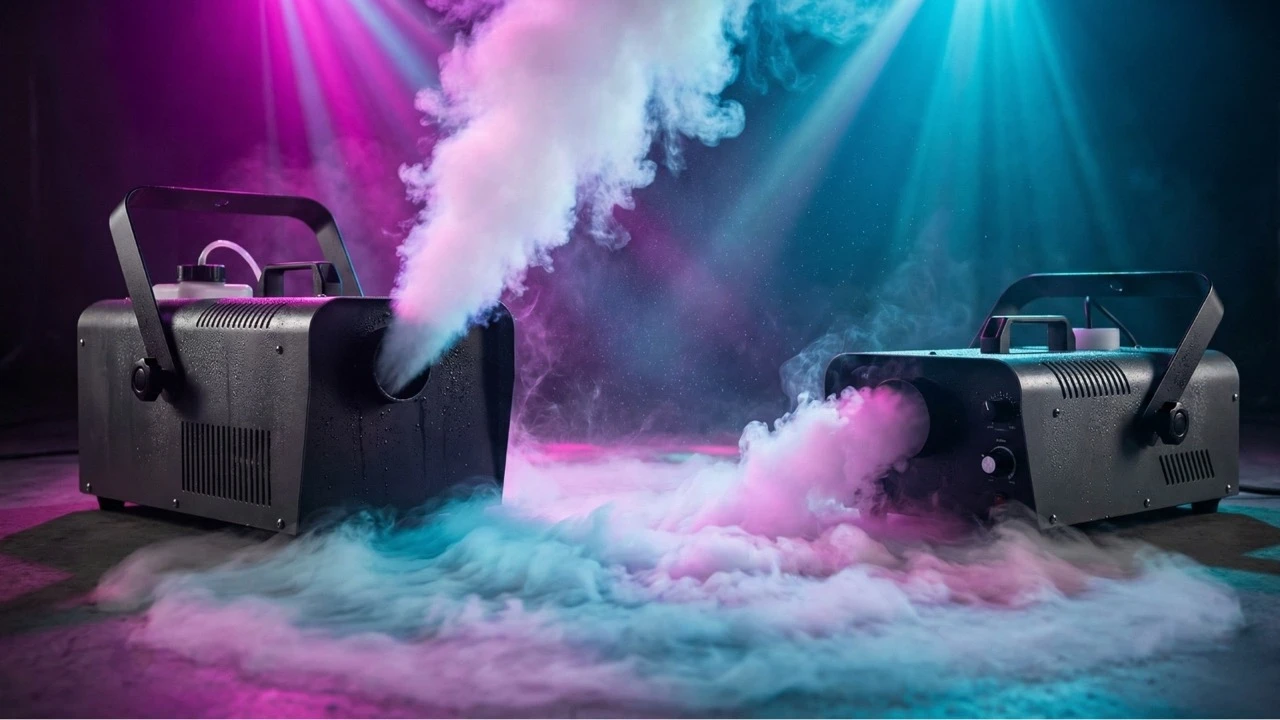
Klassische Nebelmaschinen stoßen den Nebel in kräftigen Schüben aus. Zwischen den Stößen heizt der Heizblock wieder auf.
Not all fog is the same. Four types create four completely different effects, and confusion is the most common cause of disappointment: if you expect low-lying fog and get a classic machine, you will see the effect disappear under the ceiling within two minutes.
The difference between a fog machine and a hazer is the most important one in this table. A fog machine creates the effect itself; you see the fog. A hazer does not create visible fog, but makes something else visible: the light beams from spotlights, moving heads, and lasers. Without this haze, a light beam simply hits a wall; with it, the beam becomes visible in the room.

Erst ein leichter Nebelschleier macht die Lichtkegel im Raum sichtbar. Ohne ihn sieht man nur die angestrahlte Fläche.
The wattage describes the heating power and thus how much fog is produced over time. As a guideline, 700 watts is enough for rooms with up to 50 people; for larger spaces, units with 1,200 to 1,600 watts are used. However, it is more important that the machine matches the desired effect than the raw number.
A rule of thumb: you can always turn down high power, but you cannot turn up low power. If you are torn between two classes, choose the larger one and use it in shorter bursts. Conversely, you cannot get dense fog from a unit that is too small, even with continuous operation; you will only overheat it.
Which type suits your occasion and which models are available at our locations can be found in the overview of fog machines by application, where the power output is also listed for each.</segment 15>
Only fog fluid approved by the manufacturer for that specific device. Anything else will damage the pump and heating block. Pure water does not create a visible effect because it lacks the carrier needed to keep the droplets suspended in the air, and limescale will clog the nozzle.
Commercially available fluids consist of distilled water and a portion of glycol or glycerin. You can control how long the fog lingers by adjusting this ratio:
Scent additives for vanilla, strawberry, or coconut are available, but they should only be used in devices approved for them. With a rental machine, the fluid is included and the tank is filled upon pickup, so this is not an issue.
Regarding health: Fog from tested water-based fluid is considered harmless, but like any aerosol, it can irritate the airways if you stand directly in it for a long time. In practice, this means: point the nozzle away from guests, ventilate occasionally, and use sparingly around children or people with respiratory issues. If you want to know the details, you can find the information in the fluid's safety data sheet, which is included with every canister.
Yes, this can happen, and it is a common occurrence with optical smoke detectors. They measure scattered light in a chamber and cannot distinguish between fire smoke and fog droplets. Rising fog can reach the ceiling in one to two minutes.
What helps:
If there is a fire alarm system connected to the fire department, this is not a matter of caution, but an agreement that must be in place beforehand. A false alarm costs money and will end the event. For commercial events, DGUV regulations also govern the use of fog, and the venue is usually aware of its own facility's requirements.
Not in the middle of the dance floor and not directly next to guests. The fog comes out of the nozzle hot and needs distance to disperse. A raised position at the edge of the room is best, with the nozzle pointed across the room rather than toward the people.
Two points that are regularly overlooked during setup: The machine should not be placed directly in front of an air vent, or the fog will be drawn away immediately. Also, there should be no parquet flooring under the nozzle where people will be dancing later, as condensed fluid makes the floor slippery. A towel underneath is sufficient.
Different rules apply outdoors. Wind disperses the fog within seconds, and the more open the area, the less effect remains. It works under a party tent or against a wind-sheltered wall, but not in an open field. If you want an effect outdoors, use low-lying fog or plan for double the amount.

Unter einem Partyzelt bleibt der Nebel stehen. Auf offener Fläche verweht er innerhalb von Sekunden.
There are almost always one of four reasons for this, and none of them are a defect:
The step-by-step operation is shown in the video tutorial for the fog machine. For the cooling setup, there is a separate guide for the low-lying fog machine.
A ten-minute test run in the afternoon saves you from panic at 9 p.m. The test answers three questions: Is there fog, how much is there, and how quickly does it dissipate? These three values depend on the room and cannot be looked up anywhere.
After the event, the process is reversed: let the device cool down before transport and do not leave the tank open. For rental equipment, Renty handles the cleaning; for your own machines, flush the line with distilled water after intensive use, otherwise the nozzle will clog.
The honest answer: rarely. A fog machine spends most of its time in the basement, the fluid ages in an opened canister, and the type you need for one occasion is often not the one you want for the next. If you host parties twice a year, you are better off with a rental device and will get the right type every time.
Conversely, if you are a DJ or event organizer who is out regularly and always needs the same effect, you are better off with your own device after about a dozen uses a year. For low-lying fog and professional hazers, renting is still usually the better financial choice because the purchase price is significantly higher and the devices require more maintenance.
In October. The analysis of 2,176 bookings in the Renty Event Report shows that 29.2 percent of all fog machine bookings in a year occur in October. Halloween thus concentrates nearly a third of the annual business for an entire product category into four weeks.
In practical terms, this means that if you need a specific device in October, you should plan further ahead than usual. A lead time of two to three weeks is realistic during this period, whereas a few days are sufficient for the rest of the year. You can find out how to combine fog with lighting in our guide on <a href="#">lighting for themed parties</a>, and for the event itself, we have a guide on <a href="#">planning a Halloween party</a>.
Is the fog from a fog machine harmful to health?
Can you use water instead of fog fluid?
How long does fog fluid last?
Does a fog machine work outdoors?
What is the difference between a fog machine and a hazer?
How long does the fog stay in the room?
Check event equipment, book in 90 seconds, and choose pickup or delivery. Deposit-free and insured throughout Germany and Austria.

Wir haben dir eine Mail geschickt, bitte bestätige sie um den Rabattcode zu erhalten.