A graduation ball begins with two decisions: date and venue. Both are booked early, and everything else—from budget and program to technology—depends on them. Here, you will find the path from forming the ball committee and budgeting to entertainment, legal matters, and security, step by step.

To successfully plan the perfect graduation ball, you should ideally start 9 to 12 months in advance by forming a dedicated ball committee and calculating a realistic budget of 50 to 100 euros per guest on average. To cover costs for the venue, catering, and professional event technology, you can supplement standard ticket sales with lucrative raffle proceeds, local sponsors, and revenue from selling the graduation yearbook. This comprehensive guide leads you step by step through the entire organization, shows you profitable fundraising campaigns, and provides detailed checklists for the ceremonial polonaise and the creative midnight show.
The grueling final exams are finally over, and now comes the absolute highlight of your school years: the festive graduation ball. Throughout Austria, this special evening is a tradition that goes far beyond a standard graduation ceremony. A traditional opening, a fun midnight show, a printed yearbook, and a wild party that lasts until the early hours of the morning. Organizing all of this is a massive project that requires reliable planning, an extremely strong committee, and a crystal-clear financial plan. Whether you are a graduate yourself or a supporting parent, you will find absolutely everything you need for a successful event right here.
👉 Is the venue in Vienna, Graz, or Salzburg already booked? Don't leave the sound to chance. At Renty, you can rent the complete event technology for your graduation ball, completely deposit-free and extremely budget-friendly.
Planning a graduation ball is best started 9 to 12 months before the date. The first step: form an organizing team and clearly define task distribution. Typical departments include Chair (overall coordination), Finance and Treasurer (budget, ticket sales, invoices), Venue and Technology (hall rental, sound, lighting, power), Program (polonaise, midnight show, speeches, DJ or band), PR and Communication (invitations, social media, advertising, graduation yearbook), Sponsorship (local businesses, raffle prizes), and Security (entry, youth protection, emergency plan).
Task distribution should take individual strengths into account. External support from trusted teachers, experienced parents, or professional service providers reduces risks and stress. Everyone on the team should know what they are responsible for and which decisions they are authorized to make. Working with experts for technology, decoration, or catering is particularly helpful for larger balls.
A well-thought-out financial plan is the foundation of any graduation ball organization. Average costs per person for most graduation balls range between 50 and 100 euros, depending on the scope and venue. A clean cost breakdown includes fixed items and a buffer of at least 10 percent.
| Item | Budget share |
|---|---|
|
🏛️
Venue & Hall Rental
|
|
|
🍽️
Catering & Drinks
|
|
|
🎛️
Technology (Sound, Lighting, DJ / Band)
|
|
|
🎨
Decoration
|
|
|
📰
Printed materials (invitations, graduation yearbook)
|
|
|
📸
Photographer & photo booth
|
|
|
📋
Insurance & AKM fees
|
|
|
🛡️
Contingency fund
|
|
Revenue sources: Admission fees and ticket sales are the primary source of income. These are supplemented by sponsorships from local businesses, class contributions, fundraising activities (bake sales, flea markets, charity runs), and grants from local institutions. Raffle prizes donated by sponsors are a well-established tradition in Austria and provide additional funds. Crowdfunding can be a useful supplement if you offer campaign-related rewards. Such income can also be specifically earmarked for a graduation trip after the ball; it is best to plan the finances for the ball and the graduation trip together.
To determine ticket prices, perform a break-even analysis: fixed costs plus variable costs per person divided by the expected number of guests. A dedicated graduation ball bank account helps manage finances cleanly. Read our guide to learn how to perfectly plan your main source of income: Graduation Ball Tickets: Calculation and Printing.

The theme serves as a common thread throughout the entire graduation ball: decorations, invitations, dress code, and the program are all based on it. The graduating class should agree on a theme early on. Wordplay, film references, or classic ball themes are popular choices. The theme should suit the class and work well on invitations, the graduation yearbook, and promotional materials. Some graduating classes also carry the theme through their final days of school and "theme week."
The traditional ball season in Austria takes place in January and February, though some schools choose dates in the autumn. Coordinate the date with the school administration early on and check for any overlaps with other balls in the district. The sooner the date is set, the better your selection of venues and service providers will be.
Choosing the venue is one of the most important decisions in organizing a graduation ball. Whether a traditional ballroom or a modern event hall, both have advantages and disadvantages. When selecting, pay attention to capacity (seating, dance floor, stage, buffet area), technical equipment (lighting, sound, power), accessibility and parking for guests and guests of honor, catering options, and the hall rental fee in relation to your budget. Many venues offer all-inclusive packages. Compare multiple offers and watch out for hidden costs. Table arrangements and table decorations play an important role in planning, especially if guests of honor and parents are assigned their own tables.
Venue checklist: Set the ball date early (keep the January/February ball season in mind). Clarify hall rental, catering exclusivity, and AKM fees. Check capacity for the number of guests plus a buffer. Inspect the on-site technical infrastructure (power outlets, stage, power for DJ equipment and lighting).
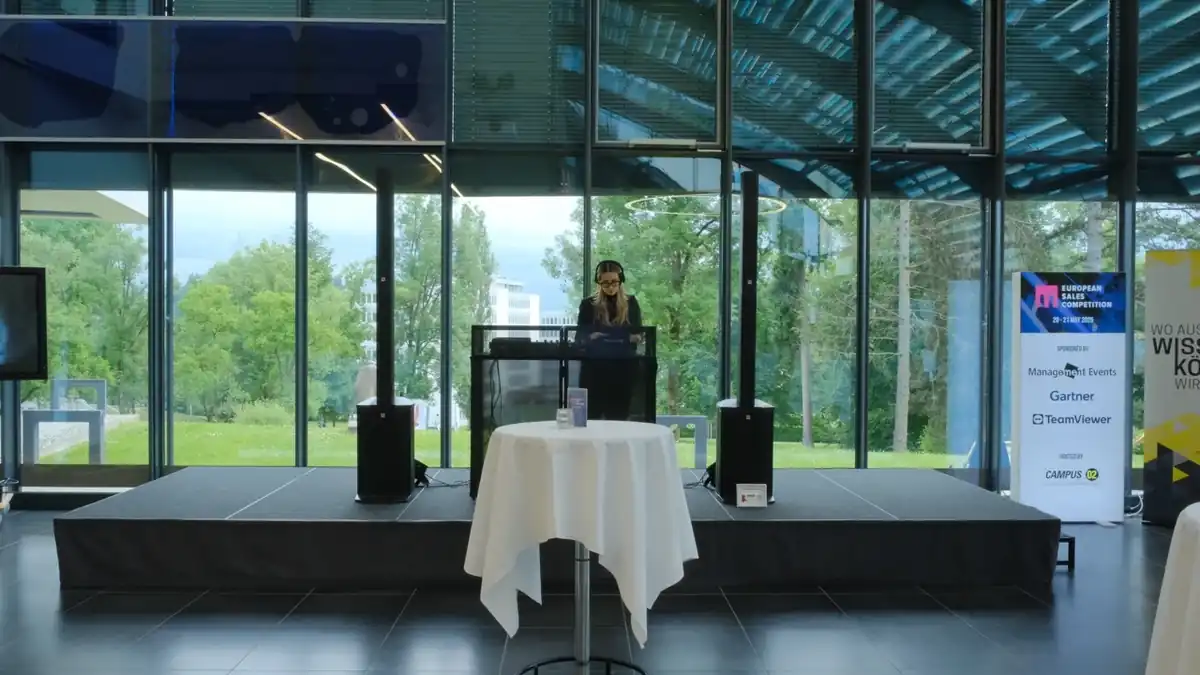
A large ballroom requires professional sound reinforcement. The principal's opening speech must be crystal clear, the band needs perfect sound on stage, and the after-party in the side area needs deep bass. Then there is the lighting technology to set the scene: from atmospheric lighting during the polonaise to a club vibe on the dance floor. Technology is one of the areas where graduating classes most often underestimate what is actually needed. A Bluetooth speaker is not enough for 200 guests in a ballroom. Plan for sound and lighting as a separate budget item and hire professional equipment.
Whether for the main stage or the disco floor: discover our deposit-free sound and lighting packages for graduation parties. Available in Vienna, Graz, Salzburg, and at all other Renty locations in Austria.
Music and DJ: Live band or DJ—this decision impacts costs, space requirements, and permits. Many graduation balls combine both: a band for the official part and a DJ for the party afterward. The choice of music is central to the atmosphere and the feel of the evening. Coordinate the playlist in advance and allow enough time for a soundcheck.
Catering: Catering options range from buffets and set menus to food trucks for the after-party. The price per person varies significantly. Clarify early on whether the venue requires you to use their in-house catering or if you can choose external providers. Drink flat rates sound attractive but can drive up costs.
Polonaise and opening: The opening with the polonaise is the festive highlight of the evening. The choreography should be rehearsed weeks in advance. Clarify early on whether you will hire a dance instructor and how many couples will participate. The official part, including speeches by the school administration and the committee, is an essential part of the schedule.
Midnight show: The midnight show is the creative highlight of the evening. Whether it’s sketches, dances, parodies of teachers, or a group performance by the entire class, this is where the graduating year shows what they’re made of. The midnight show requires preparation, technical equipment (microphones, music, and potentially a projector for images and video), and rehearsals. Need ideas for your midnight show? Check out our guide: Midnight graduation ball show: Ideas and implementation.
The graduation yearbook is both a keepsake and a source of revenue. Classic content includes profiles of the graduates, teacher rankings, funny quotes from class, photos, and a look back at your time in school. Plan the printing and layout in good time so the yearbook is ready for sale on the night of the ball. You can find everything you need regarding content, ideas, and layout here: Designing your graduation yearbook: Content, ideas, and layout tips.
In Austria, a raffle is a staple of any graduation ball. Collect prizes from local businesses. Sponsorship packages with clear benefits (logo placement, acknowledgments) increase your chances of success during outreach. With tickets priced between 2 and 5 euros each, you can easily generate several hundred euros in net profit with 200 guests.
A graduation ball is a once-in-a-lifetime event for many students. A professional photographer should be a fixed item on every checklist. Check references and clarify in advance what services are included in the price: group photos, portraits, online gallery. It is not uncommon to have two or three photographers at large balls. A photo booth is the perfect icebreaker for guests and provides additional photos and memories that you can share via the graduation yearbook or an online link. Learn more in our guide: Photo booth for your graduation party.
Event liability insurance: For public events, event liability insurance is generally mandatory. Clarify this early on. Liability lies with the organizer—in this case, your committee. For legal questions and professional coverage, it is advisable to consult experts like Ulrich Seitz.
Youth protection and admission: Youth protection regulations govern curfews and the serving of alcohol to minors. Admission checks are mandatory. State laws vary by region. Clarify these aspects early on with the responsible authorities.
AKM fees and registration: The AKM is the Austrian equivalent of the GEMA. Fees apply for public music playback and must be included in your budget. Graduation balls are considered public events and must be registered with the authorities. Fire department inspections and emergency exits must be documented in accordance with local regulations.
Sustainability: Avoiding single-use items reduces waste and disposal costs. Energy-efficient lighting and targeted technical planning lower electricity consumption. Using local suppliers and seasonal food for catering reduces transport requirements. Reusable decorations or DIY ideas are often cost-effective as well. Sustainability protects not only the environment but also your budget.
The Youth App offers event publication and reach through a youthful user base. You can use images and video in the Youth App to promote your graduation ball effectively and communicate everything related to the event. Nizer and similar tools offer invitation management, registration, and carpool organization. Digital registration systems make guest list management easier and automate ticket sales.
Social media integration increases visibility and simplifies communication with guests and sponsors. Setting up your organization digitally saves the committee a great deal of manual effort.
9 to 12 months before: Form an organizing team and define task distribution. Create a rough budget and set up a graduation ball bank account. Visit and pre-book potential locations. Contact service providers like bands, DJs, and photographers early. Choose a theme.
6 to 9 months before: Sign contracts for the venue, catering, and technical equipment. Target sponsors and collect raffle prizes. Start working on the graduation yearbook (form an editorial team, plan content). Launch fundraising campaigns.
3 to 6 months before: Finalize the program (polonaise, midnight show, speeches). Print invitations and tickets. Start advertising (social media, posters, Youth App). Define your decoration concept. Book photographers and a photo booth.
1 month before: Create the final guest list. Write a detailed schedule. Finalize the safety concept and duty rosters. Check youth protection regulations and plan admission checks. Register the event with the authorities.
1 to 7 days before: Technical rehearsal at the venue (soundcheck, lighting). Brief the setup team and check inventory for decorations and catering. Final coordination with all service providers. Ensure everyone on the team knows the schedule and is focused on their specific tasks.
👉 Planning your graduation ball and want to play it safe with the technology? At Renty, you can get PA systems, lighting, and photo booths for your ball—deposit-free, with delivery to your location anywhere in Austria.
When is the best time to start organizing the graduation ball?
Which roles should definitely be filled in the organizing team?
What are the typical costs and how do we finance the ball?
What legal and safety requirements must we consider?
Should we book a DJ or a live band for the music?
How can digital tools help us with ball organization?
Check event equipment, book in 90 seconds, and choose pickup or delivery. Deposit-free and insured throughout Germany and Austria.

Wir haben dir eine Mail geschickt, bitte bestätige sie um den Rabattcode zu erhalten.