An event budget clearly separates fixed costs, variable costs per guest, and revenue. A common mistake is a buffer that is too small; 10 to 15 percent should be included in every calculation. Here you will find the categories, three sample calculations for different types of events, and a template to download.

No budget, no event. And without a proper budget planning template, your calculation quickly becomes a guessing game. This guide shows you how to set up your event budget properly, which items you must consider, and how to significantly speed up budget planning using templates.
Whether it's a company party, conference, or meeting, the foundation of every event plan is a realistic budget. Working accurately here saves you from nasty surprises later. Creating a solid budget plan doesn't require event software or expensive tools. A well-structured Excel template is perfectly sufficient for most events.
Before you start with event budgeting, you need to understand the three pillars of your budget: fixed costs, variable costs, and revenue. Event calculation stands or falls with the correct classification.
Fixed costs are incurred regardless of the number of your participants. They are set as soon as you have decided on a venue and a framework.
Variable costs depend directly on the number of participants and the scope of your event. The more people who attend, the higher the expenses.
Calculating variable costs is one of the most critical steps in budgeting. It is best to create three scenarios with different numbers of participants (e.g., 50, 100, 150 people) to see the impact on your total budget.
The revenue side includes all income generated by your event:
Setting realistic revenue targets is just as important as estimating costs. Sponsors play a central role here, as they often cover a significant portion of the event budget.

A useful event budget requires clear categories. Without structure, you will quickly lose track of where the money is going. The following items form the basic framework for most event budgets:
Typical budget categories:
Every trade should have its own budget framework. This way, you can immediately see when a category is getting out of hand. Event costs are made up of all these items and form the basis for your controlling.
Assigning items to cost types: Assign each item to either fixed or variable costs. Technology and venue are usually fixed, while catering and materials are variable. This classification helps with event budgeting because you can immediately see which costs you can influence and which you cannot.
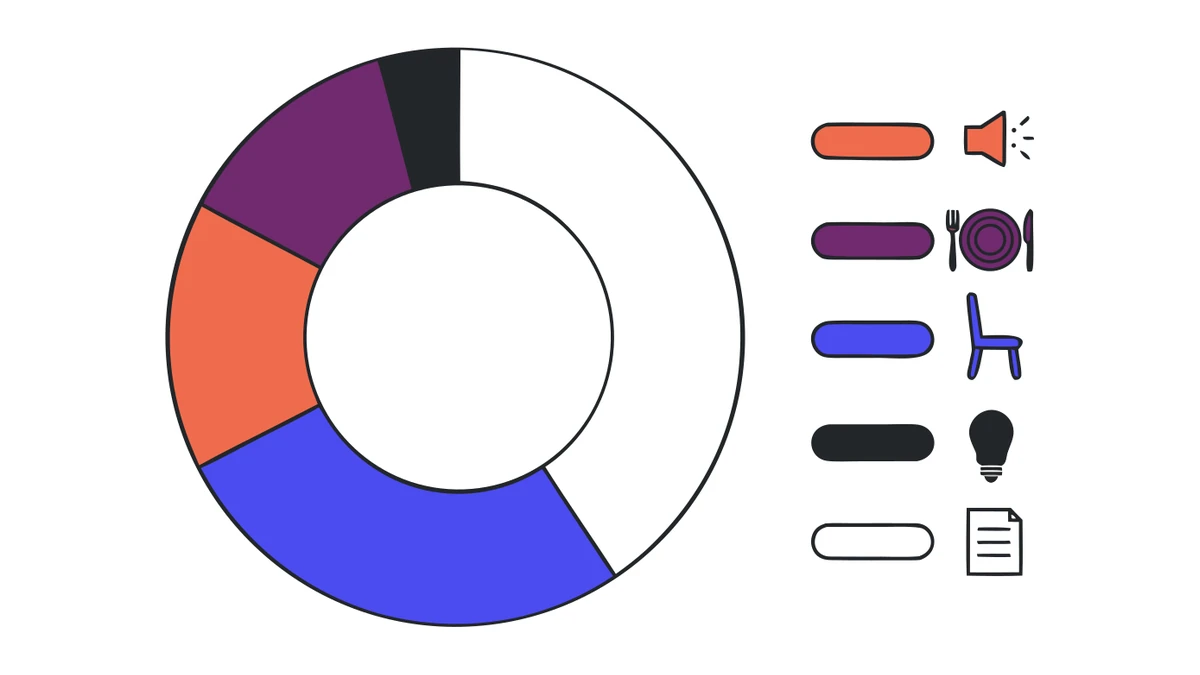
Always separate expenses and income in different sections of your template. This helps you keep an overview and see at a glance whether your event is planned to break even.
On the expense side, list all costs by category. Document all invoices and quotes from service providers so that the calculation remains transparent. You should store invoices centrally so you can quickly access them for queries or controlling purposes.
On the income side, record ticket sales, sponsorships, merchandise, and other revenue. Budgeting only becomes meaningful once both sides are complete. Also, include an emergency fund as a reserve for unforeseen expenses. Ten to fifteen percent of the total budget is a good rule of thumb here.
You can only make sound decisions regarding budget allocation if you keep your income and expenses up to date at all times.
Marketing is an integral part of every event plan. The costs for this should be included as a separate category in your event budget.
Set a timeline for when each measure will start. The possibilities are numerous, but not every channel is suitable for every type of event. A simple invitation is often enough for an internal meeting, while a public celebration requires more effort.
Budget planning differs significantly depending on the type of event. Here are two examples for guidance:
| Item | Estimated costs |
|---|---|
🏛️Venue (conference hotel) |
€2,500 |
🎛️Equipment (projector, microphones, lighting) |
€800 |
🍽️Catering (lunch, coffee, snacks) |
€3,500 |
👥Staff (technicians, reception) |
€1,200 |
📣Marketing and invitations |
€500 |
📦Logistics and materials |
€400 |
🛡️Contingency (10%) |
€890 |
ΣTotal |
€9,790 |
For a conference, catering and venue costs often account for more than half of the total expenses. Working with reliable service providers is crucial here.
| Item | Estimated costs |
|---|---|
🌳Venue (outdoor / garden) |
€1,000 |
🔊Equipment (PA system, lighting, photo booth) |
€600 |
🍽️Catering (buffet, drinks) |
€4,000 |
🎧DJ / Music |
€500 |
🎨Decoration |
€800 |
📦Logistics |
€300 |
🛡️Contingency (10%) |
€720 |
ΣTotal |
€7,920 |
For outdoor events, costs shift: less for the venue, more for logistics and equipment. If you want to stay flexible with technology, you can rent PA systems, lighting, and photo booths instead of buying them.
Calculate the break-even point: The break-even point shows you how many tickets sold or what level of sponsorship is required for your event to cover its costs. Simply divide the total costs by the revenue per ticket. Everything above that is profit.

Before you enter a single number into your template, you must clearly define your goals. What do you want to achieve with the event? Generate leads, build customer loyalty, launch a product? Your event goals will determine how you weight your budget.
Also define your desired return on investment. The simple formula: ROI = (Revenue - Costs) / Costs x 100. For an event with €10,000 in costs and €15,000 in revenue, this results in an ROI of 50%. Your organization's goals and the expected ROI serve as the compass for all further steps.
Collect binding quotes from all service providers and contractors. Don't forget the small items that add up: parking fees, coat check services, tips. Set aside a buffer of at least 10% to mitigate risks.
Summarize everything in a template and create a profit and loss forecast. This is the basis for approval by stakeholders or management. The more transparent your budget proposal, the faster you will get the green light.
The budget is set, now the real work begins. Set up a controlling process that continuously compares planned and actual expenses. Update your cash flow regularly and react to discrepancies early on. After the event, conduct an analysis: What worked, and where were there cost overruns? These insights will flow directly into the planning of your next event.
To ensure that cost control doesn't fall by the wayside on the day of the event, every item should also be included in the timeline. The event schedule shows you how to do this.
One item can be locked in earlier than most others: the technical equipment. Unlike catering or staffing, it doesn't depend on the final guest count, but rather on the venue and the program, and the price is fixed in advance. Starting with this gives you a reliable anchor for your budget. Our sound systems with transparent pricing display the daily rate directly.
For practical implementation, you need a template that fits your scope. Here are a few options:
Many templates offer visualizations like charts, which allow you to grasp the distribution of expenses at a glance. Choose the template that best supports your planning process.
Are you planning an event and need help with the overall planning in addition to the budget? In our event planning guide you will find everything you need regarding organization, technology, and procedures.
How do you create a budget plan?
Are there budget templates in Excel?
What should be included in a budget plan?
How high should an event budget be?
What costs are involved in an event?
How is sponsorship recorded in accounting?
Check event equipment, book in 90 seconds, and choose pickup or delivery. Deposit-free and insured throughout Germany and Austria.

Wir haben dir eine Mail geschickt, bitte bestätige sie um den Rabattcode zu erhalten.