A corporate event is any event hosted by a company that serves a business purpose rather than a private one. The term encompasses ten formats, from conferences to roadshows, which differ significantly in terms of participant numbers, duration, and technical requirements. The goal—leads, reach, knowledge transfer, or engagement—determines which format is the right fit.

A corporate event is an event hosted by a company to achieve a business goal. The term represents an entire category rather than a single format: it includes conferences, product launches, trade fair appearances, and internal kick-offs. What these events have in common is not their structure, but the intention behind them.
Anyone encountering this term in a briefing for the first time usually needs two things: a reliable definition and an overview of which event formats belong to this category and what they are good for. Both are provided here, along with the question of which key metric can be used to measure the success of a format.
A corporate event is any event initiated and funded by a company that serves a business purpose rather than a private occasion. The defining characteristic is the intention: there is a goal that extends beyond the day of the event, and someone within the company who is accountable for it.
The German equivalents are Firmenveranstaltung and Unternehmensveranstaltung, with Business Event also commonly used in the industry. All four terms refer to the same thing. "Corporate Event" and "Business Event" have become established primarily in marketing and agency environments, while "Firmenveranstaltung" is used more in internal communications and labor law contexts. There is no difference in meaning, even if "Business Event" is used slightly more often for external target groups.
A corporate event differs from a private celebration in ways that are also reflected in accounting: the company acts as the organizer and bears the costs, the invitation follows a business relationship rather than a personal one, and there is an expectation of a result. If the latter is missing, the event is not necessarily bad, but it cannot be evaluated afterward.
A common misconception: "corporate event" does not automatically mean large and formal. A workshop with twelve participants in your own meeting room falls into this category just as much as a congress with several hundred guests. The size determines the effort, not the classification.
Corporate events include ten formats that can be clearly distinguished from one another: conferences, meetings, congresses, product launches, trade fair appearances, kick-offs, customer events, roadshows, annual general meetings, and incentives. They differ less in terms of effort than in purpose, and that is exactly what determines which type of event suits a specific task.
The following overview categorizes common event formats by participant number, main goal, duration, and technical requirements. These values are based on practical experience rather than collected data. They indicate the scale at which a format typically takes place, not its upper limit.
| Format | Typical number of participants | Main goal | Typical duration | Technical requirements |
|---|---|---|---|---|
| 🎤Conference | 50-300 | Knowledge transfer and professional positioning | 1-2 days | high |
| 🗂️Conference | 20-150 | Coordination within the expert group | 0.5-1 day | medium |
| 🏛️Congress | from 200 | Industry exchange with multiple program tracks | 2-3 days | high |
| 🚀Product launch | 30-200 | Attention and press coverage | 2-4 hours | high |
| 🎪Trade fair appearance | open | Leads at the booth | 2-4 days | medium |
| 🧭Kick-off | 20-200 | Internal alignment and motivation | 0.5-1 day | medium |
| 🤝Customer event | 30-150 | Engagement and trust | 3-5 hours | medium |
| 🚗Roadshow | 20-80 per location | Broad regional reach | 3-4 hours per location | medium |
| 📋Annual general meeting | 50-500 | Legally required information | 3-6 hours | high |
| 🏖️Incentive | 10-60 | Appreciation and retention | 1-3 days | low |
Two observations from the table are more important for your selection than the individual figures. Technical requirements do not depend on the number of participants, but rather on whether there will be speaking and visual presentations: An annual general meeting with 80 people places higher demands on speech intelligibility than an incentive with the same group, because in the former, every word is part of the official record. Furthermore, shorter formats are not necessarily the simpler ones. A product launch often lasts only two hours, but requires the most intensive technical setup of all, because everything must be perfect within those two hours and there is no second take.
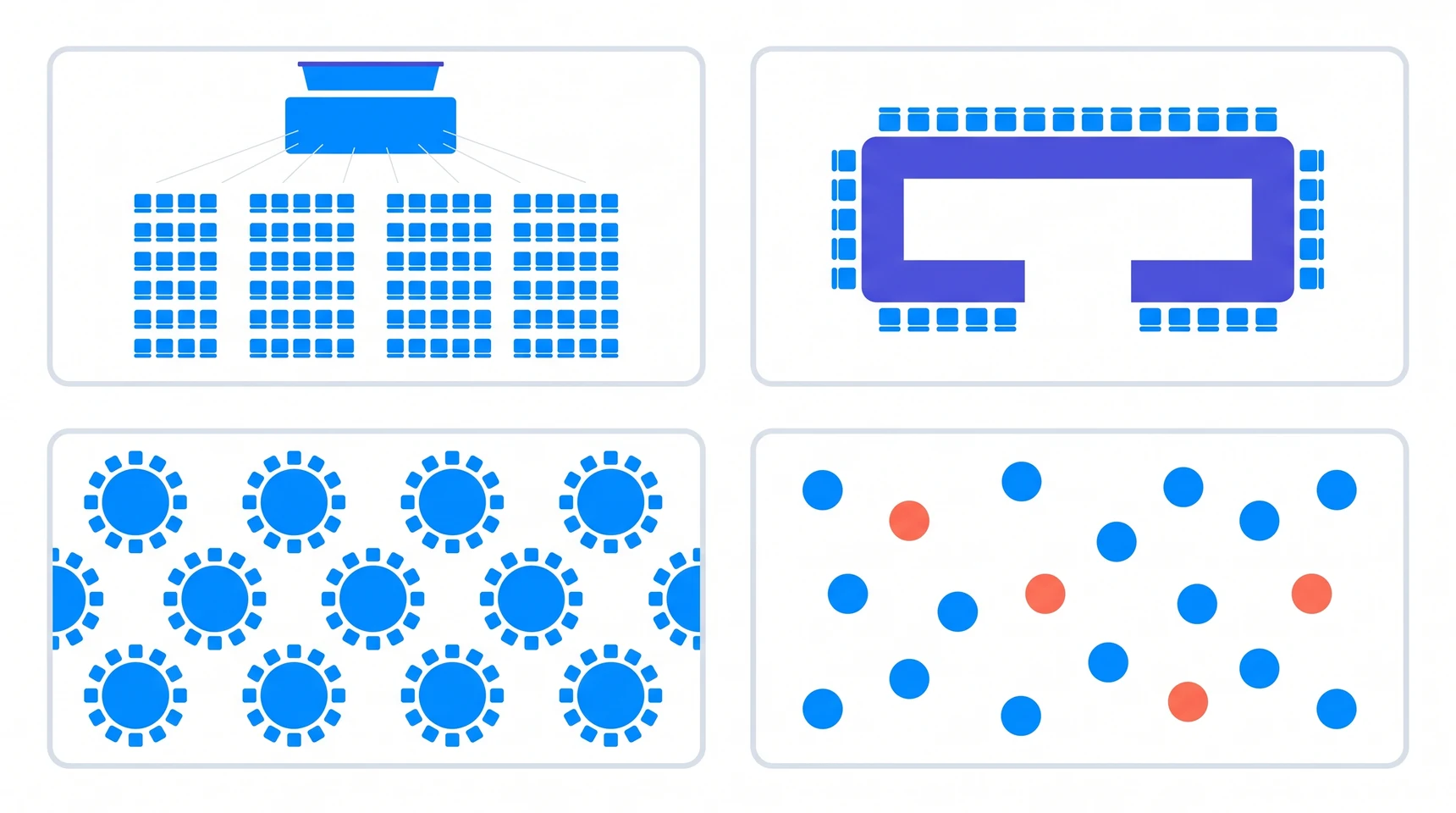
Theater-style seating accommodates the most people in the smallest space and is suitable for presentations where no active participation is required. U-shape seating works for up to about 25 people and facilitates discussion; beyond that, the ends are too far apart. Round tables are the choice when dining is followed by work, though they require more than double the space per person. A standing reception offers the highest rate of interaction per hour but the lowest level of attention for stage presentations, which is why speeches should be kept brief.
Company parties, team events, and company outings are subcategories of corporate events, not opposites. All three are hosted by the company and pursue a specific goal; they differ only in their target audience and purpose.
| Term | Target audience | Purpose | A corporate event? |
|---|---|---|---|
| Corporate event | Internal or external, depending on the format | Achieve a business goal | Umbrella term for all of the following |
| Company party | Staff, often with guests | Recognition and cohesion | Yes, as a subcategory |
| Team event | A team or department | Improve collaboration | Yes, as a subcategory |
| Company outing | Staff | Time spent together outside the workplace | Yes, usually without a specific program objective |
| Private party at company expense | Individual and personal circle | Private occasion | No |
In practice, this distinction becomes particularly important when allocating budgets and responsibilities. A company party is usually handled by HR or management, a customer event by marketing or sales, and a team event by the respective manager. If you mislabel the format, you end up in the wrong budget pot and have to seek approval twice.
Drawing the line at the lower end is easier than at the upper end: as soon as an event is predominantly private in nature and only coincidentally attended by colleagues, it is not a corporate event, even if the company contributes to the costs. Conversely, a format remains a corporate event even if it is fun. You can find an overview of which event types are suitable for individual teams in our overview of team-focused formats.
Every event format should have exactly one primary KPI used to measure its success. If you measure everything at once, you end up measuring nothing, and if you don't define anything beforehand, you end up evaluating based on the mood in the room.
| Format | Primary KPI | How it is collected |
|---|---|---|
| Conference and congress | Participation rate and satisfaction | Registrations versus actual attendance, brief follow-up survey for each program item |
| Meeting | Outcome density | Number of decisions made versus the agenda |
| Product launch | Reach and media coverage | Mentions, clippings, and search queries for the product name in the weeks following |
| Trade fair appearance | Qualified leads per day at the booth | Badge scans and meeting notes, excluding casual booth visits |
| Kick-off | Understanding of objectives | The same short survey before and after; three to four questions are sufficient |
| Customer event | Retention rate | Renewals, repeat purchases, and contact frequency of the invited group |
| Roadshow | Cost per contact | Total costs per location divided by the number of participants at that location |
| Annual general meeting | Attendance rate and voting participation | From the minutes, without additional data collection |
| Incentive | Retention rate of the invited group | HR data or sales figures over the twelve months following |

No benchmark figures. There are no reliable industry standards for any of these metrics to compare against. Publicly circulating benchmarks almost always come from self-reported data by individual providers and cannot be transferred between industries. A 60 percent participation rate can be excellent for a voluntary professional conference but a warning sign for a mandatory event. The only meaningful comparison is your own event from the previous year.
Two rules make measurement reliable. The metric must be defined before the event, not after; otherwise, you end up searching for the number that looks best. And it must be measured once the impact could have actually occurred: a retention rate after two weeks means nothing, but the same rate after two quarters does.
Costs must be part of the evaluation; otherwise, the denominator is missing. A customer event with a high retention rate is only a good event if the cost per retained customer is lower than the cost of acquiring a new one. A simple structure based on location, catering, technology, program, and personnel is sufficient for this; the <a href="#">Guide to Event Budget Planning</a>, including a template, shows how to set this up properly.
Two questions determine the technical requirements: Will there be speaking, and will something be shown? Everything else follows from the room size and the number of participants.
If there is speaking, speech intelligibility determines success. From about 30 people in a room with hard surfaces, the voice no longer carries reliably to the back, and attention drops long before anyone admits it. A handheld microphone or headset with a suitable pair of speakers solves this. For formats with audience questions, a second microphone is essential; otherwise, the moderator has to repeat every question, which noticeably wastes time over the course of two hours.
If something is being shown, luminous flux is the limiting factor. As a rule of thumb, the image width should be at least one-sixth of the distance to the last row; otherwise, text on the slides will no longer be legible from there. And every projector works against ambient light: in a conference room with closed blinds, a few thousand lumens are sufficient, but in front of a window on a bright morning, even a device with a good 5,000 lumens will not produce a clear image. If you have to present in daylight, a large screen is more reliable than a projection. Which devices are suitable for conference and meeting formats is sorted by luminous flux and resolution in the <a href="#">Overview of Presentation Technology</a>.
The most common mistake is not in the selection, but in the timing. Setup and soundcheck should not be on the day of the event if the room is accessible the evening before. Experience shows that the first time you switch everything on is when you discover if a cable is missing, and a day's buffer is worth more than any replacement device.
Beyond about 500 people, a format moves outside this scope. At that point, it becomes a matter of stage construction, trusses, and dedicated power supply—a different trade with its own planning and safety requirements. The values in the format table above refer to events below this threshold.
Corporate event management is the discipline that steers a business event from defining the goals to the follow-up. It encompasses much more than just the organization on the day of the event and begins long before that.
It starts with the goal, from which the format, target group, and budget are derived. This is followed by the concept, including location, schedule, program, and service providers, then the on-site implementation, and finally the evaluation against the previously defined metric. In larger companies, this role sits within marketing; in smaller ones, it is handled by the executive assistant or the HR department on the side. Professionally, it is an interface role: it rarely makes decisions itself but coordinates everyone who does.
The difference between a well-managed and a poorly managed event almost always shows in the sequence. Anyone who books the location first and then thinks about what should happen there will spend the rest of the project working against a room that doesn't fit the format.
After the format decision comes scheduling, working backward from the event date. The sequence is more important than the total lead time because the individual components have very different levels of scarcity.
Location and music are only available once for a specific date, so they must be clarified first. Technology is available in multiple units in the warehouse and can be determined later. An <a href="#">analysis of 2,176 bookings</a> at Renty shows how much this affects actual behavior: the median time between booking and the start of the event is 7.09 days, and a quarter of all events are equipped with technology less than 48 hours in advance. For the largest orders, this value rises to 15.89 days, still remaining under three weeks.
For your own planning, this means: the date and the room determine the scope of action, not the technology. However, if you need a specific device rather than just any solution, it is better to plan 2-3 weeks ahead during the peak season between May and September. The complete process, including a checklist and schedule, can be found in the <a href="#">Guide for Company Parties and Corporate Events</a>.
What is a corporate event?
What is the German term for a corporate event?
What is the difference between a business event and a company party?
What event formats are used in a corporate environment?
How do you measure the success of a corporate event?
What technology does a corporate event require?
Check event equipment, book in 90 seconds, and choose pickup or delivery. Deposit-free and insured throughout Germany and Austria.

Wir haben dir eine Mail geschickt, bitte bestätige sie um den Rabattcode zu erhalten.