A summer party relies on three building blocks: an interactive activity, a food concept that keeps guests moving, and equipment that works outdoors. The twelve ideas here include group size, effort, weather risk, and technical requirements, along with the point where they typically fall apart in practice.

A summer party relies on three building blocks: an activity where people participate instead of watching, a food concept that keeps guests moving, and equipment that works outdoors. Everything else is just a bonus.
The twelve ideas here include group size, effort, weather risk, and technical requirements, along with the point where they typically fall apart in practice. This is more useful than a list of forty keywords, half of which only reveal their pitfalls during setup.
Three categories cover the needs: competitive activities that quickly mix up a group, relaxed interactive formats for those who don't want to compete, and open games that run in the background. A good party has something from each category, otherwise the same half of the guests will always end up standing on the sidelines.
The following overview organizes the twelve ideas according to the four factors that really matter when choosing. These details are based on experience, not collected data.
| Idea | Group size | Effort | Weather risk | Technical requirements |
|---|---|---|---|---|
| 🏅Station-based Olympics | 20 or more | medium | medium | Microphone |
| 🧵Tug-of-war and throwing events | 16 or more | low | high | none |
| 🗺️Scavenger hunt or outdoor escape game | 10-60 | medium | low | none |
| 🍖Team grill-off | 12-40 | medium | medium | none |
| 🎨Collaborative canvas | any | low | high | none |
| 🍸Cocktail workshop | 8-30 | medium | low | Power |
| 📸Photo booth with a mission | 25+ | low | low | Power |
| 🔥Campfire with stick bread | 10-50 | low | high | none |
| 🪓Viking chess | 4-24 | low | medium | none |
| 🧱Giant games | any | low | medium | none |
| 💦Water relay | 20 or more | low | high | none |
| 🎯Target games | any | low | medium | none |
Formats with mixed teams where no one competes alone. The effect comes not from the competition itself, but from people working together who wouldn't normally interact in their daily routine. That is why teams are drawn by lot rather than chosen by the participants.
Station Olympics. Four to six mini-challenges that each group rotates through. You need one person per station, materials from a hardware store, and a sheet with a scorecard. Allow 60-90 minutes. It makes sense for 20+ people; any fewer and there is too much waiting around. The classic mistake: too many stations. Four well-prepared stations beat six improvised ones.
Tug-of-war and throwing games. The rustic classic, Highland Games on a small scale. A thick rope, a few weights or rubber boots for throwing, and you're set. 20-30 minutes, for about 16+ people. You need a flat, dry surface: on wet grass, tug-of-war becomes a slip-and-slide, and that is exactly when someone gets hurt.
Scavenger hunt or outdoor escape game. Small groups solve tasks along a route across the grounds or through the neighborhood. Preparation takes half a day, and the activity itself takes 60-120 minutes. It works for 10 to 60 people and is the most weather-resistant activity in the field because it can continue under rain jackets. A strict time limit is important, otherwise, groups will trickle in over the course of an hour.
Team grill duel. Each team receives the same box of ingredients and a grill, followed by a tasting at the end. It combines the program with catering, which saves time. 90-120 minutes, good for 12 to about 40 people. Beyond that, you run out of grill space and the duel turns into a queue. A neutral jury prevents arguments at the end.
Formats where you can join in or leave at any time. They are the counterpoint to scheduled program items and carry the part of the evening when no one wants to be guided anymore.
Community canvas. A large canvas or wooden board, paint, brushes, and a picture emerges over the course of the evening. It runs without supervision, costs little, and can be hung in the office afterward. Suitable for any group size. The catch is the weather: acrylic paint and rain don't mix, so this belongs under a roof.
Cocktail workshop or mocktail bar. Someone demonstrates three drinks, then the guests mix their own. Requires electricity for an ice crusher and cooling, a sturdy table, and someone to handle refills. 45-60 minutes for 8-30 people. Plan the non-alcoholic version as an equal option, not as an afterthought, otherwise half the guests will be standing around with just water.
Photo booth with a mission. A photo booth on its own gets used for two hours and then forgotten. With a task list—say, five motifs that every team has to deliver—it stays active all evening. Requires electricity and a wind-protected spot. It is worth it for about 25 guests or more; any fewer and the line is never long enough to create a buzz.
Campfire with bread on a stick. The most tranquil part of the program and often the one everyone remembers. Fire pit, wood, dough, sticks. From dusk onwards, 60 minutes or longer, for 10-50 people. Check for local permits beforehand and keep a bucket of water nearby. In dry or windy conditions, this activity must be cancelled without replacement.
Games that start without instructions and don't require a referee. They aren't announced; they are simply set out, and that is exactly why they work: those who want to join in do, and those who don't, watch.
Viking chess (Kubb). Throwing wooden blocks, rules explained in two minutes. 4-24 people, one game lasts 20-40 minutes. Requires a flat lawn area of about 5 by 8 meters and enough distance from seating areas, as thrown blocks travel further than expected.
Giant games. Connect Four, Jenga, or Mikado in XXL format. These run in the background, any group size, no time limit. They require a firm, level surface: on soft grass, a giant Jenga set will tip over by the third turn, and the fun is over before it even begins.
Water relay race. Cups, buckets, sponges, and everyone ends up wet. The most reliable activity on hot days, for 20+ people, 20-30 minutes. Announce it beforehand so people bring a change of clothes. Without an announcement, the very people you wanted to reach won't participate.
Target games. Can toss, ring toss, target wall. Set up in ten minutes, runs all day, for any group size. A small scoreboard nearby turns a pastime into a competition that can last for hours without needing anyone to moderate it.
A theme is only a theme if it changes at least three things: decoration, food, and music. If it's just the decoration, it's a color scheme, not a theme, and the effort isn't worth it.
Four themes that are easy to pull off: Summer Festival with wristbands at the entrance, multiple stalls, and street food. Mediterranean with long tables, antipasti, and soft guitar music, great for quieter groups. Retro Sports Day with sack races, egg-and-spoon races, and headbands; it helps break the ice for new colleagues. White as a dress code, minimal effort and maximum impact in photos.
When it comes to decoration, a special rule applies outdoors: paper and light fabrics won't withstand the first gust of wind. What works well outdoors and how to divide a space without walls can be found in our guide to decorating for garden parties.
Ideally, something that requires guests to get up. A single buffet line creates a queue and then a seating arrangement that won't change for the rest of the evening. Two or three distributed stations create movement, and movement creates conversation.
Proven ideas include live cooking with two or three stations at separate points, a food truck as a substitute for your own grilling team, a grill station with a full-fledged vegetarian line instead of just a single vegetable skewer, and an ice cream station for the late afternoon. The latter is the most underestimated item: it costs little and is the most popular part of the party on hot days.
When it comes to drinks, people often underestimate the amount needed outdoors because significantly more non-alcoholic beverages are consumed in the heat than at an indoor party. The drink calculator can work out what is realistic per person per hour in just a few steps.
For up to 30 people in a limited space, exactly one continuous activity plus two things running in the background works best. Anything more won't fit spatially and will feel rushed.
The most reliable combination is a grill-off or a cocktail workshop as the main theme, plus Viking chess and target games on the sidelines. None of these three require a stage, a schedule, or a moderator. If you prefer something quieter, swap the grill-off for a collaborative canvas and start later in the afternoon.
In a private or company garden, three things are different than at a rented venue. Power comes from a single outdoor outlet, which shouldn't be used for an ice crusher, photo booth, and music all at once. The ground is rarely as level as it looks, which affects high tables and giant games. And the neighbors are listening, so it's better to schedule the loud part of the program before the evening.
With a budget, the effort shifts from your own time to purchased services—not from bad to good. A party with Kubb and a grill-off can be better than one with three service providers, provided the group is the right fit.
Kubb, target games, tug-of-war, a grill-off, and bread on a stick. Equipment comes from your own supplies or from colleagues, and music plays through a portable speaker. This is enough to carry an afternoon for a manageable group.
A photo booth, a cocktail workshop, a pavilion for rain protection, and rented sound equipment. Here, the effort shifts from your own time to purchased services, and the evening becomes more predictable.
Multiple stations running in parallel, live cooking or a food truck, lighting for the evening, and music from a band instead of a playlist. From this level on, you need someone whose sole focus is managing the schedule.
What is underestimated at every level are the items that aren't "ideas": seating, shade, power, waste disposal, and the hours for setup and teardown. If you only factor these in at the end, you'll end up cutting the program. A structure for this is provided in the Event Budget Planning Guide including a template.
Both require a decision in advance, not a reaction on the day itself. Rain costs you space, heat costs you programming, and both can be mitigated if the alternative is already in place.
The weather decision should be scheduled, not debated. Decide in advance who makes the call and when. A fixed time on the day before is sufficient in most cases and gives catering, technical staff, and guests enough lead time. Anyone who pushes the decision to the morning of the event is deciding under pressure and usually makes the wrong choice.
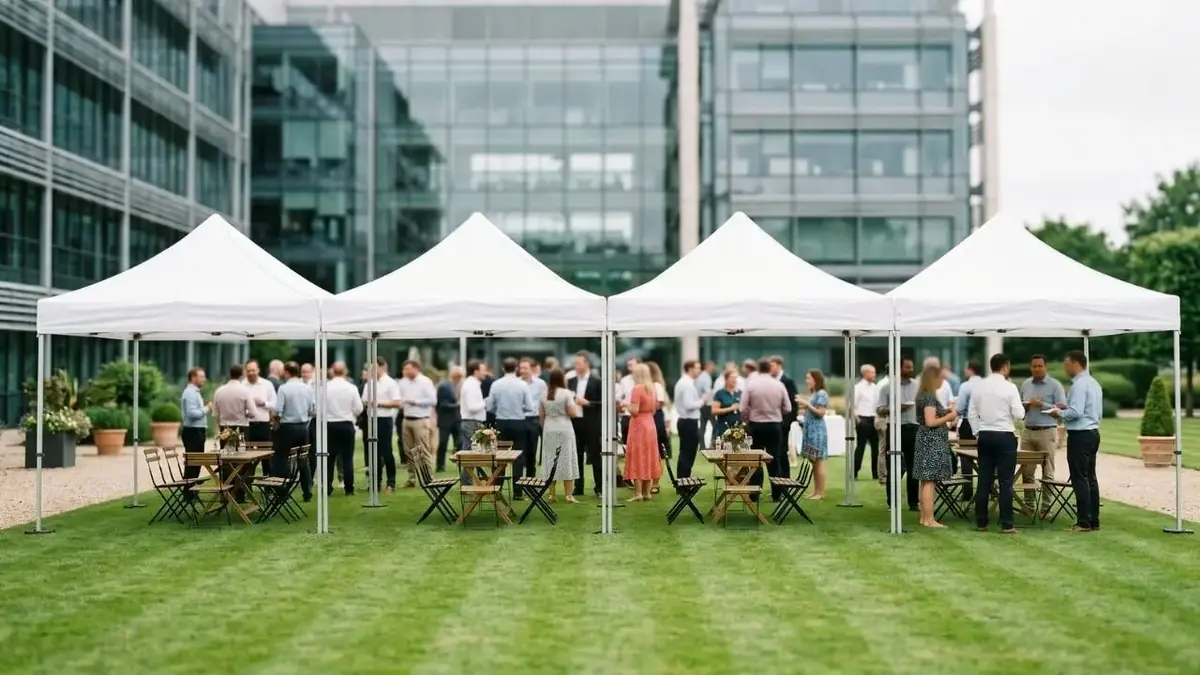
In the event of rain, covered space is the bottleneck, not the mood. A three-by-three-meter pavilion holds significantly fewer people standing than you might expect on paper once a table is placed underneath. So, plan the space for half the guests, not all of them. The ground is the second issue: a lawn after two hours of rain is no longer a playing field. Move activities that can continue indoors or under cover—like scavenger hunts, workshops, or presentations—to an earlier time. Technical equipment should be elevated and covered, and cable connections should not be on the ground.
In the heat, shade is more important than any drink. Without a shaded area, guests will sit inside the building rather than on the lawn once it hits 30 degrees Celsius. Water should be freely accessible, not just at a bar where people have to queue. Push the start time back; starting at 4 p.m. saves more than any decoration. Physically demanding activities should not take place during the midday heat, and technical equipment with dark casings—especially batteries and power stations—should be kept in the shade, as they will shut down in the sun.
Two things decide this: whether there will be speeches and how large the area is. The number of guests is a poor indicator outdoors because people spread out much further than they do in a room.
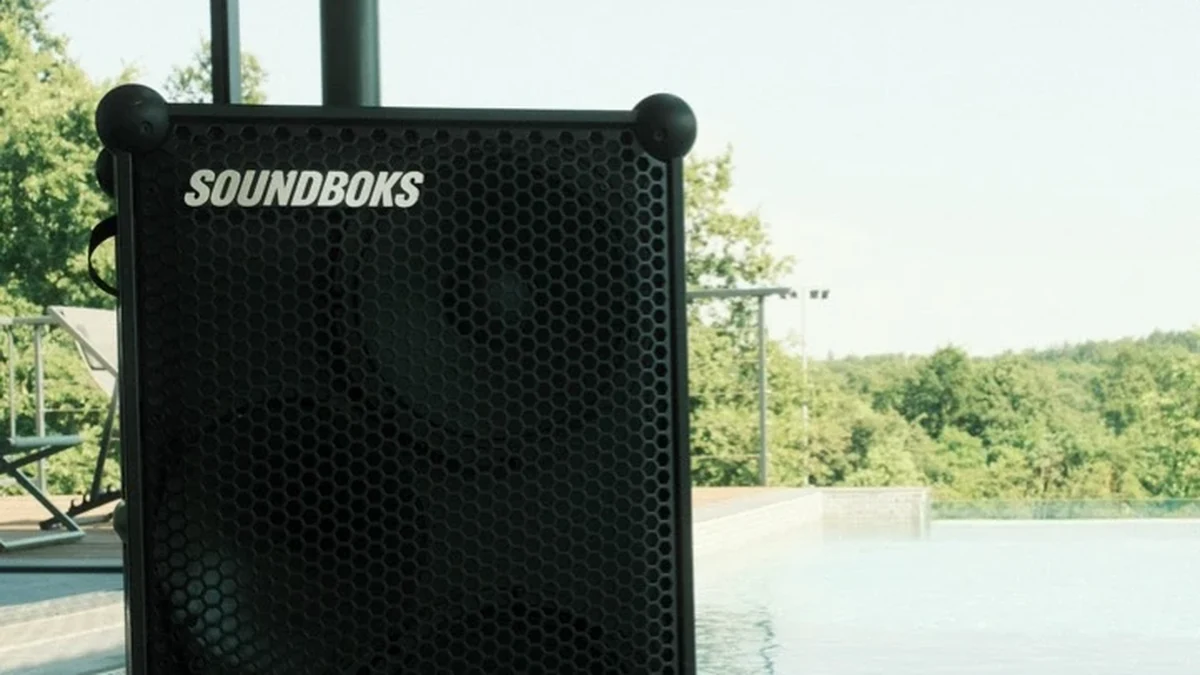
Sound behaves differently outdoors than in a hall. Without walls, there is no reflection, the volume drops noticeably with every meter, and the wind carries the rest away. A portable speaker can reliably cover a seating area, but not a lawn with scattered stations. From Renty's experience: the point at which a party speaker is no longer enough isn't determined by a specific number of guests, but rather when the furthest corner is more than 15 meters away from the speaker. Beyond that size, a proper outdoor PA system belongs on the list; otherwise, the music will be too loud in the middle before it even reaches the back.
Two other points are regularly forgotten. Electricity is practically non-existent in meadows and parks, and a mobile power station is a quieter solution than a generator. And lighting: once dusk falls, the lighting determines whether the party continues or fizzles out. Paths and food stations should be illuminated; the rest can remain dark.
Once the concept is set, implementation follows with the date, location, and schedule. The complete process for this is included in the guide to summer parties with a checklist.
What can you do at a summer party?
Which summer party ideas are suitable for a small company?
Which games are suitable for an outdoor summer party?
What to do if it rains during your summer party?
What theme works for a summer party?
When is a portable speaker no longer enough for music?
Check event equipment, book in 90 seconds, and choose pickup or delivery. Deposit-free and insured throughout Germany and Austria.

Wir haben dir eine Mail geschickt, bitte bestätige sie um den Rabattcode zu erhalten.