A garden wedding rarely fails because of the decor, but rather because of power, sound, and weather. First, clarify where the power will come from and where guests can go if it rains; everything else follows. Here you will find step-by-step planning, how to choose a sound system and power station, and a Plan B for the weather.

A garden wedding is one of the most beautiful ways to get married, but also one of the most demanding in terms of organization. Because in your own garden, there is no ready-made infrastructure: no power on the dance floor, no toilets, no kitchen for catering, and no rain protection.
This guide shows you how to plan a garden wedding without any nasty surprises. From layout planning, technology, and weather protection to the decor that will transform your garden into a dream location.
👉 You can find everything about music, sound, and entertainment in our Wedding Music & Entertainment Guide.
A garden wedding is not just a cheap alternative to a classic venue. It has real advantages that no event location in the world can offer:
But: A garden wedding requires significantly more planning than a ready-made venue. You are essentially your own event planner. If you know this in advance and plan systematically, you will be rewarded with a celebration that is more personal than anything a banquet hall could offer.
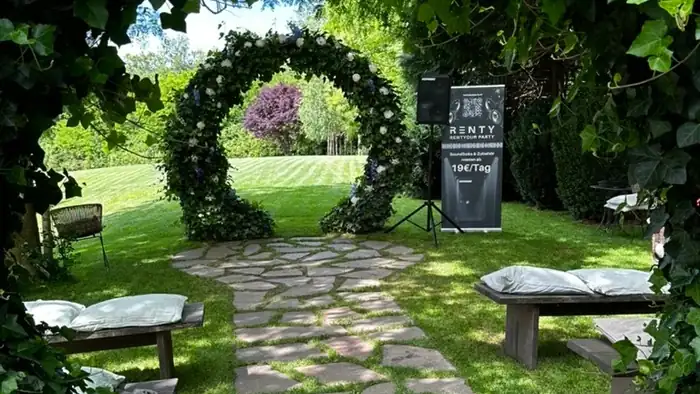
Before you dive into the planning, honestly check whether your garden (or the garden of friends or family) is suitable as a location for a wedding celebration.
Rule of thumb: Allow for approx. 8-10 m² per guest (including ceremony, dining area, dance floor, and paths). For 50 guests, you therefore need at least 400-500 m² of usable space. That is more than most people underestimate.
Sketch the garden to scale and divide it into zones:
A lawn looks beautiful, but it can become slippery when it rains. Check whether the ground can support tables, chairs, and a tent. For the dance floor and dining area, floor panels or a solid surface are recommended, especially if guests are wearing heels.
Is the garden located in a residential area? If so, noise control is a real issue. More on that later.
This is the point where most garden weddings succeed or fail. A private garden does not have the infrastructure designed for 50–100 guests.
Music, lighting, refrigerators, coffee machines, and possibly a photo booth—all of these require electricity. Standard household outlets are usually not enough, and long extension cords running across the lawn are a tripping hazard.
The solution: Portable power stations provide electricity exactly where you need it—wirelessly, quietly, and without the noise of a generator. Portable power stations are available for rent and can power your sound system, string lights, and battery-operated spotlights all evening long.
If you have high power requirements (e.g., catering with electrical appliances), plan early with an electrician to set up a separate distribution box. The house alone usually cannot handle it.
Your home bathroom is not enough for 50+ guests. Mobile toilets are a must for a garden wedding and are no longer just construction site cabins. There are elegant restroom trailers with mirrors, sinks, and lighting. Plan for about one unit per 25 guests.
If you are hiring a caterer, they will need a water connection near the kitchen area. Clarify this in advance, as a garden hose is not always sufficient for professional providers.
The weather is the biggest uncertainty factor for any outdoor wedding. Even in the height of summer, it can rain, storm, or turn unexpectedly cold in Germany and Austria.
For a garden wedding, a tent isn't a luxury option—it's essential. Even if the weather forecast looks perfect, plan for a tent that covers at least the dining area and the dance floor. An overview of tent types:
Tip: Book your tent early; during peak season, the best providers are booked out months in advance.
It’s not just rain that can be a problem. Blazing sun in a meadow with no shade is just as uncomfortable for guests in wedding attire. Make sure to provide:
Outdoor garden weddings can get chilly quickly in the evening. Plan for:
The decor turns your garden into a wedding venue. The best part: at a garden wedding, nature is already half the decoration—you just need to showcase it.
Choose 2-3 colors that run throughout the entire celebration, from the invitations to the table decor. Especially popular for garden weddings: cream, sage green, dusty rose, and warm gold tones. These colors blend perfectly into the natural surroundings and create a harmonious atmosphere.
The wedding table is the centerpiece of your garden wedding. Combine:
A floral-adorned wedding arch is the visual focal point of the ceremony and the most popular photo spot of the day. Whether made of wood, metal, or macramé, the arch defines the ceremony area and provides a festive frame for an outdoor wedding in the garden.
If the ceremony itself is to take place in the garden, the question of logistics and equipment arises early on. This guide shows how to plan an outdoor wedding ceremony.
Lighting makes the difference between a "garden party" and a "dream wedding." Once dusk falls, lighting completely takes over the atmosphere:
Battery-operated LED spotlights: they don't require a power outlet and can be positioned anywhere in the garden. Perfect for highlighting individual decor elements once it gets dark outdoors.
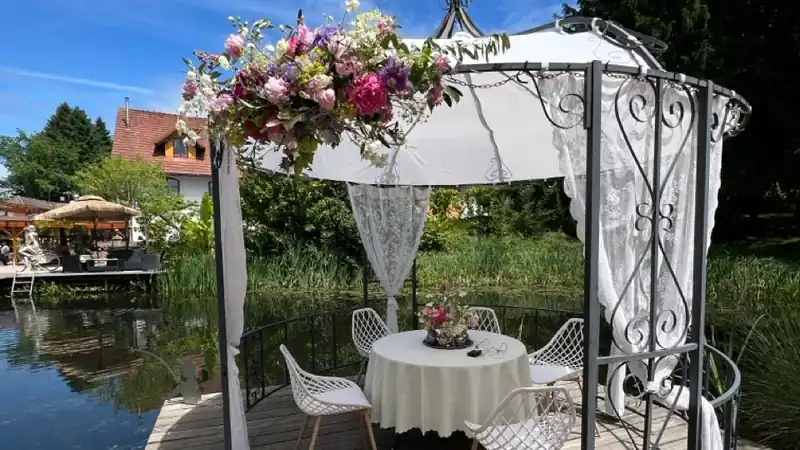
When it comes to catering for a garden wedding, you have more freedom than at any venue, but also more responsibility.
Popular catering formats:
What you need to look out for: The caterer requires a sheltered workspace (tent or pavilion), access to water and electricity, sufficient refrigeration, and enough room for preparation. Clarify these details before you book.
Supplement your catering with self-service stations: a lemonade bar, a candy bar, or a coffee station with espresso. These stations fill the gaps between program items and always give guests a place to gather.
A wedding in your own garden is not a private affair if the neighbors call the police at 10 p.m. Here are the most important points:
Inform neighbors early: Talk to your neighbors in person at least 4–6 weeks in advance. A friendly conversation combined with a small invitation card works wonders. Some couples even invite their immediate neighbors over for a glass of sparkling wine, which builds understanding and prevents complaints.
Observe quiet hours: In Germany, quiet hours generally begin at 10:00 p.m. in most municipalities. This doesn't mean the party has to end at 10 p.m., but the volume must be turned down significantly. Move the party into the tent from that point on (closed sides dampen sound tremendously) and turn the music down.
Check for permits: Depending on the municipality and the size of the celebration, an event permit may be required. This is especially true if a tent is being set up or if the garden borders public property. A quick call to the local regulatory office will clarify this in five minutes.
Music is essential for every wedding celebration and presents a special challenge in a garden. Because outdoors, you lack the acoustics of an enclosed space: The sound disperses in all directions, and after 20 meters, you won't be able to hear the wedding vows anymore.
What you need for good sound at a garden wedding:
Battery-powered speakers like the Soundboks can be rented from Renty without a deposit. They provide enough power for a garden wedding and work completely without a power connection. Set up, switch on, done.
👉 More on the topic of music, equipment, and DIY DJs: Our Wedding Music & Entertainment Guide explains everything in detail.
12–9 months before:
6–3 months before:
1 month before:
The day before:
Music and sound for your garden wedding in detail: Our Wedding Music & Entertainment Guide shows you how to choose the right system, what a DJ costs, and why a playlist is often the better choice. And for all other planning steps: Planning a Wedding: Guide & Checklist (2026).
How many guests fit into a standard garden?
Isn't a large private Bluetooth speaker enough for a small outdoor wedding with 40 guests?
How much does a garden wedding cost?
How do I solve the power problem?
What should we do if it rains?
Do I need a permit?
Check event equipment, book in 90 seconds, and choose pickup or delivery. Deposit-free and insured throughout Germany and Austria.

Wir haben dir eine Mail geschickt, bitte bestätige sie um den Rabattcode zu erhalten.