


Gib Gästezahl, Ort und Eventart ein. Du bekommst die benötigte Leistung in Watt RMS und die Anlage, die dazu passt.
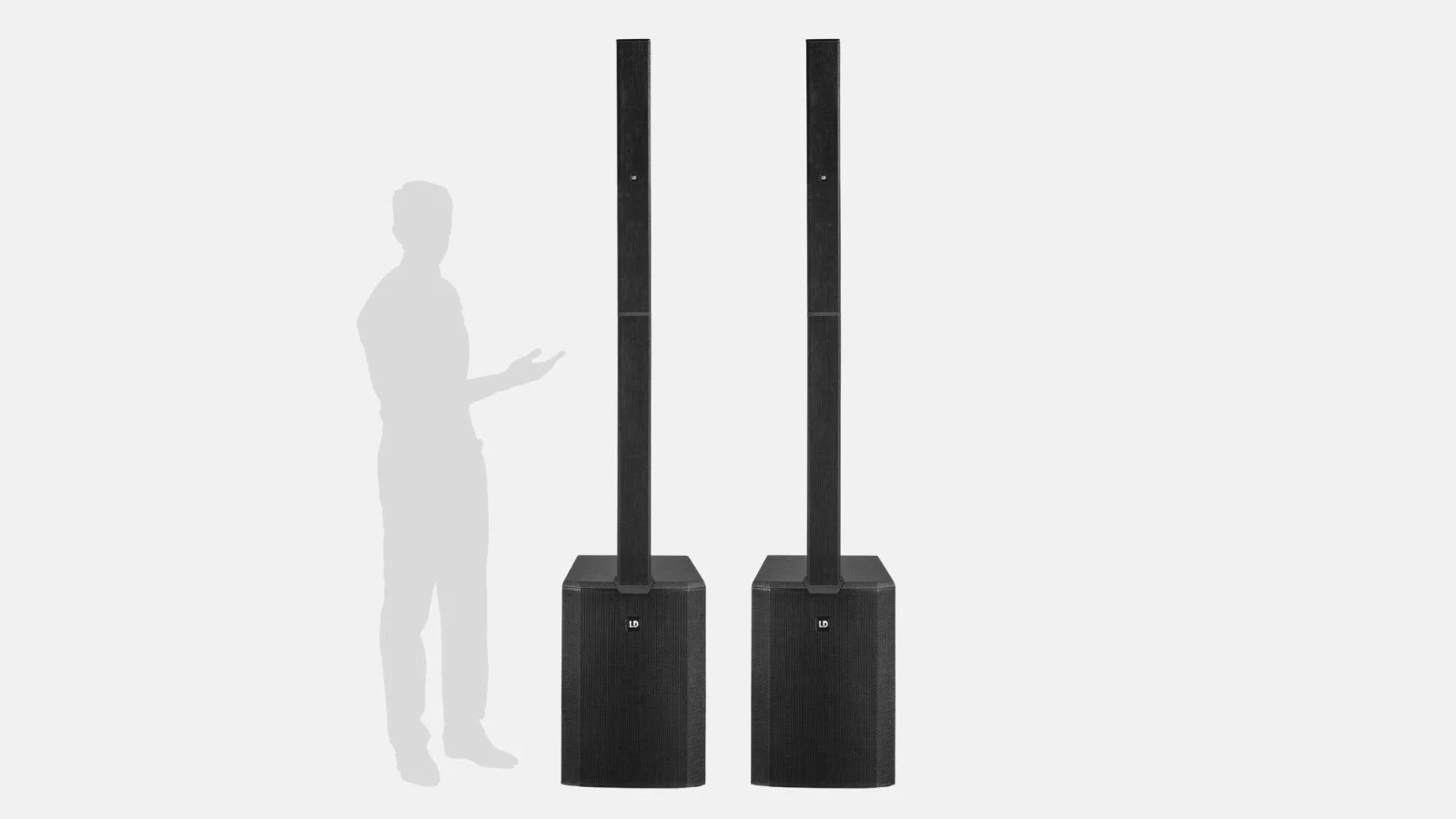
Mehr Reichweite bei gleicher Bauform. Sinnvoll in langen Räumen und überall dort, wo die Anlage nicht auffallen soll.
Richtwerte in Watt RMS für Indoor-Veranstaltungen. Draußen rechnest du das 1,4-fache dazu, weil der Schall sich ohne Wände ungebremst verteilt.
| Personen | Vortrag und Rede | Hochzeit und Feier | Party und DJ | Live-Band und Konzert | Typische Anlage |
|---|---|---|---|---|---|
| 50 Personen | 50 W | 200 W | 300 W | 600 W | Akku-Lautsprecher oder Säulensystem |
| 100 Personen | 100 W | 400 W | 600 W | 1.200 W | Säulensystem oder 2 Topteile |
| 200 Personen | 200 W | 800 W | 1.200 W | 2.400 W | Erweitertes Säulensystem oder 2 Topteile |
| 300 Personen | 300 W | 1.200 W | 1.800 W | 3.600 W | 2 Topteile mit Subwoofer |
| 500 Personen | 500 W | 2.000 W | 3.000 W | 6.000 W | 2 Topteile mit 2 Subwoofern |
| 1.000 Personen | 1.000 W | 4.000 W | 6.000 W | 12.000 W | Line-Array als Groundstack |
| 2.000 Personen | 2.000 W | 8.000 W | 12.000 W | 24.000 W | Line-Array als Groundstack |
| 5.000 Personen | 5.000 W | 20.000 W | 30.000 W | 60.000 W | Line-Array geflogen |
Ab etwa 800 Gästen entscheidet nicht mehr die Wattzahl, sondern die Abdeckung. Eine Anlage aus zwei Topteilen erreicht die hinteren Reihen auch dann nicht sauber, wenn die Leistung rechnerisch passt. Deshalb steht ab dieser Größe ein Line-Array in der Tabelle und keine größere Box.
Die Gegenrichtung: du kennst die Leistung einer Anlage und willst wissen, wofür sie reicht. Werte für Indoor, gerechnet auf Watt RMS.
| Leistung | Vortrag und Rede | Hochzeit und Feier | Party und DJ | Live-Band und Konzert |
|---|---|---|---|---|
| 500 W RMS | 500 Personen | 125 Personen | 85 Personen | 40 Personen |
| 1.000 W RMS | 1.000 Personen | 250 Personen | 165 Personen | 85 Personen |
| 2.000 W RMS | 2.000 Personen | 500 Personen | 330 Personen | 165 Personen |
| 4.000 W RMS | 4.000 Personen | 1.000 Personen | 665 Personen | 330 Personen |
| 6.000 W RMS | 6.000 Personen | 1.500 Personen | 1.000 Personen | 500 Personen |
| 10.000 W RMS | 10.000 Personen | 2.500 Personen | 1.665 Personen | 835 Personen |
| 20.000 W RMS | 20.000 Personen | 5.000 Personen | 3.330 Personen | 1.665 Personen |
Die Spalte Vortrag und Rede zeigt, wie unbrauchbar die Wattzahl als alleiniger Maßstab ist: rechnerisch beschallt eine 2.000-Watt-Anlage 2.000 Zuhörer mit Sprache, praktisch scheitert sie lange vorher an der Abdeckung. Sprache braucht wenig Leistung, aber viele gut platzierte Lautsprecher. Nimm die Werte deshalb als Obergrenze der Leistung, nicht als Kapazität der Anlage.
As a guideline, you need 1 watt RMS per person indoors for speech, 4 watts for a celebration with dancing, 6 watts for a party with a DJ, and 12 watts for a live band or concert. For 500 people at a party, that is about 3,000 watts RMS, or about 4,200 watts outdoors. These numbers are the starting point, not the final result: from about 800 guests, it is no longer the power that matters, but how evenly the system covers the area.
Wattage remains the best initial filter. It tells you which class you need to look in and prevents the two most expensive mistakes: a system that cuts out at the crucial moment, and a system you pay for but never fully utilize. The calculator above handles the multiplication and adds the factors that are often overlooked in mental math, such as location, area, and type of event. A tip in advance: it is better to calculate based on the loudest part of the evening rather than the average.
What is interesting is not the wattage itself, but where the jumps occur. Between 80 and 120 guests, almost nothing changes technically, whereas between 300 and 500, the design of the system changes completely. The following sizes are the exact points where a larger speaker turns into a different type of system.
For 100 guests, depending on the program, you will need between 100 watts for a presentation and 1,200 watts for a loud live band. For the most common scenario—a celebration with speeches in the afternoon and dancing in the evening—about 400–600 watts RMS is realistic. This is covered by a column system like those built by LD Systems or HK Audio: a narrow column on a flat bass module that distributes sound at ear level instead of up into the ceiling. Two top speakers on stands do the same and cost less, but they take up more space and look significantly more technical in the room. You can find suitable systems in the sound systems category.
200 guests is the threshold where many systems have to work hard for the first time. For a party and DJ, you should calculate about 1,200 watts RMS; for a wedding with a dance floor, 800 watts. Technically, the design remains the same, but the placement becomes more important: a single position at the front is no longer sufficient for long rooms without it becoming uncomfortably loud at the front. Two top speakers to the left and right of the dance floor solve this better than a more powerful system in one spot. If you are planning for a live band, you are already looking at 2,400 watts, which puts you in a different class.
This is where the first real jump occurs. For 500 people at a party, you are looking at around 3,000 watts RMS, and 6,000 watts for a concert. You can no longer get this power from a full-range speaker because the low frequencies consume the majority of the energy. From this point on, you work with separate paths: two top speakers for mids and highs, plus two subwoofers on the floor for everything below about 100 Hertz. This is the exact configuration almost always used for weddings and corporate events of this size. You can find suitable systems under PA systems, and from this size upward, we will coordinate the setup with you in advance.
Mathematically, 1,000 guests at a party require 6,000 watts RMS. In practice, the number becomes secondary at this point because the problem is no longer power, but distance. With a standard speaker, sound pressure drops by about 6 decibels every time the distance is doubled. If you want people in the 30th row to hear anything, the people in the front will be sitting in noise. Line arrays solve exactly this: multiple narrow modules stacked on top of each other focus the sound vertically, losing only about 3 decibels per doubling of distance. For 1,000 guests, the system is usually set up as a ground stack on a pile of subwoofers; flying the array only happens beyond this size.
At this scale, the system is no longer a rental package, but a project. For 2,000 guests at a concert, you are looking at 24,000 watts RMS; for 5,000 guests, two and a half times that. At this point, factors that have nothing to do with wattage become decisive: rigging and structural engineering for flown arrays, a dedicated power supply instead of standard wall outlets, delay positions for the rear areas, and a sound check before doors open. Renty is designed for equipment that can be transported in a car and set up without a crane. For events of this size, we will be honest with you about what is required and what we can cover before we provide a quote.
PA systems differ less in power than in how they distribute sound. Anyone who knows the three designs immediately understands why two sound systems with the same wattage can sound completely different.
A compact PA is a single active speaker with a built-in amplifier, Bluetooth function, and often a battery. For a champagne reception, a presentation in a seminar room, or a small party, this is the most uncomplicated solution, and as a mini PA, it fits into any trunk. The column PA goes a step further: a flat bass module on the floor, topped by a narrow column with many small drivers. This design distributes sound broadly horizontally and narrowly vertically, meaning it beams at the audience rather than the ceiling. The MAUI series from LD Systems and the column systems from HK Audio are common here. The practical advantage is the look: a column is barely noticeable in a hall, whereas two tops on stands certainly are. However, this design reaches its limits at very large events.
From about 300 guests, the classic separation makes sense. Two full-range speakers as tops handle the mids and highs, while one or more subs handle the range below. A 12-inch subwoofer is sufficient for most celebrations; for electronic music and loud bands, 15 or 18 inches are the better choice. Almost all systems of this type are active, meaning they have a built-in Class-D amplifier and DSP presets that allow the system to be switched to speech, music, or sub mode at the touch of a button. Brands like JBL, RCF, Electro-Voice, and dB Technologies build the most common systems in this class, and these are exactly the devices we have in our warehouse.
Line arrays are not just larger speakers; they are a different principle. Several narrow modules are hung or stacked to acoustically couple into a line source. The result is a significantly flatter drop in volume over distance and precise control over which area is covered and which is not. This is exactly why line array systems are placed in front of the stage at large events, both outdoors and in halls. The price for this is effort: rigging, structural analysis, calibration, and a dedicated power supply are all required.
Wattage ratings are the most unreliable value in event technology because two completely different numbers share the same name. RMS is the continuous power that an amplifier can deliver cleanly. Peak is the maximum power for fractions of a second and is two to four times higher, depending on the manufacturer. A system advertised as 2,000 watts often has 500 watts RMS. Systems can only be compared via RMS, and that is exactly what the calculator above uses.
This also puts the search for a 10,000-watt PA system into perspective. 10,000 watts RMS covers about 1,700 guests for parties and DJs, or about 830 for a loud concert. 10,000 watts peak, on the other hand, is a decent system for 300–400 people. Two systems with the same number on the data sheet can therefore differ by a factor of four. When in doubt, ask for the RMS value per speaker and add the speakers together instead of trusting the total figure.
In addition, there is a physical point that often comes as a surprise: doubling the power only results in 3 decibels more, and 3 decibels is heard as a slight increase, not as double the volume. If you want noticeably more pressure, you need about ten times the power or speakers with higher efficiency. That is why the jump from 2,000 to 2,400 watts is practically useless, whereas switching to a system with better efficiency makes a huge difference.
Indoors, walls, ceilings, and floors work for you. Some of the sound is reflected and reaches the audience a second time. Outdoors, this is completely missing; the sound disperses unchecked and is gone. As a rule of thumb, calculate 1.4 times your indoor figure. This turns 3,000 watts for 500 party guests into about 4,200 watts.
The second effect hits the bass the hardest. Low frequencies need boundary surfaces to build up pressure. Without them, a system sounds thin outdoors, even if it was impressive indoors. For about 100 guests or more with dance music outdoors, a subwoofer is almost always required—preferably two small ones in two positions rather than one in the middle.
The third point is power. A standard 16-amp Schuko socket provides about 3,600 watts of continuous load for everything combined—PA, lighting, fog machine, and refrigerator. With systems in the 3,000-watt class and up, things get tight as soon as you add lighting. Calculate the requirements beforehand; the Power Consumption Calculator does this in a minute.
The number of people determines how much energy is needed in the room. The area determines how far it must travel. These two rarely align: 200 guests in a 180-square-meter hall is a different task than 200 guests spread over 600 square meters. As a guideline: you can use standard values for up to about 1 square meter per person; from 2 square meters per person, plan for about 20 percent more power. The Space Requirement Calculator estimates how much space your guests and the equipment actually need.
High ceilings over about four meters consume extra energy because some of the sound disappears upward, and they often introduce reverberation. Rooms with lots of glass, concrete, or bare walls sound echoey, and reverberation eats up speech intelligibility faster than power can compensate for it. Room acoustics therefore directly influence how much power you actually need. In such rooms, an additional speaker in the middle of the hall helps more than a more powerful system at the front.
There are two rules for setup. Speakers belong above head height; otherwise, only the front row will hear clearly. Also, the distance between the left and right speakers should roughly correspond to the depth of the audience area. If they are too far apart, a hole forms in the middle; if they are too close, you waste the width.
A PA system is never just the speaker. The basic setup includes the top speakers for mids and highs, one or more subwoofers for low frequencies at larger events, stands to get the speakers to ear level, and all the cabling. Active systems have the amplifier built-in and only require power and an audio signal, which comes from a mixer or directly from a phone via an audio cable. Passive systems separate the speakers and the amplifier; they are more flexible in configuration but usually more cumbersome for one-off use.
Then there is the audio source. A phone or laptop connected via jack or RCA is sufficient for background music. As soon as you add multiple sources—such as a DJ console, microphone, and music from a notebook—you need a mixer to switch between them and keep the volume levels clean. A small mixer with four to six channels covers almost every private party; a band usually needs eight to twelve. Digital mixers offer effects, presets, and often app control, while analog ones can be understood in five minutes. For speeches, microphones are essential—ideally a headset or lavalier mic, because the distance to the mouth remains constant and the risk of feedback decreases. For speech intelligibility, the quality of the microphones is more important than any amount of wattage.
An example of a typical setup for 200 guests: two tops on stands, one subwoofer, a six-channel mixer, two wireless microphones, and the necessary cables. This is the configuration used at most events of this size, regardless of whether it is a wedding, a company party, or a club festival.
A full-range speaker typically covers 50 hertz to 20 kilohertz, which is everything except the deepest bass. That is exactly why a subwoofer is added below about 100 hertz as soon as there is dancing. Regarding sound pressure, use these as a guide: background music is around 75 decibels, a party with a dance floor is 90–95 decibels, and a loud rock concert is 95–105 decibels. Every step up costs power, and the last 10 decibels are the most expensive.
The rule of thumb of 5–10 watts per person found in many forums applies specifically to loud events. It works for parties, live bands, and concerts. For speech, presentations, and background music, it is many times too high, and that is where most over-dimensioning fails. That is why the calculator works based on the type of event rather than using a single value for everything.
Two points come up repeatedly during comparison. Active systems are usually more expensive to purchase than passive ones, but they eliminate the need for a separate amplifier and are much easier for laypeople to set up. Modular systems, where you add subwoofers individually, adapt to the event instead of locking you into a fixed size. If you plan one or two events a year, renting is clearly cheaper. If you DJ weekly, you should honestly weigh the cost of buying.
The calculator takes four inputs and multiplies them in a fixed order. First, the guest count multiplied by the wattage value for the event type—ranging from 1 watt per person for speech to 12 watts for a loud concert. Next is the location factor: 1.4 times for outdoors. Finally, the area, if you provide it, with up to a 20 percent increase if there is a lot of space per person.
Based on the result, the calculator selects the equipment class that provides this power and additionally checks the guest count. For over 350 guests, we show the configuration as a diagram instead of a ready-made package, because setup and room acoustics become more important than the data sheet. For over 800 guests, the calculator suggests a line array regardless of the wattage, because two speakers can no longer cover that area evenly.
Renty equips several thousand events every year, and three patterns keep appearing.
The first is a wedding with around 120 guests. Mathematically, you might be looking at about 500 watts, which is correct. Nevertheless, the evening rarely fails because of the sound system, but rather because of the microphones used for speeches and the ceremony. If you cut corners with 120 guests, you are cutting them in the wrong place.
The second is the company party in a tent. A tent looks like a room, but acoustically it behaves like an outdoor space: the canvas barely reflects sound, and the bass dissipates. We therefore always calculate tents using the outdoor factor.
The third scenario involves sports events, company tours, and factory visits. These are almost exclusively about speech; the wattage required is low, but the area is huge. The solution is never a more powerful speaker, but rather multiple small units positioned along the route or a mobile system that moves with the group.
For a celebration with dancing, 400-600 watts RMS is sufficient, such as a column system or two top speakers on stands. If it is just for speeches, 100-200 watts will do. For a live band, you should plan for 1,200 watts and a subwoofer.
Indoors, you need about 3,000 watts RMS for a party with a DJ, 2,000 watts for a celebration with dancing, and 6,000 watts for a concert. Outdoors, you should add 1.4 times the power in each case. A typical setup consists of two top speakers and two subwoofers.
That depends on whether you mean RMS or peak. 2,000 watts RMS can cover about 330 party guests, while 2,000 watts peak often corresponds to only 500-700 watts RMS, which is enough for about 100 guests. Without this distinction, the number is meaningless.
At 10,000 watts RMS, you can cover about 1,700 guests for a party with a DJ and around 830 for a loud concert. At this scale, however, covering the area is the real challenge, which is why line arrays are usually used instead of individual speakers.
RMS is the continuous power that a system actually delivers during operation. Peak is the short-term maximum power and is usually two to four times higher. Only compare systems based on RMS.
Yes, plan for 1.4 times the power. Without walls, there are no reflections, and the bass is what suffers most. For outdoor events with more than about 100 guests and dance music, a subwoofer is a must.
At Renty, PA system rentals start at 159 euros per day, with no deposit required and all-risk insurance included. The daily rate decreases with the rental duration: the first day is the base price, and each additional 24-hour day costs 15 percent of that. This makes a weekend significantly cheaper than three individual days.
For a champagne reception with up to 30 guests, yes. As soon as there is dancing or speeches via microphone, you need a proper sound system. A column PA or two tops on stands are the right size here.
Plan every detail of your event with our free calculators and configurators. All tools can be used without registration.

Wir haben dir eine Mail geschickt, bitte bestätige sie um den Rabattcode zu erhalten.

