


Creating a party playlist here means: select the occasion, choose a music genre, enter two or three favorite artists, and set the length. This allows you to create a party playlist that follows the structure of a DJ mix. The generator sorts the tracks according to the phases of the evening. A button copies everything as text, which you can then recreate in Spotify, Apple Music, or YouTube Music using the search function.
The point about artists is the most important, as the generator derives the music genre from every name. If you enter Netsky and Wilkinson, it identifies Drum and Bass. For Seiler und Speer, it identifies Austropop. If a name isn't in the provided register, your browser queries two open music databases. If that yields nothing, the generator informs you and continues calculating without that name. Substituting something else silently would be the inferior approach.
The library covers 22 genres, from disco and pop hits to Schlager, hip hop, and drum and bass. It is curated rather than simply copied, and every track is verified against a music database. There isn't a single song in the list that doesn't exist in reality. For a party, it’s not the quantity that counts, but whether the right 50 tracks are included.
It draws from two sources: an included register and two open music databases. The register knows 635 names along with their genres, covering the vast majority of inputs immediately. If it doesn't recognize a name, your browser queries MusicBrainz and ListenBrainz. Both of these databases provide their data freely and do not require login credentials.
The second step is the interesting one, as ListenBrainz provides related names for a given artist. The generator compares this list against its own library. If you type in Culture Shock, it returns Pendulum, Sub Focus, and Camo & Krooked, from which the tool identifies Drum and Bass. This workaround allows it to function even with names that aren't explicitly stored. Only the name you typed is transmitted; nothing else from your input is shared.
We mention two limitations openly because they occur in practice. Very new acts are sometimes missing from open databases, in which case the generator reports the name as not found. If two musicians share the same name, the tool checks both and selects the one whose musical context better fits the library.
Without a specified music genre, it defaults to party hits that work at almost any celebration. The table shows the twelve most frequent songs from 480 test runs.
Based on 480 runs across all eight occasions without specifying a music genre, as of 09/15/2026. A total of 912 different songs appeared.
The wide variety is striking. Even the most frequent track appears in only about four out of ten runs. Across all runs, 912 different songs were featured. That was exactly the goal, as no two guests should receive the same list.
The best party songs have a sing-along chorus, a tempo between 110–130 BPM, and cross-generational appeal. The first table collects the classics from the library, while the second covers newer tracks, Schlager, and German-language music.
All tracks come from the generator's library, and both the title and artist have been verified against a music database. The "purpose" column is a practical classification, not a measured value.
These hits carry the evening when multiple generations come together. At a wedding or a company anniversary, they often make up half the playlist. They even get people onto the dance floor who would otherwise stay seated. These tracks really shake the floor.
These tracks are also in the library. The generator mixes them differently depending on the occasion and the era settings.
A word of warning: a music mix consisting only of safe bets quickly becomes predictable. Sprinkle in two or three songs that only the hosts know. In the end, those are the tracks people will be talking about the next day. Anyone who has hosted a few parties knows this from experience.
Every party has an arc. When guests arrive, the atmosphere should encourage conversation; by midnight, the crowd should be on the dance floor; and toward the end, the tempo should wind down. The generator distributes songs according to this pattern.
This is how the generator distributes the songs. For 50 songs, that’s 9, 12, 20, and 9 tracks respectively.
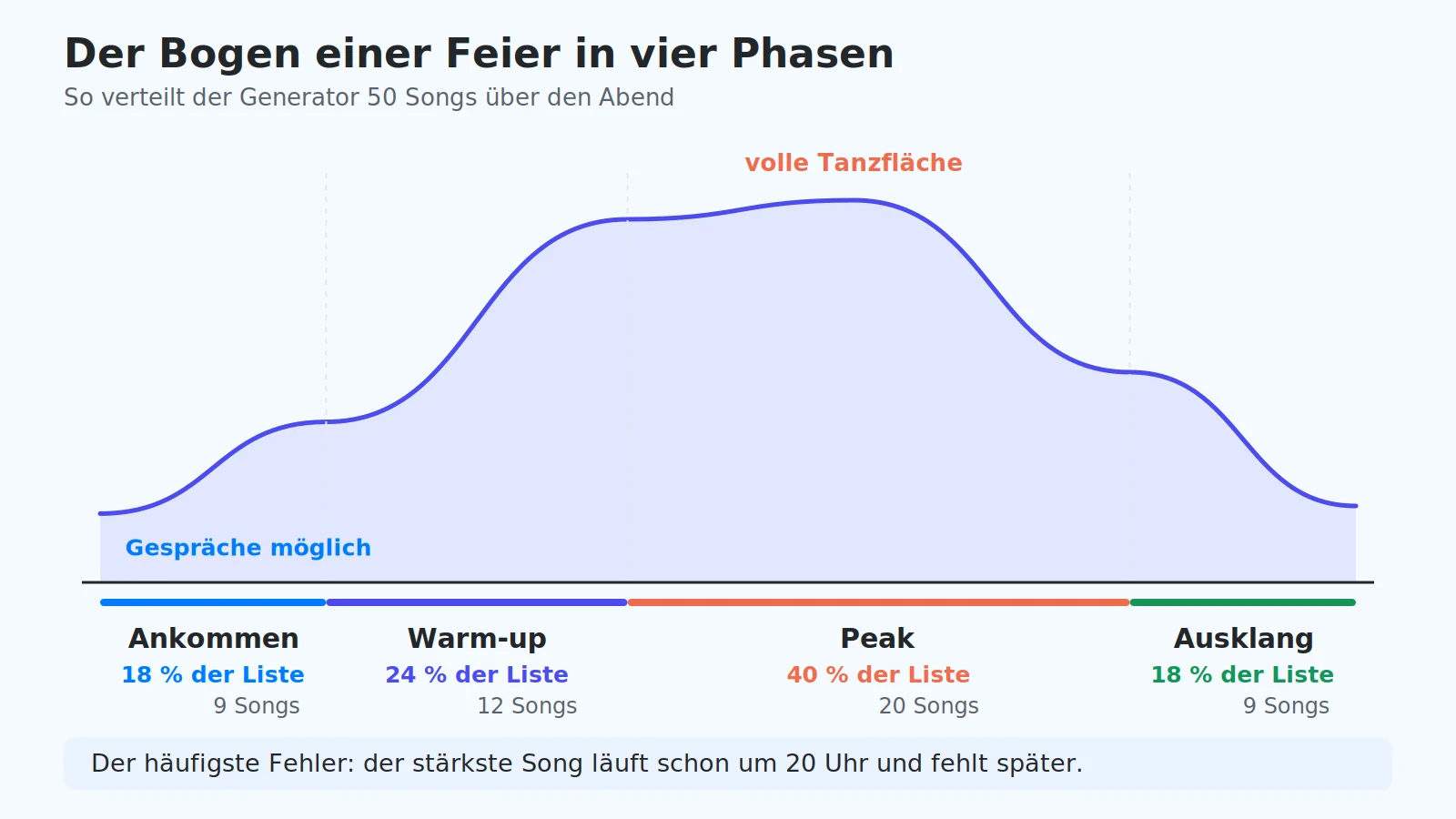
The most common mistake is peaking too early; if you play your best track at 8 p.m., you'll miss it later. The second mistake is a "getting started" phase that lasts too long, leaving half the room sitting down. If no one is up after two hours of background music, it’s rarely the crowd's fault—it’s the selection.
Ideally beforehand and in writing. Here are three practical tips—all of which end with you entering the names into the favorite artist field.
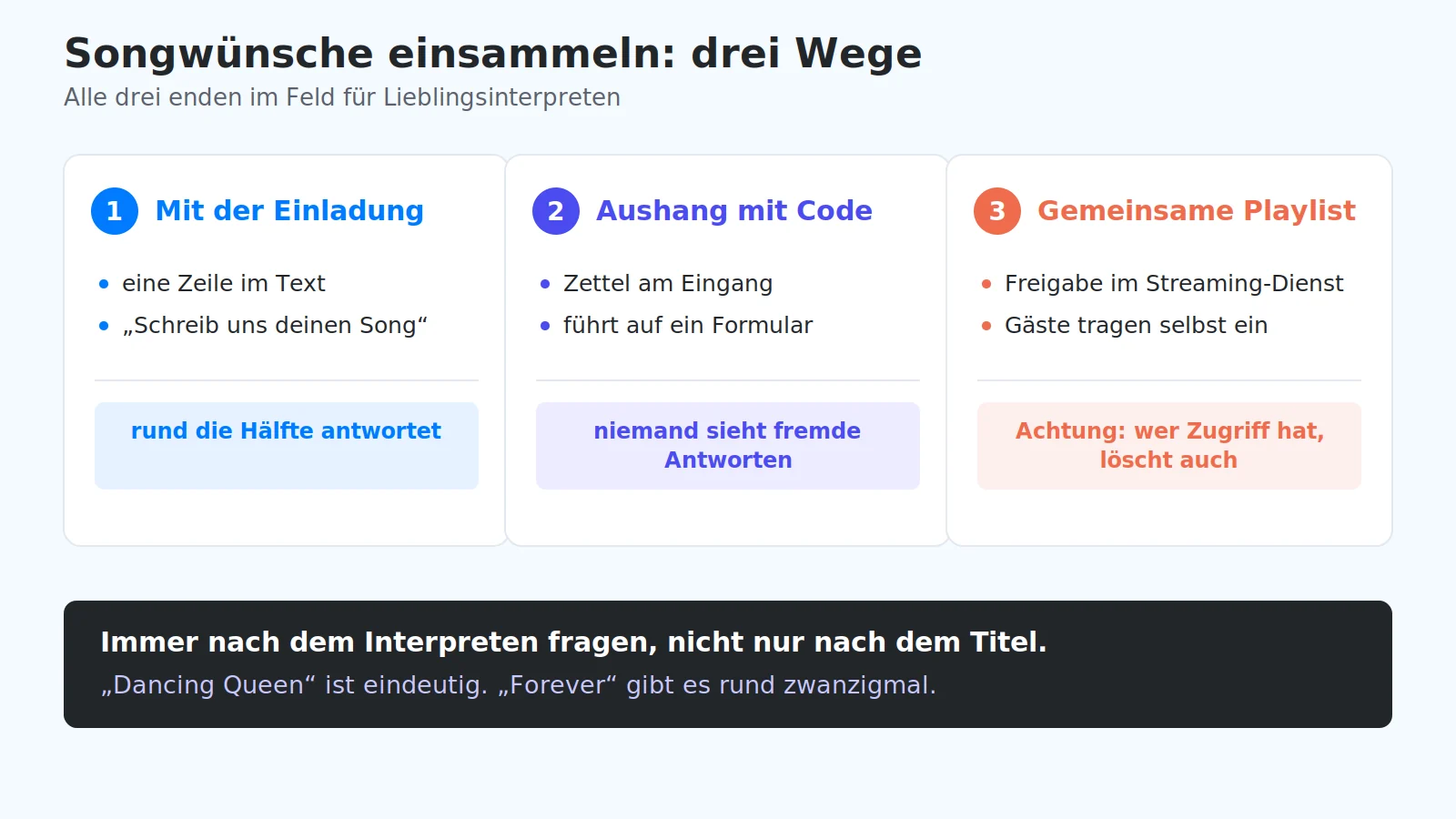
Two rules for this: collecting requests doesn't mean you have to play every single one. If you make that clear beforehand, no one will be disappointed later. This applies to children and grandparents alike. Also, always ask for the artist, not just the song title. "Dancing Queen" is unique, but there are about twenty songs called "Forever."
For the right vibe throughout the evening, count on about 16 songs per hour. With an average track length of 3.84 minutes, 50 songs will comfortably fill three hours.
Calculated using an average track length of 3.84 minutes from the library. A DJ can fit in more tracks because they mix songs and transition earlier.
Plan for about 20 percent more music than the event is scheduled to last. You’ll need that buffer if people end up dancing longer than expected. A playlist that runs out before the guests do is the worst-case scenario.
Three things: a suitable sound system, a stable connection, and a backup device. Without them, even the best music mix is useless. The size you need depends on the room and the number of guests; our guide to party sound systems will help you figure that out.
Download the playlist beforehand; streaming services offer this in their paid versions. In a marquee or a basement, this isn't just a convenience—it's a necessity. Success here comes down to preparation. Turn off the automatic standby on your laptop. Mute your notifications, otherwise, a notification sound might interrupt the music right at the peak of the party.
Practical tip: The most common failure at our events isn't the technology, but a dead phone battery. If you're using a device as your player, plug it into a charger and keep a second device with the same list nearby. You can rent appropriately sized sound systems from Renty without a deposit, available for pickup or with on-site setup.
Yes, for a private party with a guest list. No, as soon as the party is public or serves a business. The terms and conditions of streaming services only allow for private use; for anything else, you need your own physical media, radio, or a service licensed for commercial use.
In addition, there is the registration with the collecting society. You can calculate the costs for Germany using the GEMA calculator and for Austria using the AKM calculator. The conditions for events can be found on the GEMA website.
A wedding with a guest list remains private, whereas a company party is considered public, even if only the team is attending. If you want to dive deeper into wedding planning, you can find the structure for the ceremony, dinner, and dancing in our guide to the perfect wedding playlist.
Yes, without registration and without a Spotify login. Your browser calculates the selection itself; nothing is sent to us. It only queries the open databases MusicBrainz and ListenBrainz for unknown artist names. This tool is not part of Spotify and is not a partner of the service.
That would require the generator to have access to your account, which would necessitate a login plus write permissions. Instead, we output the list as text. You can create an empty playlist in Spotify and search for the tracks one by one; for 50 songs, that takes about ten minutes.
About 16 songs per hour, assuming an average duration of 3.84 minutes. For a three-hour party, 50 songs are enough; for a long night, plan for 110 to 120. It’s a good idea to add about 20 percent as a buffer.
No, the "Re-roll" button creates a different list from the same criteria. In 480 test runs, 912 different songs appeared. The most frequent track showed up in just over four out of ten runs.
In that case, your browser looks up the name on MusicBrainz and ListenBrainz and categorizes it based on related artists. This takes a few seconds and also covers names not included in the tool itself. If the name remains unknown there as well, it is flagged, and the rest of your input continues to function.
Not for a private party with a guest list. As soon as tickets are sold, advertising is involved, or a business is behind it, the event is considered public and must be registered. In Germany, this is done via GEMA, and in Austria via AKM.
Use these free calculators and generators to plan the rest of your event, from the technical requirements to the tournament schedule.

Wir haben dir eine Mail geschickt, bitte bestätige sie um den Rabattcode zu erhalten.

